


The usual bar advice treats the faster chiller as the winner. If stainless steel drops the temperature quicker, it must be the better cube, and if ice is colder still, stones are only a novelty. That advice skips the question a gift buyer has to answer. What kind of drink, and what kind of drinker, is this for?
Whiskey stones vs stainless steel is a speed-versus-hold choice, not a single ranking. A metal cube can pull heat out of a neat pour in the first minutes, then give that heat back. A stone cube moves more slowly and can stay useful through a longer sip. Neither one waters the spirit down. Ice cools hard and adds water at the same time.
For a birthday, a client thank-you, or a team event, the right cube is the one that matches how that person drinks. A faster chill is not automatically the better gift.
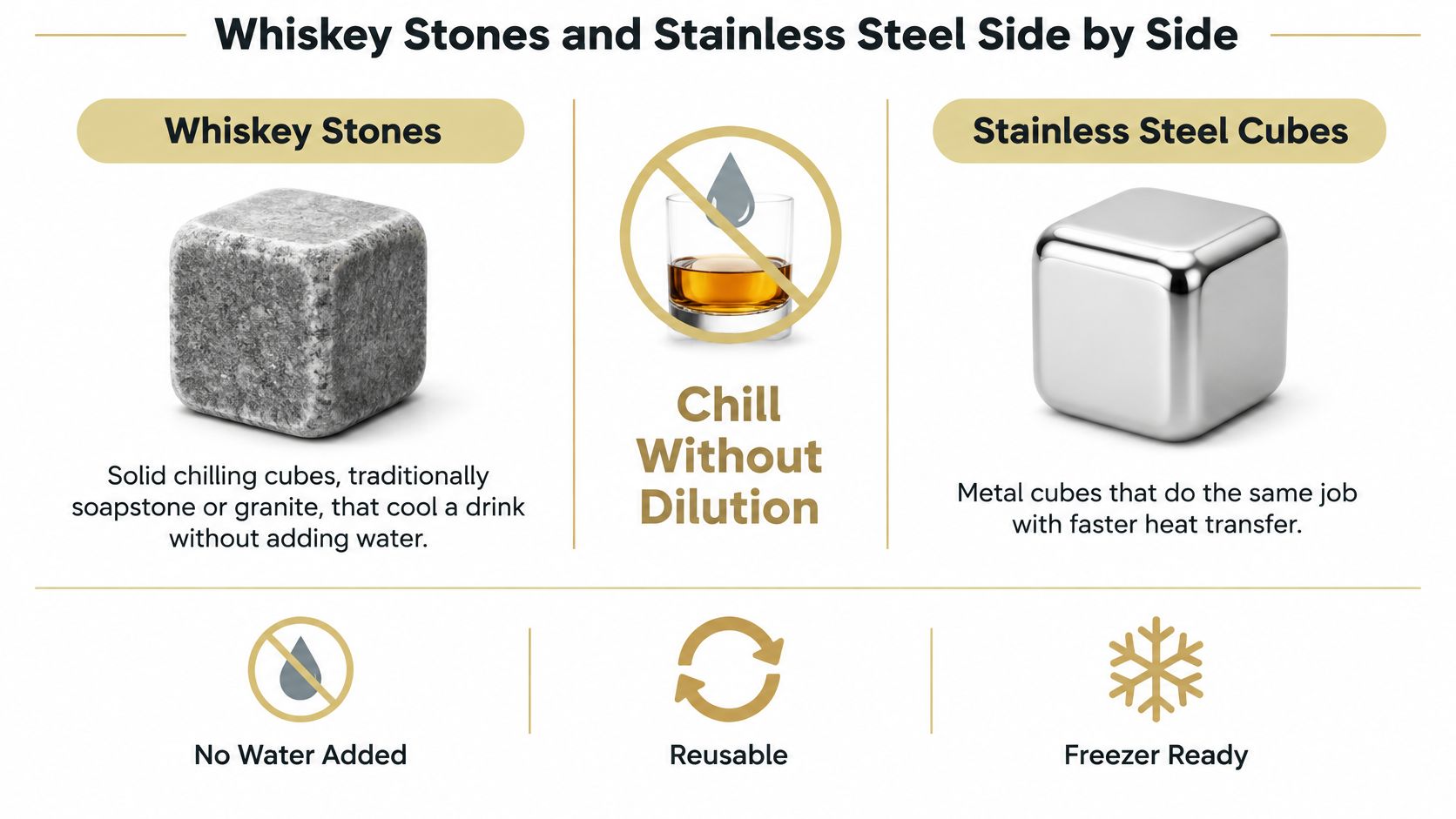
Whiskey Stones and Stainless Steel Side by Side
Whiskey stones are solid chilling cubes, traditionally soapstone or granite, that cool a drink without adding water. Stainless steel cubes do the same job with a metal body. The branded category is young, not an ancient whisky rite. Vice traces the best-documented commercial launch to late 2007, when Andrew and Anna Hellman's company, Teroforma, began selling chilled soapstone cubes in the United States. The idea drew on a wider Scandinavian and European habit of cooling drinks with naturally cold stone, then settled into gift sets and barware after that launch.
The original product was non-porous soapstone. You freeze it, drop it in, and reuse it. It doesn't melt, so the spirit keeps its alcohol concentration and its volume. The trade-off is intensity. Stones absorb heat only as they warm up, so they generally chill less hard than melting ice. That is exactly why they suit dilution-free sipping and a presentable gift more than a maximum-cold serve.
Steel moves heat faster. Stone releases cold at a steadier pace, with less total intensity than ice.
A materials comparison published by Rocks puts soapstone thermal conductivity at 2.5–3.18 W/m·K against about 16.2 W/m·K for 304 stainless steel between 0°C and 100°C, and specific heat at about 1.074 J/g·K for soapstone at 20°C versus about 0.500 J/g·K for 304 stainless steel. Those two rows explain the rest of the table.
| Criterion | Whiskey stones | Stainless steel cubes |
|---|---|---|
| Thermal conductivity | About 2.5–3.18 W/m·K for soapstone | About 16.2 W/m·K for 304 stainless steel |
| Specific heat | About 1.074 J/g·K for soapstone at 20°C | About 0.500 J/g·K for 304 stainless steel |
| Chilling pace | Gradual and steadier | Fast initial drop |
| Dilution | None; no water added | None; no water added |
| Care load | Dry fully; moisture can linger in rough or grooved surfaces | Easy to sanitize; watch for corrosion |
| Gift presentation | Traditional and tactile | Modern and sleek |
Freezer temperature, cube mass, pour volume, and glass thickness still change the result on both sides. The table shows the material tendency. It doesn't lock in the glass you'll pour tonight, or the one your client will open at home.
Why Stone and Steel Chill Differently
Thermal conductivity is how quickly heat moves through a material. Specific heat is how much heat a given mass can take on before its own temperature rises. Steel's high conductivity lets it pull warmth out of whiskey almost on contact. Its lower specific heat means a light steel cube fills up with that heat quickly, then warms in turn. Soapstone conducts slowly and stores more heat per gram, so it takes warmth in gradually and gives its cold back over a longer span.
Neither material melts or changes phase. Both add no water, and both leave bottled strength intact. Ice is different. A large share of its cooling comes from melting, which is why a rocks pour gets colder and weaker at the same time. A Polimesin engineering comparison found stainless steel's thermal performance comparable to water ice under its tested conditions, while a stainless-steel and graphite composite held lower temperatures longer than the other cubes in that test. That result is about one setup, not every cube on a bar cart.
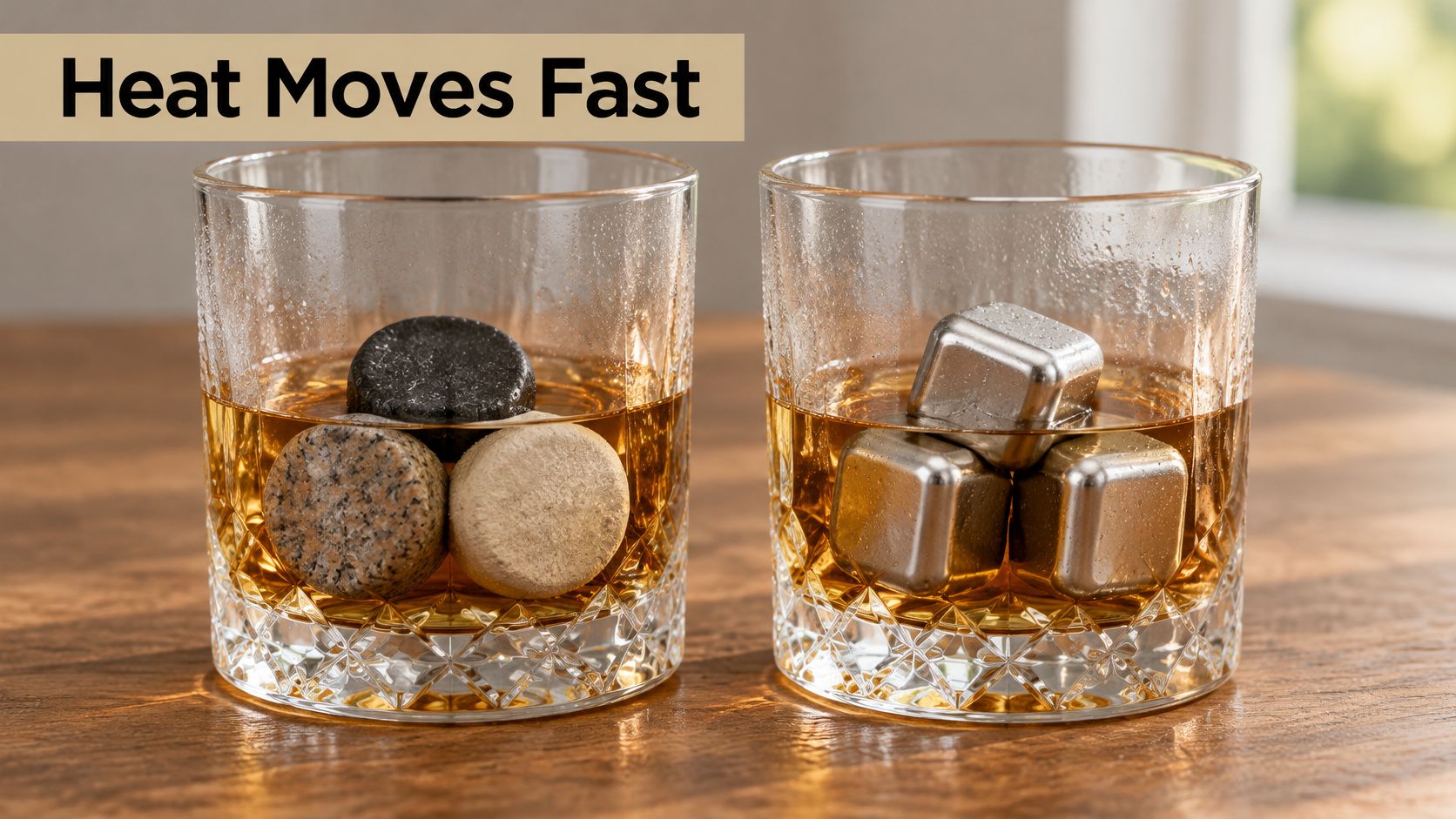
A worked pour
Say you pour 60 mL of whiskey into two identical heavy tumblers, both starting at room temperature, both chillers pulled from the same freezer.
- One small steel cube: It has a lot of surface for its mass. The first minute feels brisk. The metal has little spare cold left, so the pour can drift back toward room temperature while you're still nosing it.
- Two heavier stones: Each gram holds more cold, and the extra mass gives the glass a larger heat sink. The drop is gentler. If you sip slowly, the second half of the pour is closer to the first half than it would be with one light metal cube.
Swap the masses and the story changes. A heavy, gel-filled steel cube can outlast a tiny stone. A thin soapstone chip can feel like it did nothing. Geometry and mass set the result. Material only sets the tendency.
Practical rule: Match cube weight to pour size before you match material to taste. A fast metal cube in a large neat pour often peaks early and then fades.
Measured Cooling Speed and Holding Time
Published timings separate a quick drop from a long hold, and they don't all carry the same weight.
A commercial product-insights comparison, not a peer-reviewed study, is the clearest side-by-side on a fixed pour. On Alibaba's product-insights page, stainless-steel cubes reduced a 60 mL, 46% ABV bourbon pour by 8.3°C in three minutes, stone by 3.1°C, and ice by 14.2°C. Treat that as directional. Cube mass, surface area, and freezer conditions aren't a universal lab protocol.
A separate comparative account, summarized in a Taobao shopping guide, stretches the clock. Stainless-steel stones lowered the drink quickly during the first five minutes, and the drink began warming around the 40-minute mark. Soapstone needed about 15 minutes to reach peak cooling efficiency and held a low temperature for as long as 90 minutes. One account, one setup. Still, it shows why "which is colder?" is the wrong question. Steel wins the opening. Stone can win the sitting.
| Chiller | Fast drop window | Holding window | Evidence level |
|---|---|---|---|
| Stainless steel cubes | Within the first 5 minutes | Begins warming near 40 minutes | Comparative account, single test |
| Soapstone stones | Peak efficiency near 15 minutes | Low temperature for up to 90 minutes | Comparative account, single test |
| Ice cube (reference) | 14.2°C drop in 3 minutes | Melts and dilutes the pour | Directional product-insights result |
Our stones aren't meant to be as cold as ice cubes. We recommend two stones per glass, which adds mass without turning the tumbler into a pile of rocks. If you want to see what a modest chill looks like next to a nosing glass, The Connoisseur's Set - Nosing Glass Edition pairs round solid granite stones with a crystal nosing glass so the pour stays undiluted.
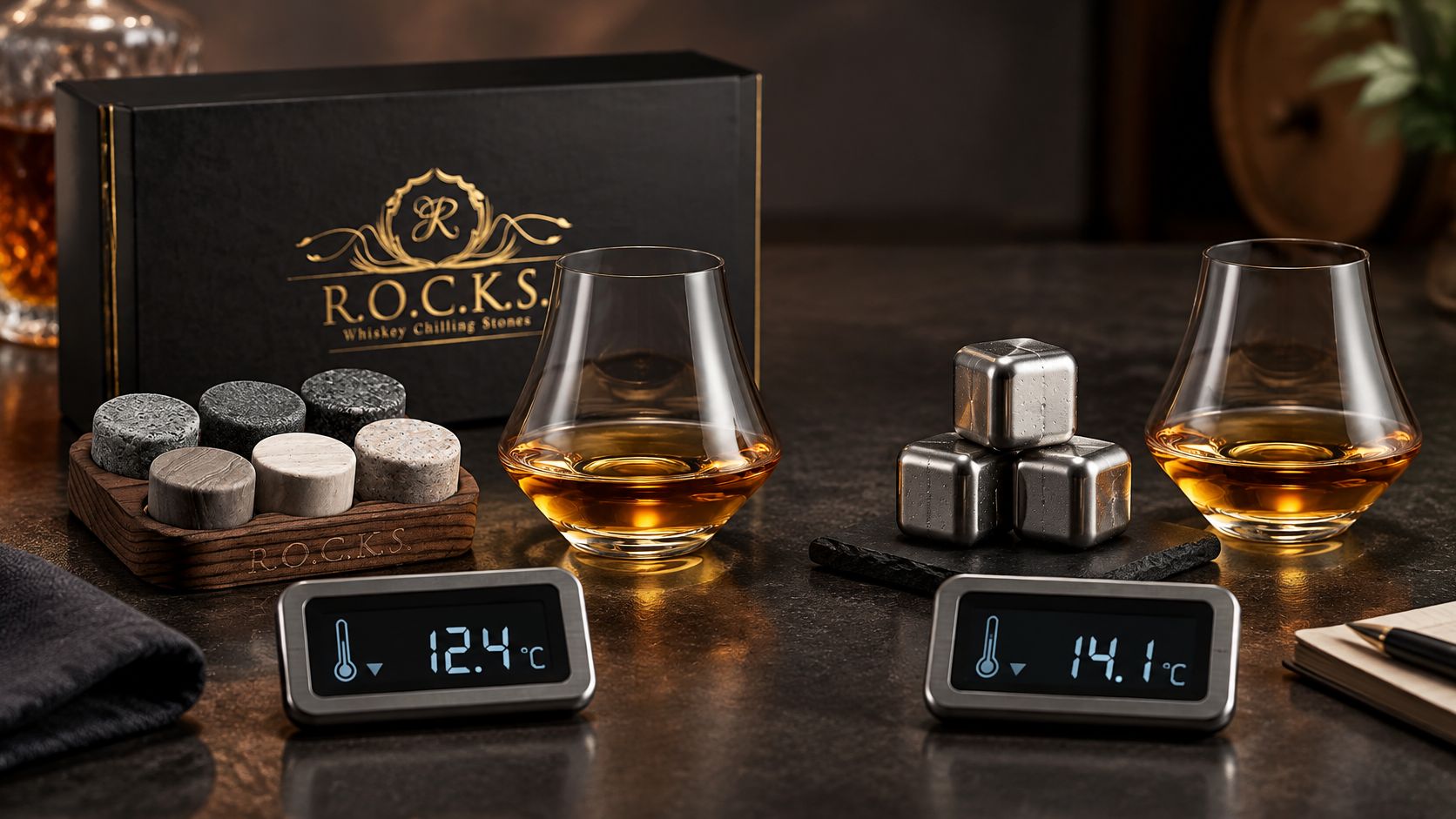
A plain walk-through of what stones can and can't do sits in our note on whether whiskey stones work.
A simple home test
Freeze each chiller for the time the maker states before first use, and keep the freezer at the same setting for every run.
- Pour the same volume into the same glass, starting from the same bottle temperature.
- Read at 1, 5, 20, and 40 minutes without adding cubes halfway through.
- Note the first sip and the last sip separately. A big early drop that fades by minute 40 is a steel-style result. A slow slide that is still cool at the end is a stone-style result.
Corporate buyers comparing premium sets should run that protocol on the actual set, not on a generic claim. Two cubes of different weight aren't a fair material test.
How Each Chiller Changes Flavor
A colder first sip and a better dram are different outcomes. Cooling speed, how long the chill holds, and whether the pour stays at bottled strength each move aroma in a different direction. A peer-reviewed Oregon State University study examined how whisky dilution affects aroma and volatile compounds, using controlled sensory testing and chemical analysis. Added water can shift a spirit's perceived character. How much water belongs in the glass depends on the spirit, the drinker, and the point of the tasting. Full strength is the right serve when the bottled profile is the one you want to taste.
Set two glasses of the same cask-strength bourbon side by side. Leave one neat over granite. Add a teaspoon of water to the other. In the neat high-proof glass, alcohol often sits on top of the aroma. The watered glass can show more oak and spice because the proof drops. Stone and steel cannot do that job. They keep the pour at bottled strength, so the nose shows the cask's profile without meltwater. Round solid granite stones cool a drink without the dilution melting ice cubes cause. Steel's faster opening drop means the first sip lands colder, which can mute alcohol heat for a minute or two, then let that heat return as the metal warms. The slower stone chill holds a milder cool longer, so flavor stays closer to the bottle from first sip to last.
Neat single malts bottled near standard strength often taste flatter once meltwater piles up. A stone set keeps the dram at the strength the bottler chose, with a gentle temperature slide. That serve fits someone who already likes the spirit as bottled.
Cask-strength whisky and high-proof bourbon raise a different problem. A teaspoon of water, or a slow melt from one large ice piece, lowers proof so buried aromas can surface. A steel cube gives a colder first sip and still no water, so the heat comes back rather than the aroma opening up. If the recipient always adds a splash, stones alone will not reproduce that habit. Speed of chill and length of hold do not stand in for dilution.
Cocktails are a third case. A stirred drink expects some dilution as part of the recipe. The mixing method, the ice in the tin, and the glass matter more than the cube dropped in afterward. Steel can take the edge off a finished pour quickly. It should not replace the water the recipe already counted on. A stone in a finished cocktail mainly limits extra melt after the drink is built.
"Absolutely pure liquor with no dilution and the stones are just the right size and weight for a good short, heavy-bottomed whiskey glass." Stephen
Compare the first sip with the last after the chiller has had time to work. If the last sip is warmer and the flavor has not thinned, the change is temperature, not water. If the spirit needs to open, add a measured splash yourself. A cube will not open it, however fast that cube cools.
Care, Cleaning and Long-Term Durability
A chiller that smells like last night's freezer will undo a careful pour. The routine is short, and drying is the step people skip.
- Rinse right after use in warm water, before residue dries on the surface.
- Wash by hand with mild, unscented soap, then rinse until the water runs clear.
- Dry completely for several hours on a rack, not in a closed tin.
- Store dry in a tray or box, and only then put the set back in the freezer.
Drying matters most for stone. Non-porous soapstone is safe to reuse, but a rough, chipped, or grooved face can hold moisture and odors if it stays damp. Granite with a polished face is easier, and our stones have round edges that avoid scratching glasses, which also means fewer chips for liquid to sit in. Stainless steel is generally easier to sanitize. Condensation still makes the outside slippery, and leftover drops can spot the metal or wet the next glass.
When to retire a cube
Retire a stone that has cracked, chipped, or started flaking. A flake in a glass is a ruined pour and a sharp edge against crystal. Don't try to sand it back into service for drinks.
Replace a steel cube that shows pitting, corrosion, or any sign the interior is breaking down. A sealed cube that weeps gel, rattles, or smells metallic after a wash is finished. Retail listings often call stainless steel dishwasher-safe. Those claims aren't always checked against the actual cube, so follow the maker's care note before you run either material through a machine. Heat and detergent can dull a finish even when the metal survives.
Our whiskey stones come with a lifetime warranty, which only helps if the set is still the product you bought, not a cracked stand-in. For how surface wear shows up over years of freezing and washing, see our guide on how long whiskey stones last.
Put written care steps in the gift box. A client or an employee who gets a card with the four steps above is far more likely to keep the set in service than someone who finds unlabeled cubes in a drawer.
Gifting Fit for Clients, Teams and Whiskey Lovers
Employee rewards and client thank-yous already cluster in a narrow band, and a chiller set sits in that presentable middle. The Advertising Specialty Institute reported that companies giving employee gifts or rewards spent an average of $44 per recipient in 2015, companies thanking clients planned an average of $48 per recipient, and nearly one-quarter of companies giving employee gifts spent more than $100 per employee, compared with 18% the year before. Those figures are historical, not a current price list. They still mark two bands: modest rewards, and recognition people are meant to keep.
The faster chiller is not the better gift. Whiskey stones suit a slow sipper and a traditional tasting: the chill is gradual, the pour stays at bottled strength, and the stones are not meant to be as cold as ice. Stainless steel suits a cocktail host who wants a quicker drop on a modern bar cart. Cooling speed and the way a drink is meant to be tasted pull apart. A steel cube serves stirred and mixed drinks. Stones serve a neat glass where proof and pace matter more than a cold shock. If the recipient's habit is unknown, a stone set with a nosing or twist glass gives a tactile object and a clear story. The glass is still useful after the event.
| Recipient or occasion | Better fit | Why it fits |
|---|---|---|
| Neat whiskey sipper | Whiskey stones | Gradual chill with no dilution and a slower tasting pace |
| Cocktail host or bar cart owner | Stainless steel cubes | Quicker chill for stirred and mixed drinks |
| Client appreciation gift | Stone set with crystal nosing glass | Presentation and a tactile story the recipient keeps |
| Employee reward or team event | Both formats, if the budget allows | One material misses the other drinking style |
| Birthday or anniversary | Stone set | Traditional, personal and easy to personalize |
| Gift for a barware collector | Stone set | Repeat use and display on a bar cart, not a one-night gadget |
ROCKS offers personalised corporate whiskey gifts, including engraving, so a client appreciation piece or an employee reward can carry the company name without looking like swag. The same assortment covers birthdays, anniversaries, housewarmings, and event merchandise. A short briefing on what makes whiskey chilling stones a distinctive corporate gift is worth reading before a quantity is locked.
Confirm the row in the table before you order. A steel cube for a neat-pour collector, or a stone set for a bartender who wants ice-level cold, is a polite miss.
If the budget allows both formats for a team event, split the order by drinking style instead of sending one material to everyone.
Confirm the Right Chiller Before You Buy
Order the material that matches the chill you want, then check whether the calendar and the budget can support it. A fast metal drop and a slower stone hold solve different pours. The wrong one still looks generous and still misses.
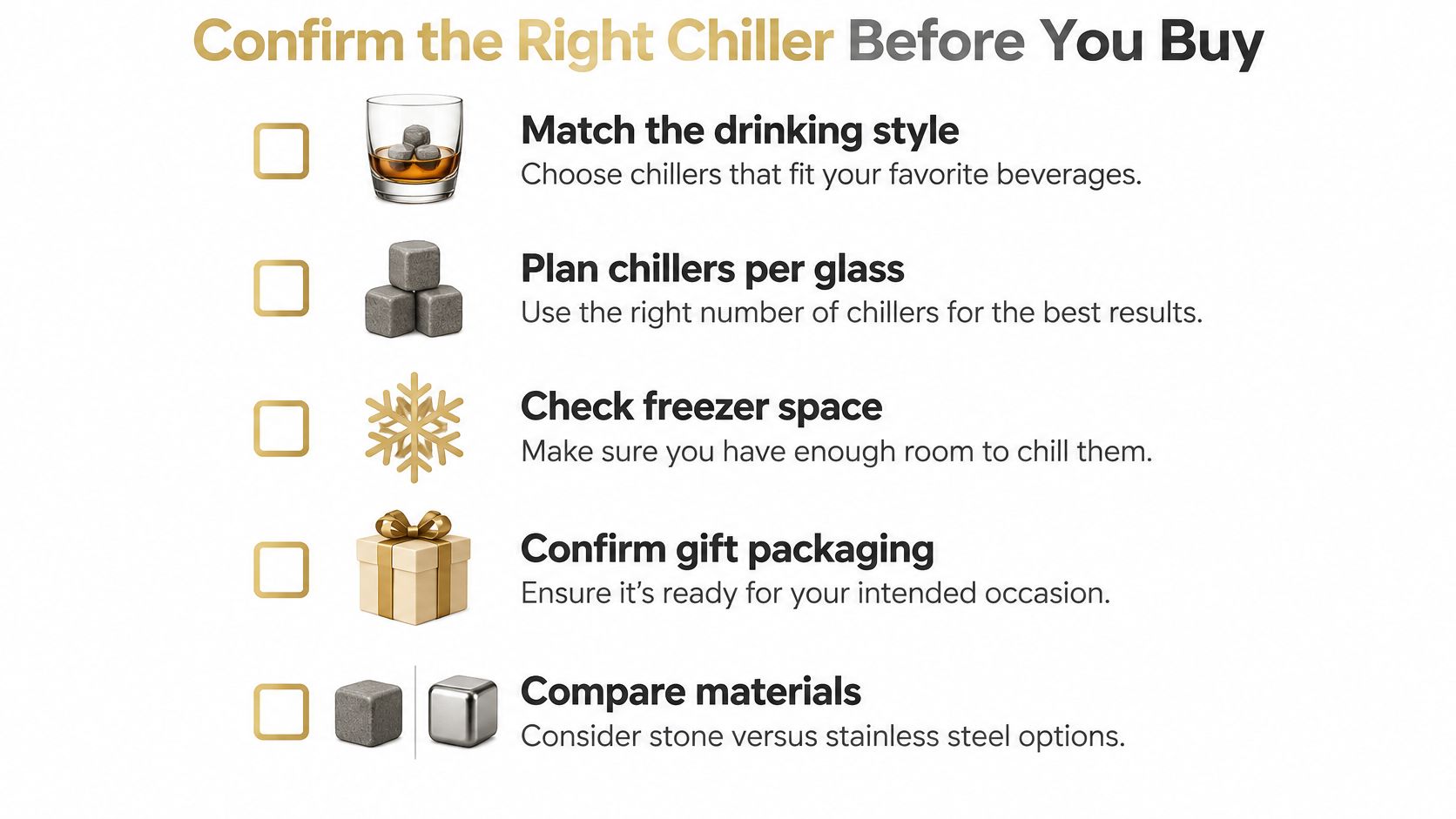
The shortlist before you order
- Lock lead time before quantity. Engraved corporate gifts need the logo file and the event date in production with room to spare. A late file is the usual reason a client gift misses the dinner.
- Count stones per glass. ROCKS recommends two stones per glass. The stones chill a drink to about a few degrees below room temperature, and they are not meant to be as cold as ice, so one stone leaves a generous pour barely moved.
- Match cleaning to the owner. Stone needs a full dry-down after rinsing. Steel needs a look for corrosion. A recipient who will not wash barware by hand will fight either material.
- Compare the line items, not just the material. A stone set, glassware, and an engraved tray sit at a different price than steel cubes alone. If the budget only covers one format, spend it on the chill profile the drink needs: hold without dilution, or speed.
- Read the buyback and the warranty before checkout. ROCKS will buy back its Whiskey Chilling Stones at any time and for any reason if you do not love them. The whiskey stones also come with a lifetime warranty.
ROCKS Whiskey Chilling Stones are handcrafted, hand-polished granite stones for a neat pour that should stay at bottled strength. Gift sets pair those stones with crystal glassware when the occasion calls for a set rather than a single tool. Visit ROCKS Whiskey Chilling Stones to match a set to the occasion.


