


A coupe glass is a stemmed glass with a broad, shallow, saucer-shaped bowl, first made for Champagne and now used mainly for cocktails served without ice. The standard format is measurable: a rim about 3.5 to 4.5 inches wide, a stem about 3 to 5 inches long, and a bowl that holds 5 to 7 oz.
Why does a glass that is famously bad at holding bubbles still turn up at weddings, product launches and serious cocktail bars? Search for what is a coupe glass and most answers give you the shape plus a story about a French queen, then stop. They rarely explain the part that matters when you're standing at the bar or choosing a gift, which is the service decision the bowl forces on you: wide surface for aroma and garnish, faster warming, faster fizz loss, more spill risk. Once you see the coupe as a set of trade-offs rather than a retro silhouette, it becomes a deliberate pick for a specific kind of drink, and a much easier piece of barware to buy for someone else.
A Coupe Glass at a Glance
A coupe is built for drinks served up: shake or stir the cocktail with ice, strain it into the glass, and serve it with nothing cold and solid left inside. That is the mechanical job the vessel does, and Glassique Cadeau's coupe guide describes it in exactly those terms. Three parts are visible without lifting it. The bowl is the wide, curved cup. The stem is the handle. The base is the flat foot that keeps the whole thing level on a table or a tray.
| Feature | Typical value | Why it matters |
|---|---|---|
| Bowl shape | Broad, shallow, saucer-like | Exposes more surface so aromas reach the nose and garnishes show |
| Rim width | About 3.5 to 4.5 inches | Wide opening makes sipping easy but speeds up carbonation loss |
| Stem length | About 3 to 5 inches | Lets the hand hold the glass away from the drink |
| Filling height | About 29 mm in a Champagne study | Little headroom, so overfilling causes spills |
| Bowl profile | Rounded, no sharp V | Forgiving to carry compared with a martini glass |
The shallow bowl produces two everyday consequences. A modest pour sits low in a wide bowl and the glass can look half empty when it's correctly filled, so hosts overpour to make it look generous. That is precisely when a coupe becomes hard to carry across a room.
Practical rule: fill a coupe to about two thirds and leave the remaining third as headroom, then carry it by the stem, not the bowl.
The stem is not decoration either. It gives your fingers somewhere to go that isn't the bowl, which keeps body heat out of a drink that was deliberately chilled a moment ago.
If the glass is wide, rounded at the bottom and fairly short in the stem with no sharp V, it's a coupe. A bowl that narrows to a cone on a long stem is a martini glass, and a tall narrow one is a flute. That unmistakable silhouette is why a coupe set reads as polished barware from the far side of a room, which makes our coupe-style glassware a natural fit for cocktail lovers and for corporate buyers choosing pieces for client events or team celebrations.
Where the Coupe Came From and Common Myths
The documented starting point is 1663, when Venetian glassmakers working at the Duke of Buckingham's glass factory in Greenwich produced an early shallow cup called a tazza, meaning cup, as the published history of the Champagne glass records. The royal origin story attached to the coupe belongs to a much later period, which is the first hint that the legend and the evidence tell different stories.
Here is the sequence in brief, with the legend marked where it separates from the record.
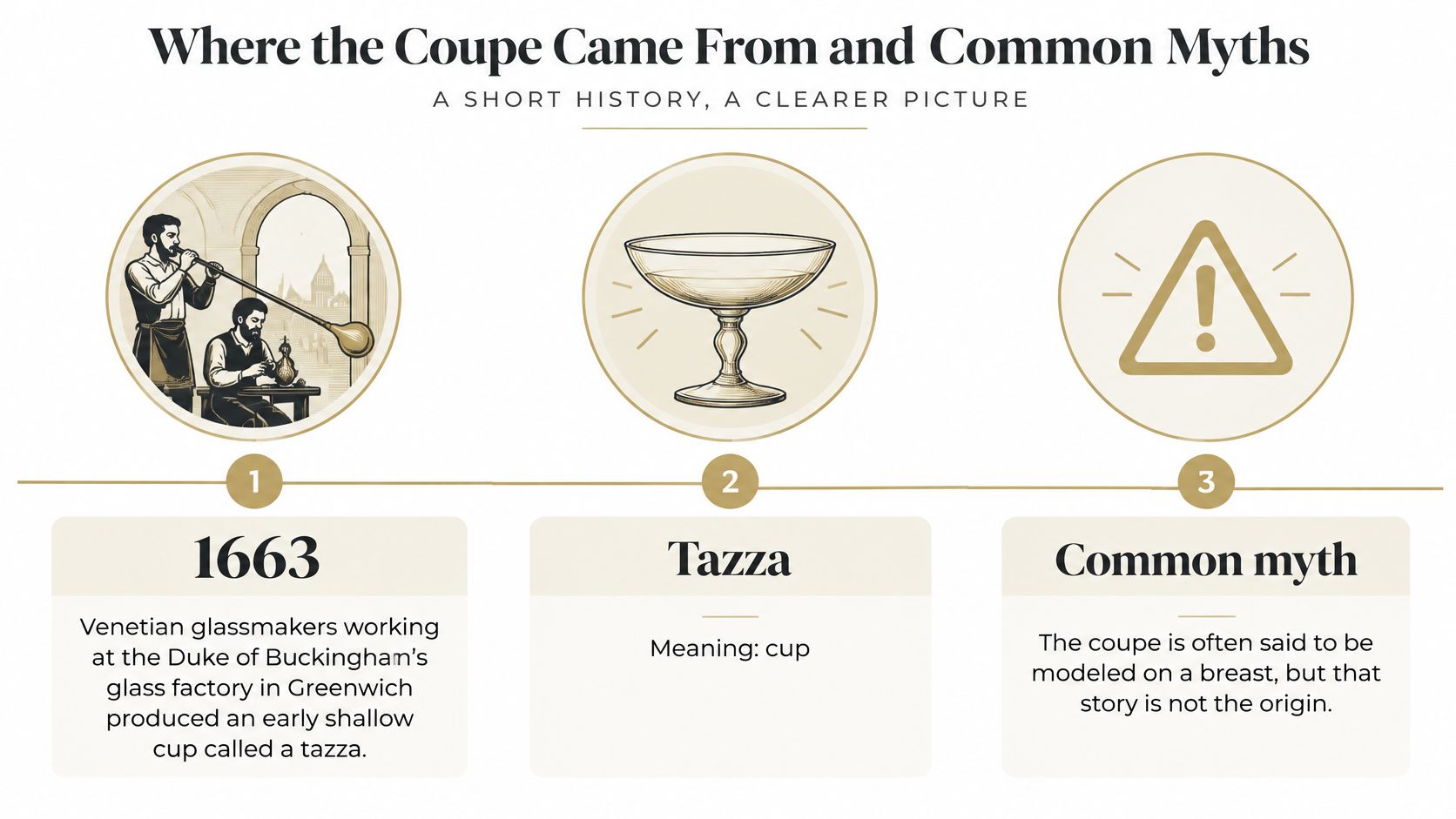
What the dates actually say
Cup-shaped Champagne glasses appear in the record around 1830, and the form had become standard by the 1860s, a dating described in the Plate Artists glassware guide. Read that against the 1663 tazza and the picture is clear: an Italian-influenced English glassmaking shape, refined into a dedicated Champagne vessel generations later.
British drinkers in the 1830s liked what the wide bowl did to a sparkling pour. The foam spread across the surface and looked festive, and the shallow cup showed it off better than anything else on the table. Taste shifted later, when drinkers began to value a long, persistent bead of bubbles more than a big head of foam, and the flute took over the job.
That shift matters for how you read the glass today. The flute won the Champagne argument on bubble retention, so the coupe's wide bowl came to be judged by a standard it was never designed around. Judged by aroma and presentation instead, the shape makes sense again.
Why the royal story fails
The breast-shaped-glass legend asks you to believe one royal woman invented a vessel that glassmakers were already producing, in another country, as part of an existing trade in shallow drinking cups. The dates do not cooperate, and neither does the geography. A craft tradition explains the shape better than any single legendary event.
Two more misreadings are worth clearing up. A coupe's Champagne era ending does not make it outdated: it is a service choice for short, chilled, served-up drinks, and it performs that job well. And no single capacity defines the shape, so a set should be chosen by the drink it will hold rather than by the picture on the box.
The long association with Champagne on one side and cocktails on the other gives a well-chosen coupe set unusually wide gifting reach. It suits Champagne drinkers, cocktail enthusiasts, wedding gifts, anniversaries, housewarmings, and client or employee gifts, all without needing to know much about the recipient's taste.
How the Coupe Shape Changes Your Drink
A coupe is a shallow dish; a flute is a tall pencil. The dish holds its contents open to the air, and the pencil keeps them stacked and contained. Pour the same liquid into both and the dish lets the room in, which is the whole trade you're buying.
Three things the bowl does
- Aroma comes forward. The shallow bowl exposes more surface than an enclosed glass, so aromatic compounds diffuse into the headspace and reach your nose on the first lift, as Eater's account of the coupe's design sets out. A Sidecar smells like lemon oil and cognac rather than vaguely of spirit.
- Temperature moves faster. The same open bowl holds less liquid against more air, and a drink warms sooner once your hand settles on the glass. Hold the stem and the clock slows.
- The surface becomes a stage. Foam, a citrus twist, a floated cherry or a rim of sugar all sit in plain view, which is why a coupe photographs so well on a bar cart.
For shaken and stirred drinks served without ice, that combination is close to ideal. A Daiquiri, a Sidecar or a Manhattan variation all arrive cold, short and aromatic, and each benefits from a wide nose and a visible garnish. Our coupe glass cocktail recipes and serving notes walk through the drinks that suit the shape best.
The glass is built for drinks that carry no ice, so chill the cocktail properly before it goes in. A warm drink in a wide bowl has nowhere to hide.
If the drink is cold, short, aromatic, and the look of it matters, the coupe is doing its job. If the drink is long, icy or highly carbonated, another glass will serve it better.
Coupe, Flute and Martini Glass Compared
Four stemmed glasses get confused with each other, and the differences come down to bowl geometry.
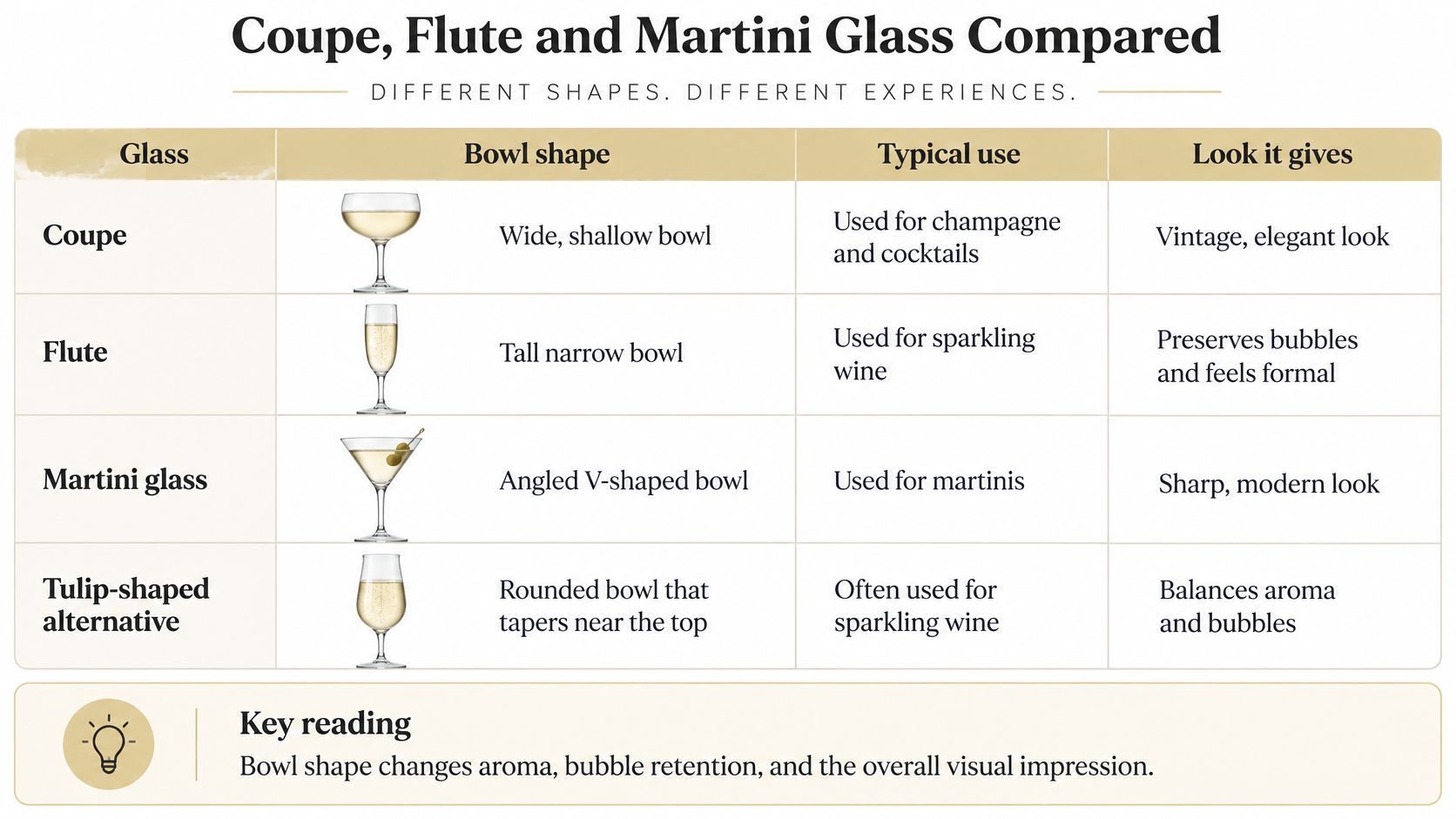
| Glass | Bowl shape | Typical use | Visual effect |
|---|---|---|---|
| Coupe | Broad, shallow, saucer-like | Cocktails served up and short sparkling pours | Foam and garnish show well |
| Flute | Tall and narrow | Sparkling wine for toasts | Bubbles rise in a visible column |
| Martini | Conical bowl narrowing to a V on a long stem | Stirred or shaken spirit-forward cocktails | Sharp, angular silhouette |
| Tulip | Widens toward the bowl, narrows at the rim | Sparkling wine where aroma matters | Aroma and bubbles both stay in view |
A rule for choosing in seconds
Sparkling wine for a toast: reach for the flute or the tulip. The narrow column keeps the bead visible and the wine lively for the length of a speech.
A shaken cocktail served up: coupe or martini. Both take a strained drink without ice, so pick on handling. The martini glass gives a sharper, more theatrical line. The coupe's rounded bowl is the steadier of the two to carry through a crowd.
A presentation-led drink at an event: the coupe, because the garnish sits in the open and the drink looks finished rather than severe.
The dictionary sense of the word is too broad to settle any of this: a stemmed glass with a shallow bowl used for cocktails or Champagne covers four different vessels. Shape is the deciding detail. A tulip is the compromise for anyone torn between aroma and effervescence, since it widens toward the bowl to release scent and narrows near the rim to hold gas in.
The same logic runs through spirits glassware. If you're buying for someone who tastes whiskey more often than they mix cocktails, this guide to the best whiskey glass for tasting shows how a tulip-shaped nosing glass concentrates aroma, which is the identical principle at work in the sparkling tulip above. Anyone building a full bar will find the rest of the family in our overview of the different types of cocktail glasses.
Why Coupes Lose Bubbles Faster
The shape extracts its price. In a controlled study of Champagne glasses, the coupe had the largest gas-exchange area of the vessels tested, measured at 58 cm², with a filling height of only 29 mm, according to the University of Reims Champagne glass study. After one minute, approximately 90% of the coupe's dissolved carbon dioxide had escaped through diffusion.
What the measurements describe
A wide, shallow pool of wine with a big open mouth is a very efficient way to release gas. Compare the flute: immediately after pouring, gaseous CO2 concentrations near the rim of a narrow flute measured about two to three times higher than those above a coupe, a finding reported in DW's coverage of the Reims Champagne research. The flute isn't creating gas. It's keeping more of it where the wine is.
What you see as a drinker follows directly. A sparkling pour in a coupe loses its visible fizz within minutes, which is the price of the wide nose and the open presentation. For a still, spirit-forward cocktail, that same openness costs you nothing at all.
If you're pouring something sparkling anyway
Serve it immediately rather than letting the filled glasses stand on a tray. Chill the glass beforehand so the wine isn't warming from both sides at once. Don't fill to the rim, because more surface means faster gas loss and a fuller glass is harder to carry.
Those three steps cut warming and splashing. None of them removes the coupe's structural disadvantage, and it's better to know that than to expect a coupe to behave like a flute.
The decision is yours to make on purpose: accept quicker fizz loss in exchange for a beautiful, aromatic, generously garnished glass, or choose a flute or tulip when a long toast matters more than the look. Our coupe sets suit hosts who want the presentation and will pour short.
Choosing a Coupe Size for Each Occasion
A coupe's wide bowl makes capacity a service decision, not just a measurement. The shallow profile that opens the drink's aroma also brings liquid close to the rim, so extra milliliters create working space for aroma, garnish and movement. Reported examples run from approximately 110 ml to 260 ml when measured brimful, with the most common bar range around 150 to 230 ml and a 200 ml, or 7 oz, coupe described as typical in Last Call's guide to coupe sizes.
| Size | Capacity | Best for |
|---|---|---|
| Small coupe | About 110 to 150 ml | Measured, spirit-forward cocktails and tasting portions |
| Standard bar coupe | About 150 to 230 ml (typical 200 ml, 7 oz) | Shaken drinks served up and Champagne toasts |
| Large coupe | About 230 to 260 ml | Sours, Flips and generous mixed drinks |
Matching capacity to the occasion
A home bar runs on the standard range. Most shaken drinks and a modest sparkling pour fit inside it without crowding the rim.
A wedding toast needs room at the rim more than it needs a bigger pour. If the plan includes a sparkling serve plus a garnish or sugar rim, a standard or large bowl gives those elements space without pushing the liquid to the edge.
A corporate event can use small coupes for measured cocktail samples, letting guests move between stations or try several drinks without each taste becoming a full serve. The smaller bowl keeps individual pours moderate and makes a varied menu easier to manage.
Size cannot fix an overfilled glass, though. A coupe's shallow bowl leaves less headroom than a deeper glass, so a brimful pour sits close enough to the rim to splash when lifted or carried. For drinks moving through a crowded room, a smaller fill in a larger bowl can be steadier than a smaller glass filled to the top.
Three checks turn the capacity range into a practical choice:
- Match the capacity to the drink served most often.
- Choose the number of glasses from the guest list, not the available shelf space.
- Confirm the stem length suits the way the glasses will be carried and stored.
Choose the Right Coupe Set for Gifting
For a gift buyer, the coupe has one advantage no other stemmed glass matches: it's instantly readable. A cocktail lover, a Champagne drinker, a host, a wedding party or a client appreciation programme all recognise what the glass is for, and none of them needs an explanation card.
Our assortment fits that brief in a few configurations. The Connoisseur's Set comes in Twist Glass, Signature Glass and Nosing Glass editions, and the Connoisseur's Sets include crystal glasses, so the weight in the hand matches the occasion. The Privilege Collection covers Reserve, Soleil, Admiral and Prestige crystal glasses, and every set arrives gift-ready, which matters when a corporate order has to look considered on arrival.
Chilling stones pair naturally with coupe service. Stones keep a spirit cold without diluting it, and a host serving chilled, short drinks neat or up can use both pieces in the same evening. For corporate orders, size the glass to the event: standard coupes for a cocktail hour, smaller pieces for a tasting station where guests work through several drinks.
One caveat worth passing to the recipient: the coupe rewards chilled, short serves. If a sparkling toast is the main event, a flute or tulip beside the set covers both.
Three steps get you to a decision. First, choose the pairing that suits the recipient or the event, whether that's a crystal set, a personalised piece, or glassware with chilling stones. Second, confirm the capacity suits the drinks you plan to serve, standard for cocktail hours and small for tastings. Third, order a quantity sized to the guest list so nobody is left holding a tumbler at a Champagne moment.
You'll find the full range of cocktail glass sets here.
Our crystal glass sets and chilling stones are built for the chilled, short, garnished drink a coupe is designed to hold, so pairing the two makes a gift that gets used rather than stored. Browse ROCKS Whiskey Chilling Stones to compare glass editions, add custom etching for a wedding or a client gift, and order quantities sized to your guest list or your team.


