

Which part of an engraved brandy glass decides whether the gift gets used, the monogram or the glass under it?
Most buyers answer with the monogram. They compare fonts, debate initials versus a full name, and approve a proof without ever asking what the glass is made of, how wide the bowl is, or whether the recipient will store brandy in it. The gift arrives looking superb in the box, then spends a decade at the back of a cupboard because it's too fragile for the dishwasher, too small for the way the person drinks, or carries no material information at all.
Choosing well means treating composition, shape and storage limits as part of the gift decision rather than admin afterwards. Get those three right and the engraving becomes the detail that makes an already useful object personal. Get them wrong and you've paid for a permanent message on a glass nobody reaches for.
Brandy Glass Shapes and Sizes Compared
Which shape fits the way the recipient drinks brandy? A snifter or tulip suits neat pours, while a tumbler works better for brandy over ice or in cocktails. A small tasting glass fits someone who likes to compare several bottles.
The National Museum of Norway's record of a Brandy glass designed by Severin Brørby shows how glass shape and decoration have long been part of considered drinkware. For a practical gift, prioritize the recipient's drinking habits over the size of the box.
Bowl shape decides more than capacity
Consider a wide 240 ml snifter beside a narrow 150 ml tulip. The snifter looks generous and offers more room for engraving. The tulip's narrower opening directs aroma toward the nose, making it a better fit for neat sipping.
| Shape | Best For | Engraving Space |
|---|---|---|
| Snifter (balloon bowl) | Slow sipping and aroma, premium gifts | Wide bowl, good for a monogram or date |
| Tulip | Concentrating aromas for neat sipping | Narrow upper bowl, best for initials |
| Tasting glass | Sampling several brandies | Small area, suits a short name or date |
| Old fashioned tumbler | Brandy with ice or in cocktails | Flat, wide side with room for a logo |
| Decanter and glass set | A complete gift presentation | Engrave the tray or a single glass |
Match the shape to how the recipient drinks
- The neat sipper: Choose a snifter or tulip. If the recipient usually enjoys one bottle at a time, prioritize a comfortable bowl over a larger glass count.
- The ice and cocktail drinker: Choose a heavy old fashioned tumbler with a thick base. A tulip is a poor fit for ice and mixed drinks.
- The sampler: Choose small tasting glasses for someone who hosts tastings or likes to compare bottles.
Engraving space also depends on shape. A wide balloon bowl can take a monogram and date without crowding. A tulip tapers quickly, so initials fit better than a full name. Tumblers have a broad, flatter side for a small logo.
The four-point check before you buy
Stem or stemless: A stem keeps hands away from the bowl and gives a formal look. Stemless glasses suit compact storage. Weight in hand: Choose a glass that feels substantial without becoming tiring to hold. A flat, stable base: A glass that rocks can chip easily. Wall thickness: Match the engraving to the glass, and favor a restrained design when the available space is narrow.
ROCKS offers whiskey and cocktail glasses that can be personalized with a name, initials or date. For a closer look at the proportions of a large snifter glass, compare its bowl and opening with the recipient's usual way of drinking.
Lead Crystal, Lead-Free and Ordinary Glass for Brandy
A heavy, sparkling glass looks like the premium choice. It isn't automatically the safest or the most practical one, and that gap is where gift buyers get caught.
There are three categories to know. Ordinary soda-lime glass contains no lead and handles everyday use. Lead-free crystal uses other metal oxides to reach similar clarity and ring without lead in the formulation. Leaded crystal contains lead oxide, which is what gives it density and that deep resonance when you flick the rim.
Ask before you assume: a product described only as "crystal" tells you nothing about lead content. A supplier who can't name the glass type in writing hasn't given you a buying decision, they've given you a hope.
What the health guidance actually says
The California Department of Public Health states that lead can leach more readily when food or alcohol stays in leaded crystal for longer periods, advises against storing alcohol in leaded crystal containers, and warns that dishwasher use can damage lead-containing surfaces and increase future leaching risk. Finland's Food Authority guidance on food contact materials notes that crystalware can contain lead, isn't recommended for everyday use, and that occasional use is considered safe, with migration assessed under EU Regulation 1935/2004.
| Glass Type | Lead Content | Brandy Storage | Dishwasher Guidance |
|---|---|---|---|
| Ordinary soda-lime glass | None | Safe for serving and short storage | Check the maker's guidance |
| Lead-free crystal | None | Serve freely; decant rather than store long term | Check the maker's guidance |
| Leaded crystal | Contains lead | Avoid long storage; decant after serving | Avoid; dishwasher use can raise leaching risk |
| Unlabelled or unverified crystal | Unknown until the maker confirms it in writing | Decant rather than store | Hand wash only until the material is confirmed |
Engraving is not the same as lead exposure
This is the point most buyers get backwards. Surface engraving removes or frosts a thin layer of glass, it doesn't add metal to the vessel. A lead-free engraved glass carries no lead risk from the engraving. A leaded crystal glass carries the same storage caveat with or without a monogram on the bowl.
The practical habit is simple. Serve brandy in the glass, then decant what's left into a stoppered bottle rather than leaving spirit sitting in crystal overnight. For a gift, that's one line in the care card, not a reason to avoid the product.
How to verify before you order
Ask the supplier to state the glass type in writing on the quote or spec sheet. Read the product label or listing for the words lead-free, lead crystal or soda-lime, not just "premium crystal". Confirm dishwasher guidance at the same time, since the answer usually differs by glass type and by whether the piece is engraved. Where the material is unconfirmed, treat the glass as hand-wash only.
For corporate programs, lead-free is the low-risk default, because recipients' households differ and you won't know who has a young child or a health concern. Clearly labelled glassware across our assortment makes that choice straightforward, which is exactly what makes engraved brandy glasses a sound gifting option for clients and staff.
Laser, Sandblast and Etching Compared
Permanence is the reason to engrave at all. Laser or mechanical methods create a controlled matte region by altering or removing the glass surface, which is a different animal from ink, paint or adhesive decoration. The mark won't peel or fade in the wash.
How that mark looks, and how much risk it adds, depends on the method.
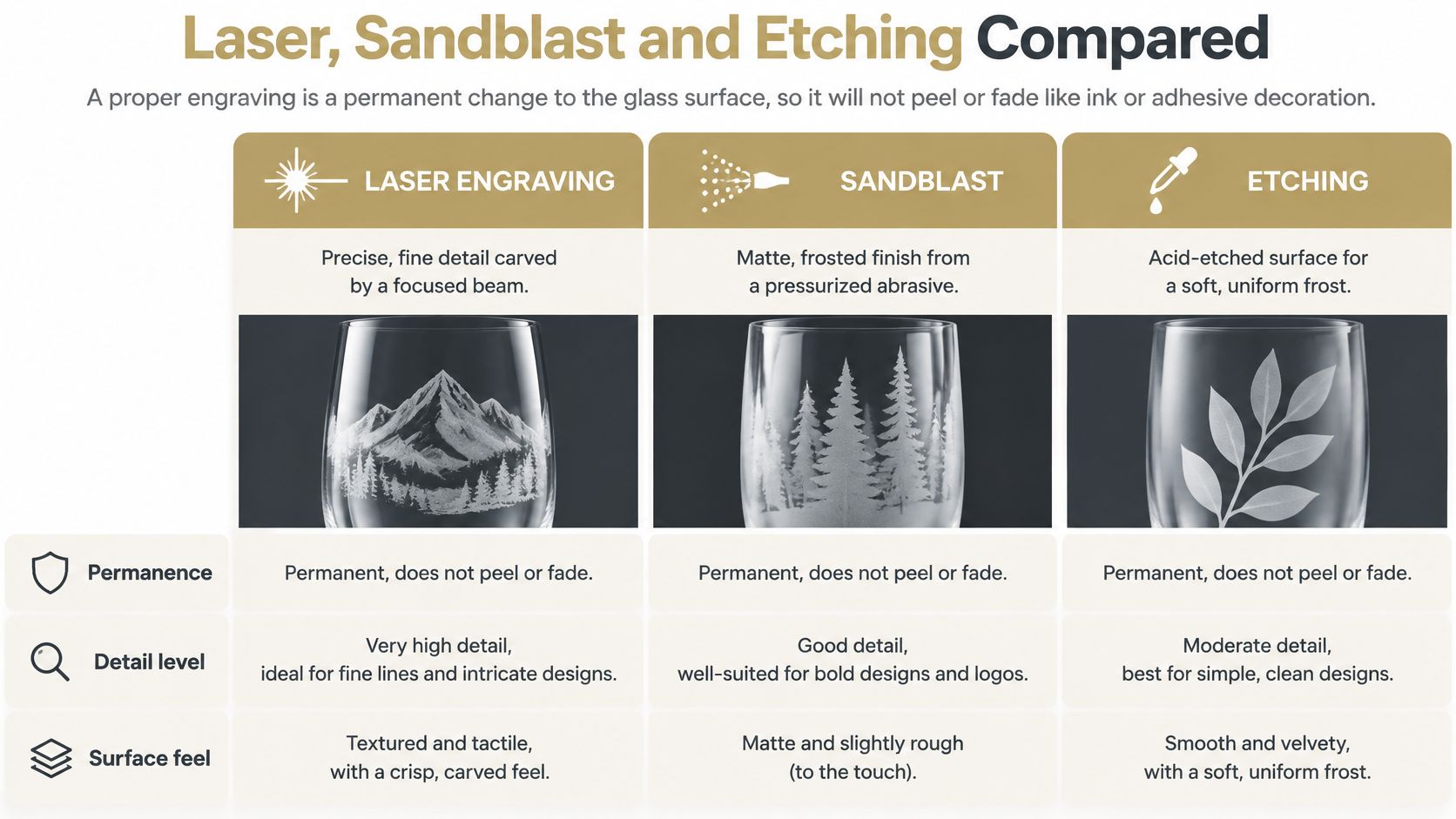
Laser engraving is the default for a reason. A focused beam produces fine, crisp matte lines and holds small text and detailed logos better than anything else on the list. For a name, a date or a company mark with a tagline under it, laser is where you start.
Sandblasting fires abrasive through a mask and leaves a frosted matte finish with softer edges. It suits bold lettering and monograms, and it flatters classic, chunky shapes where a soft frost looks deliberate.
Acid etching gives a smooth, even frost across larger areas. It's beautiful on simple shapes and poor on fine detail, so specify it for a single mark or a repeated motif, not for four lines of text.
Hand or diamond engraving cuts lines individually. It's the choice for limited premium runs and one-off gifts where the artisan variation is the point. The lines can collect residue if the piece isn't cleaned properly.
| Method | Finish | Detail Level | Wear and Washing | Best For |
|---|---|---|---|---|
| Laser engraving | Fine, crisp matte line | High, small text and fine logos | Permanent; holds through regular washing | Names, dates and detailed logos |
| Sandblast engraving | Frosted matte with soft edges | Medium, bold lettering | Permanent; edges can soften with heavy use | Initials, monograms and classic looks |
| Acid etching | Smooth, even frost | Low to medium, simple shapes | Permanent; depends on process quality | Simple designs across larger areas |
| Hand or diamond engraving | Deep, individually cut lines | High, artisan detail | Permanent; lines can collect residue if not cleaned well | Limited runs and premium one-off gifts |
| Printed decal or ink | Surface print, not engraved | Low; it's a print, not a cut | Fades or peels with washing | Not recommended for lasting gifts |
Where engraving weakens a glass
Engraving introduces micro-defects, and micro-defects act as stress concentrators. Research from McGill University on glass micro-engraving found that smoother engraved surfaces and controlled defect geometry reduce crack-initiation risk, which supports shallow, clean engraving and rounded typography over sharp internal corners or deep cuts. The study is worth reading if you're specifying artwork at volume: the McGill engraving paper.
In practice that means bold strokes and generous spacing. Avoid hairline serifs, avoid a logo crammed with detail below the readable limit, and keep the engraved zone away from the rim and the stem-to-bowl junction, where handling loads already concentrate.
The inspection step to demand
Every engraved piece should be checked for chips, radial cracks and rough edges before it's packed. Then run a sample set through washing and handling before the full run ships. A supplier who skips that step is handing you the failure rate at the worst possible moment, after the gifts have been distributed.
Personalization Ideas That Suit Each Occasion
Personalization has become the default expectation rather than a flourish. Coverage of corporate gifting trends reports that 62% of companies prioritize gifts featuring employee or client names, logos or custom messages, while 44% use automated gifting platforms to manage campaigns at scale. Consumer data points the same way: the Promotional Products Association International reports that up to 39% of consumers prefer personalized gifts, and 51% highly appreciate receiving a personalized message with a gift.
More personalization is not automatically better, though. A permanent full name or an oversized logo can make a premium glass feel like promotional merchandise, and it makes the gift hard to pass on if the recipient doesn't drink brandy.
The better rule is to match the engraving to the purpose.
Four occasions, four different marks
Weddings and executive gifts: initials and the date. Discreet, elegant, and unlikely to date badly if the recipient changes role or title.
Client appreciation: a small company logo with the recipient's name. It reads as recognition rather than advertising, which matters when the glass will sit on someone's home bar.
Anniversaries and service milestones: the year, or the number of years, next to initials. If you're shopping outside a corporate context, these host-friendly picks from Modern Lyfe show how an anniversary gift gets chosen around the recipient's home and habits rather than a generic category.
Birthdays and housewarmings: a first name and a date. Personal enough to feel deliberate, neutral enough to regift without embarrassment.
A useful piece of context for anyone worried the format is too commercial: engraved drinkware has carried status and ownership for a very long time. The Metropolitan Museum of Art's study of Roman figure-engraved glass documents figure-engraved glass from the 1st century CE, with the oldest known figure-engraved vases dated to the 1st to early 2nd century CE, and ties the craft to gem cutting. A monogram on a bowl continues that function rather than inventing it.
The details that cause reprints
Check spelling, accents and titles against a source list before anything goes into production. Keep text large enough to read at arm's length; initials smaller than a few millimetres disappear into the frost. Skip oversized logos on glasses meant for home use. And when discretion matters, put the corporate branding on the packaging and keep the vessel itself personal.
Our range suits every one of these occasions, which is what makes engraved brandy glasses such a strong gifting option across birthdays, weddings, employee milestones and client thank-you programs.
Caring for Engraved Brandy Glasses Step by Step
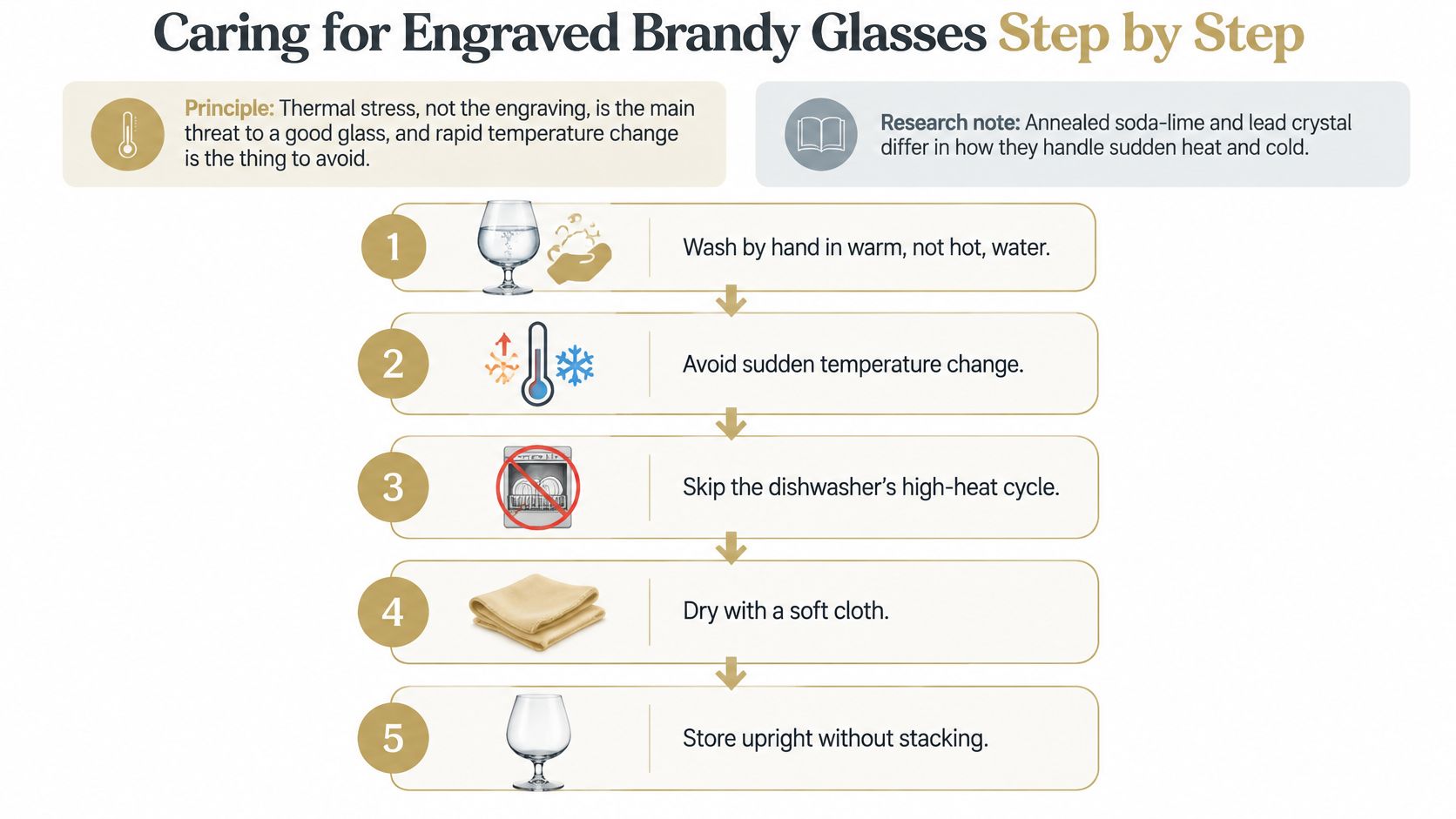
Thermal stress, not the engraving, is the main threat to a good glass. Rapid temperature change is the thing to avoid, and annealing quality decides how much abuse a piece can take before it complains.
Manufacturer data for annealed soda-lime and crystal tableware commonly specifies a thermal-shock limit around ΔT = 42°C, while borosilicate glass is designed for substantially stronger resistance, according to a recognized glassware thermal-shock testing procedure that immerses specimens in a 20°C bath and raises temperature until half the samples rupture. That 42°C margin is smaller than it sounds: a chilled glass under a hot rinse can close it in one movement.
The routine that keeps a glass in service
- Let the glass reach room temperature before pouring. Never pour boiling liquid into a chilled glass, because the bowl contracts and expands unevenly and the base takes the strain first.
- Wash by hand in warm water with mild detergent. Use a soft sponge over the engraved area and keep abrasive pads away from it, since scouring roughens the frost and dulls the design.
- Rinse at a temperature close to the wash water. Going straight from cold rinse to hot is the same shock as step one, just in reverse.
- Dry with a lint-free cloth and leave it upright to air. Trapped moisture in a deep bowl leaves mineral spots that look like damage.
- Store upright, not stacked. Nesting glasses chip at the rim, and keeping the engraved face visible makes new damage easy to spot.
- Inspect the engraved zone after every wash. Retire any glass with a chip, a radial crack or a rough edge, because those defects are where a break starts.
If you want to know which of your pieces can skip hand washing, this guide to dishwasher safe glassware covers what survives a machine cycle and what doesn't.
Room-temperature brandy service is low risk. Hot cocktails, flame-heated presentations and abrupt ice-to-hot-liquid changes are not, and they need glassware rated for those conditions rather than a gift glass pressed into service.
Anything you wouldn't do to a wine glass, don't do to an engraved brandy glass. The engraving didn't make it fragile. The temperature swing will.
Ordering Engraved Brandy Glasses for Corporate Programs
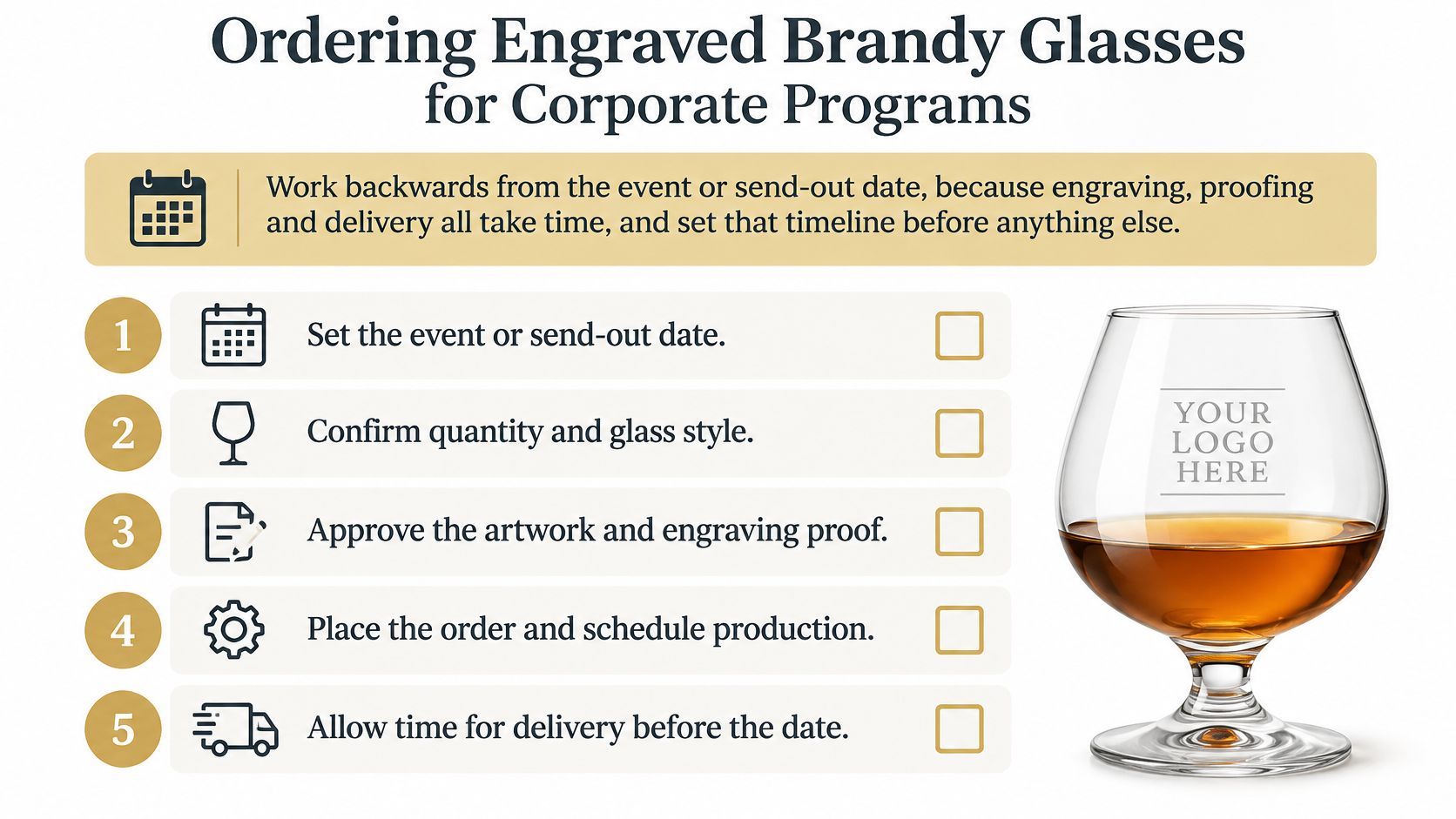
How do you choose engraved brandy glasses that feel personal without creating a risky or complicated corporate order? Start with the recipient and the occasion. Glass shape, material and engraving placement all affect whether the gift will be used, stored safely and welcomed.
The order brief in seven steps
- Set the quantity and delivery deadline. Allow time for order details and delivery before the event. Don't assume a last-minute order can be accommodated.
- Choose one glass shape or a small selection. A consistent engraving style can tie different shapes together, while giving recipients a choice respects differences in drinking habits.
- Prepare the exact personalization details. Check names, initials, titles and dates against your source list. A spelling error repeated across a batch is difficult to correct.
- Choose one clear engraving. A name, initials or date makes a personal gift. For a corporate order, a company logo is another option.
- Decide where the engraving belongs. Consider whether the message should be prominent on the glass or more discreetly placed on a wood tray.
- Set one engraving per product. For bulk custom orders, a company logo can go on the wood tray and whiskey glasses. Keep each piece's engraving simple rather than combining several messages.
- Request a quote. Corporate gifting and bulk custom orders can be quoted on request. Confirm the glass and personalization details you want before placing the order.
Proofing is where programs fail
A Business.com poll of 1,547 professionals whose roles involved receiving or sending corporate holiday gifts found that 17% identified a card or personalized thank-you note among the gift types used, while wine or liquor also accounted for 17%. Engraved brandy glasses bring the gift and message together in one useful object.
Keep the wording easy to read. Assign one person to check the final list, paying particular attention to accented characters, hyphenated surnames, titles and duplicate first names.
One owner, one signature: designate the person responsible for approving the final wording and route any changes through them.
Give recipients a choice without losing consistency
A 2025 employee holiday-gift survey of 1,051 U.S. adults working for companies with more than 10 employees, reported by WOKV, found that 82% valued personalized gifts more and 52% preferred having a choice among several gifts.
A short menu can include brandy glasses, whiskey glasses or a decanter set. Keep the personalization consistent across the options, and let recipients choose a style that suits how they drink. For celebrations, custom etched glasses can also be selected around the customer's idea and design.
What belongs in the supplier conversation
Be specific about the glass you want and the engraving you want on it. Consider whether the recipient will value a substantial crystal glass, a familiar everyday shape or a gift set with a decanter. Glass composition matters to storage and care, so choose with the recipient's likely use in mind rather than treating material as a last-minute detail.
Ask whether the logo or wording will be legible on the chosen glass. If the recipient relationship calls for a more discreet gift, consider a wood tray instead. For inspiration on shapes and personalization, see this guide to custom bar glassware.
For a mixed list of clients, prospects and employees, a snifter and a tumbler offer distinct options without making the program feel scattered. Set the quantity, choose the shape and send the exact engraving details to request a quote.
ROCKS Whiskey Chilling Stones offers engraving on its glassware and wood trays, with one engraving per product. Corporate and bulk custom orders can include a company logo on the wood tray and whiskey glasses, with quotes available on request. The Privilege Collection arrives gift-ready. Visit ROCKS Whiskey Chilling Stones to explore the options and start an order.


