


You're choosing glasses for a wedding, a client reception or a gift that should get used. On the tray, the shallow saucer looks relaxed and celebratory; the sharp V looks ready for its photograph. The question is which drink will reach the guest without ending up on a cuff.
Choose the coupe for drinks that move. Choose the martini glass for a deliberate, stationary cocktail moment. That's the useful starting point for the coupe vs martini glass decision, especially when you're buying gifts or ordering barware for a company event. Our assortment lets you build around that choice with cocktail glasses, whiskey glasses and accessories that suit the recipient's habits, not just their bar cart.
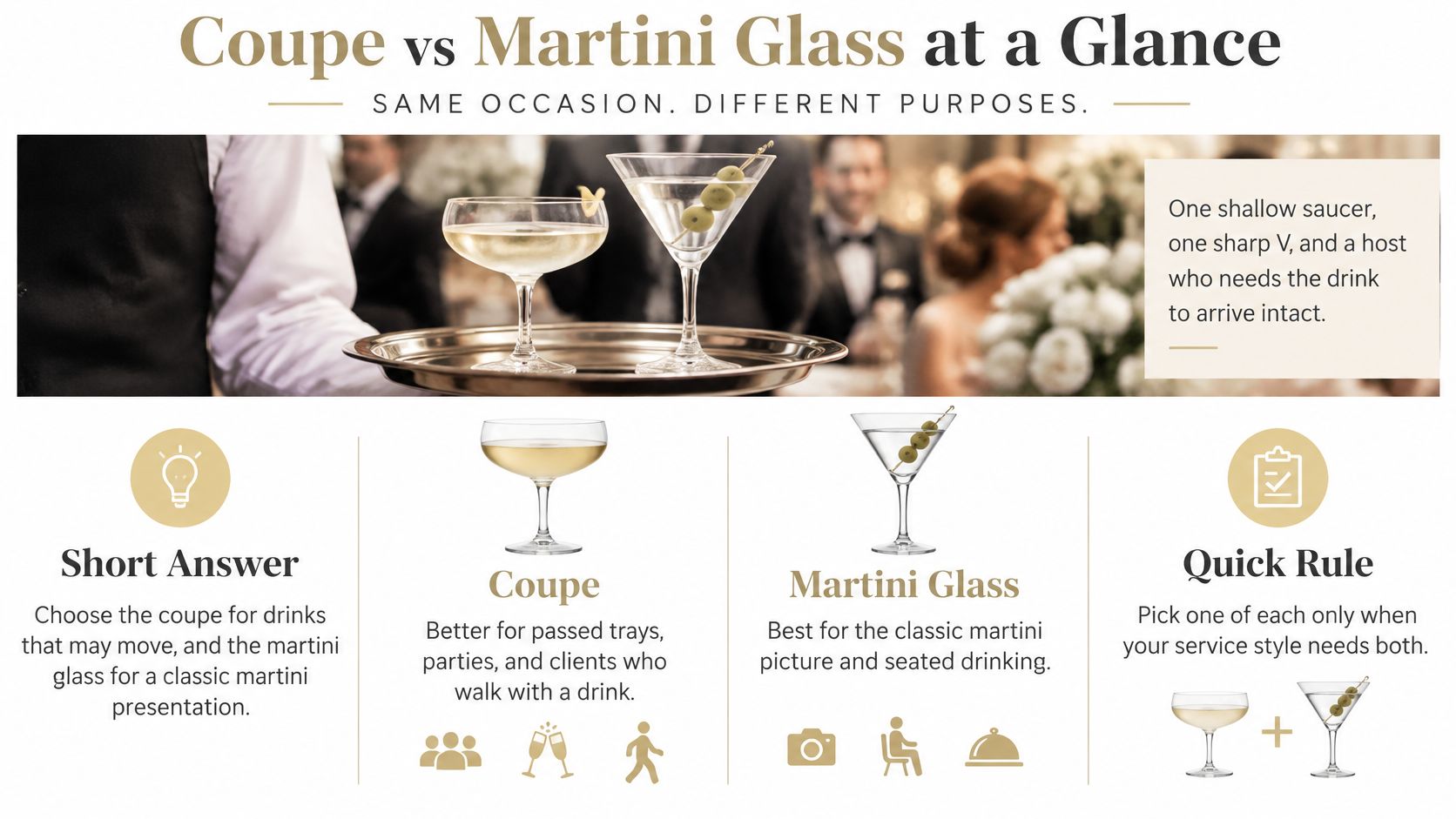
Coupe vs Martini Glass at a Glance
The coupe is the better all-purpose purchase for entertaining. Its rounded bowl is more forgiving when someone accepts a drink, turns to greet a colleague and walks across the room. The martini glass earns its place when guests are settled and the recognizable silhouette is part of the occasion.
Coupe vs martini glass by the criteria that change the serve
| Criterion | Coupe | Martini glass |
|---|---|---|
| Bowl | Shallow, rounded saucer with a gently curved rim | Angular V-shaped cone with a wide open rim |
| Stem | Stemmed, usually a lower overall profile | Stemmed, typically longer, so the bowl sits higher |
| Common listed capacity | About 5–7 oz, according to Tower of Records' glassware history; a coupe tested by Good Housekeeping in 2024 held 5.5 oz and measured 3.54 inches high | About 7–10 oz (210–300 ml); pre–World War II glasses were often only 3–5 oz, according to the same glassware history |
| Practical pour | 3–4 oz (90–120 ml), with headspace | 3–4 oz (90–120 ml); a full bowl looks large and spills sooner |
| Surface and aroma | Broad surface, open nose, faster exposure to air | Wide rim for aroma, liquid pooled deeper in the cone |
| Handling | More stable to carry and pass; stack only when the design permits | Top-heavy and prone to sloshing if tilted |
| Best occasion | Parties, weddings, receptions, versatile cocktail gifts | Iconic martini service, photographs and ceremonial toasts |
Read capacity as space, not a serving instruction
The practical-pour row matters more than the maximum capacity. A larger bowl doesn't mean the recipe needs more alcohol, and a smaller cocktail shouldn't be enlarged to make oversized glassware look full.
Practical rule: A measured 3–4 oz serve should look intentional below the rim, not like an unfinished attempt to fill the glass.
Use the capacity, handling and best occasion rows together. For a client who hosts standing gatherings, a manageable bowl and easy handoff matter more than a dramatic stem. For a martini enthusiast who enjoys a drink before dinner, that same dramatic stem may be exactly the point.
Buy for the recipient's room
A coupe set suits mixed entertaining without making the recipient commit to a particular cocktail. A martini-glass set is a more pointed gift: it says you know their preferred ritual.
For a broader spirits gift, either cocktail shape can sit beside a crystal whiskey glass. Our whiskey glasses and chilling accessories are a good fit for that mixed collection, especially when the recipient alternates between cocktails with guests and a quiet neat pour.
How Coupe and Martini Glass Histories Split
Say you're buying an anniversary gift for a couple who love old hotels, dressed tables and drinks before dinner. The coupe's appeal goes beyond looking vintage. It carries a serving tradition that ties celebration to cocktail hospitality, and that history is part of what you're giving.
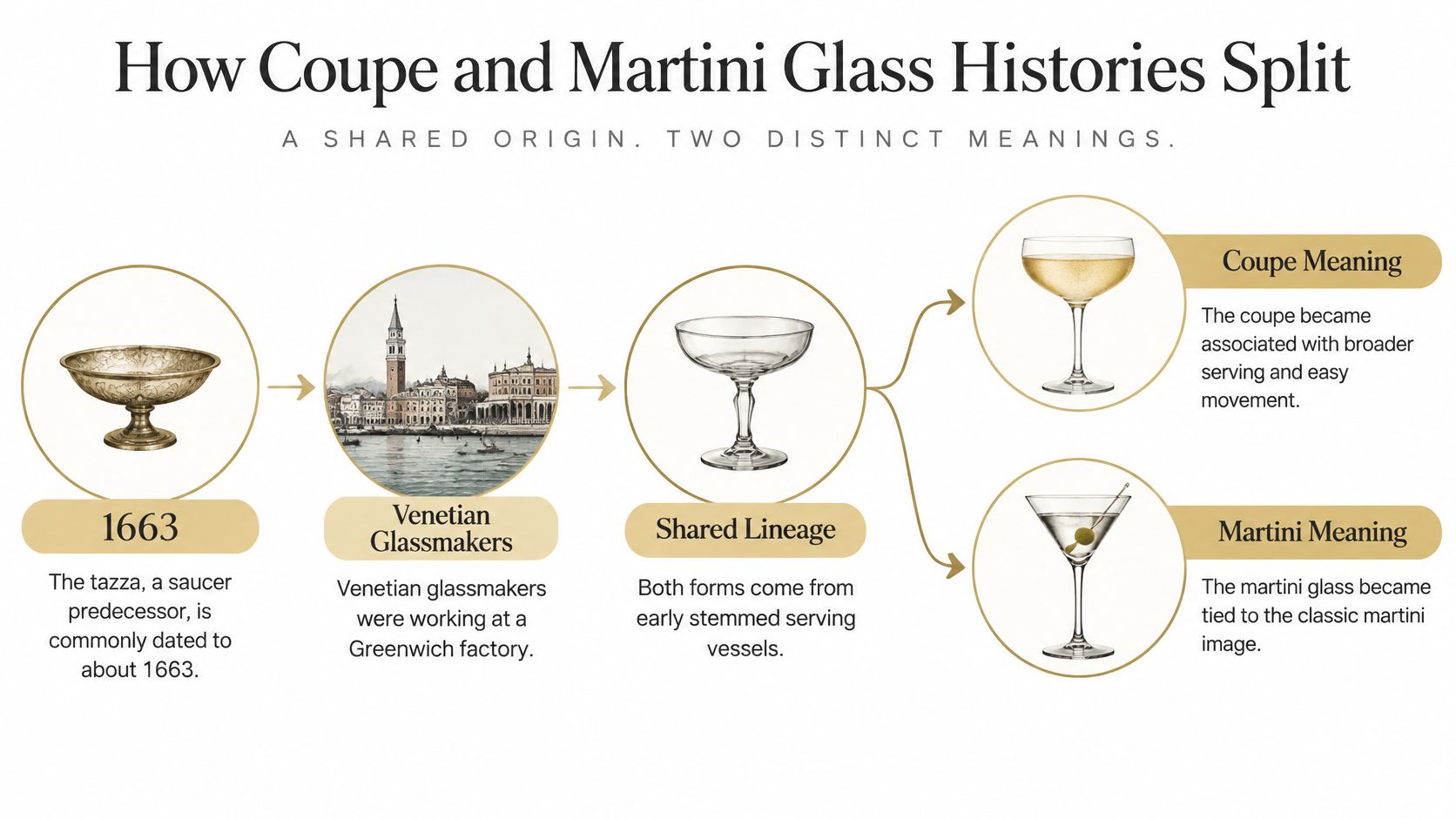
The saucer-shaped tazza, an early predecessor of the coupe, is commonly dated to around 1663, when Venetian glassmakers working at a Greenwich factory produced the form in England, according to the history of Champagne glasses. The coupe later became associated with Champagne and Victorian English high society before serving as an important vessel for mixed drinks.
The Victoria and Albert Museum's dating, reported in Plate Artists' glassware overview, places cup-shaped Champagne glasses around 1830, with the form becoming standard by the 1860s. Flutes trace back to the eighteenth century.
From rounded celebration to angular glamour
The modern V-shaped glass became a design milestone at the 1925 International Exhibition of Modern Decorative and Industrial Arts in Paris, the Art Deco showcase, according to Britannica's martini history. Its conical bowl developed from the rounded Champagne coupe, adding a sharper geometric profile and a typically longer stem.
It wasn't exclusively a martini vessel at first. Champagne and other cocktails also appeared in the shape before twentieth-century cocktail culture, including Prohibition-era America, strengthened its martini identity. Early martini glasses varied widely in size, so the historical split was never a small coupe against a large martini glass.
Give the story that fits
For gifting, the useful distinction is emotional rather than chronological.
- Coupe gifts suggest heritage, hospitality and shared celebrations. They suit a wedding table or an anniversary dinner without dictating the drink.
- Martini-glass gifts suggest modernist glamour and a recognizable cocktail ritual. They fit someone who enjoys the preparation as much as the first sip.
Neither shape is automatically more elegant. A thoughtfully chosen glass says more than an impressive silhouette chosen without regard to its owner.
Our custom etched glassware offers a way to make that connection personal. For a wedding, milestone or client celebration, we choose the glass around your idea and design, rather than treating personalization as an afterthought.
What Bowl Shape Does to Aroma and Chill
A stem doesn't make the martini glass uniquely cold. Both shapes let the drinker hold the glass without wrapping a warm hand around the bowl. The more useful distinction is how the bowl exposes the liquid to air.
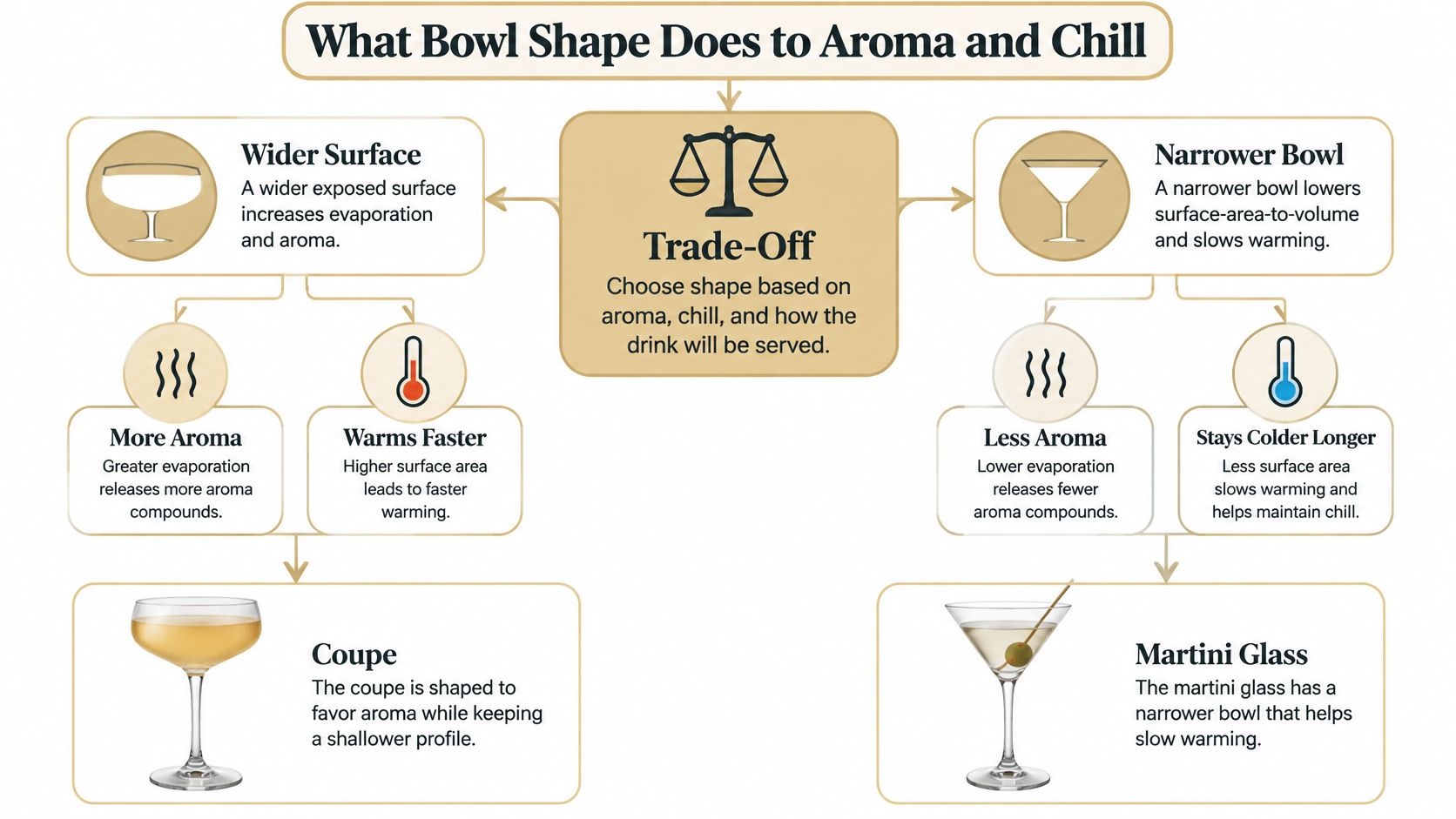
A wider exposed surface encourages evaporation and aroma delivery, while a narrower bowl reduces the surface-area-to-volume ratio and can slow warming, as explained in CocktailHQ's glassware guide. The guide recommends pre-chilling either glass and controlling the serving at 90–120 ml, rather than leaving a large cocktail standing at room temperature.
The coupe spreads the drink across a broad, shallow canvas. That makes room for aromatic release, a carefully placed garnish and a foamy cap. The martini glass also has a wide opening, but its sloping sides gather liquid into a deeper central region.
Both glasses have stems. Bowl shape still changes how the drink meets your nose.
Match the bowl to the experience
For a whiskey-based cocktail, the coupe's open surface can make the nose feel more approachable. For a sour finished with egg white or aquafaba, it gives the foam room to settle into an even cap instead of disappearing into a deep-looking cone.
Don't turn that into a promise that every coupe will warm faster than every martini glass. Bowl dimensions, serving volume and starting temperature all matter. Neither broad-rimmed shape is a substitute for proper chilling.
Chill the empty bowl while you prepare the drink. Shake or stir the cocktail with ice as its recipe requires, then strain it into the chilled glass. For an up serve, dropping ice into the finished presentation changes both the intended appearance and the dilution as it melts.
Give whiskey its own temperature tools
A recipient who likes cocktails and neat whiskey doesn't need every drink forced into the same glass. Pair the cocktail glass with a short, heavy-bottomed whiskey glass and chilling stones for a separate, dilution-free serving option.
We recommend 2 stones per glass. Our crystal whiskey nosing glass serves a different purpose: it's designed to enhance scent delivery through improved aeration and ethanol evaporation. That makes it a thoughtful addition for someone who enjoys lingering over the aroma rather than moving straight to the next drink.
Customer Stephen describes the stones this way:
“Absolutely pure liquor with no dilution and the stones are just the right size and weight for a good short, heavy-bottomed whiskey glass.”
For gifting, the distinction is useful. A coupe supports a presentation-led cocktail; a heavy whiskey glass with stones supports a neat pour without adding meltwater. Our assortment is a good fit for recipients who appreciate both experiences, without pretending that one vessel or chilling method should handle everything.
Which Glass Survives a Passing Tray
In America's Test Kitchen's handling tests, testers found martini glasses difficult to transport without spilling, while coupes could be carried approximately 25 feet with substantially greater confidence because their inward-curving rims helped contain the liquid.
That's a more useful buying signal than a photograph of an untouched cocktail. Guests don't keep their hands perfectly level while accepting a canapé, greeting a client or finding their seat.
The traditional V gives liquid a direct route toward its unobstructed rim when the glass tilts. Its raised bowl can also feel top-heavy. The coupe offers a more forgiving handoff, though no stemmed glass becomes spillproof just because its bowl is rounded.
Match the service to the setting
- Seated dinner: Either shape works. Put the glass down near the guest's place and let preference decide.
- Passed cocktail hour: Choose coupes. Servers and guests both benefit when the drink is easier to carry through a moving crowd.
- Outdoor or tented reception: Favor coupes, then plan a level service route. Uneven ground and guests turning between conversations make a dramatic V an unnecessary complication.
- Brand-event photograph: Martini glasses can be right for the moment. Pour conservatively and hand them over after guests have reached their positions.
For a corporate buyer, those are different service jobs, not competing definitions of elegance. A stationary martini station can coexist with passed coupe cocktails if the event schedule gives each a clear purpose.
Storage is part of the purchase
Bartenders cited in Liquor.com's martini-glass guide describe coupes as practical options for stability, storage and repeated handling, including designs that stack or suit freezer storage. Treat those as product-specific advantages, not permission to nest any delicate crystal bowl inside another.
Before an event order, decide where clean glasses will wait, where used glasses will return and who will wash them. Our dishwasher-safe glassware guide helps distinguish convenient cleanup from assumptions about what a particular glass can tolerate.
For client appreciation and employee gifts, I'd favor a coupe-led cocktail selection when the recipient's habits are unknown. Reserve martini glasses for a known enthusiast or an occasion built around ceremony.
Our Wholesale section is useful for corporate buyers planning coordinated barware purchases. Start with the service plan, then choose the gift configuration, rather than ordering a dramatic glass and asking the event team to work around it.
Cocktails That Belong in Each Glass
Which glass fits the drink
| Drink | Better glass | Why |
|---|---|---|
| Dry gin or vodka martini | Martini glass | The V is the iconic serve, and the wide rim lifts aroma when guests are seated |
| Espresso martini | Coupe | Foam shows on the broad surface, and the lower bowl travels with fewer spills |
| Whiskey sour or daiquiri | Coupe | A rounded bowl suits the drink; when egg white or aquafaba is used, the broad surface supports the cap |
| Manhattan up | Coupe | An open nose for a spirit-forward pour, with less risk on a passing tray |
| Short Champagne toast | Coupe | A heritage saucer for a brief celebration; choose a flute when bubble retention matters more |
| Styled nonalcoholic sour | Coupe | The same foam and garnish advantages without needing the martini silhouette |
A drink's name doesn't dictate its glass. Bartenders cited in Bon Appétit's cocktail-glass buying guide favor coupes for versatility across Martinis, Espresso Martinis and sours. Choose the shape that makes the intended service comfortable.
A classic daiquiri doesn't need a foam cap, and a whiskey sour doesn't necessarily contain egg white. Match the bowl to the recipe you're making, not just the broad cocktail category.
A housewarming menu for an easy evening
Offer a daiquiri on arrival, followed by an Espresso Martini after dinner, both in coupes. Keep the garnish restrained so guests can take a clean sip without moving a decorative obstacle.
For the gift, pair the glasses with a handwritten menu card and our cocktail picks. Our coupe-glass cocktail guide gives the recipient a useful starting point beyond the first evening.
A client reception with a clear bar menu
Serve a Manhattan up in a coupe alongside an alcohol-free sour in the same shape. Guests can choose by flavor and alcohol preference without the nonalcoholic option looking like an afterthought.
Use a measured recipe rather than judging the drink by how much empty glass remains. That keeps the bartender's instructions clear and avoids increasing the alcohol just to satisfy the bowl's proportions.
Don't scale up the alcohol to fill an oversized glass. Choose glassware that makes the intended cocktail look right.
A retirement toast with a deliberate reveal
Serve a dry gin or vodka martini after guests have gathered for the speech. Here, the V-shaped glass contributes something specific: the familiar martini image in a moment when nobody needs to carry it across the room.
For a recipient's gift menu card, include coupe-friendly sour and coffee cocktails alongside a classic martini. That gives them options without implying they need an entire commercial back bar.
Our crystal barware and mixing accessories make that menu feel considered for a birthday, housewarming or client hamper. Add tools the recipient will use, not decorative extras that never leave the box.
Gift Sets and Care Checklist
If the recipient hosts parties or walks with a drink, choose coupes. If they love the classic martini picture and drink seated, choose martini glasses. Buy both only when their menu and service habits call for both.
A mixed gift shouldn't be an apology for not choosing. It should have a clear purpose: perhaps cocktails for guests, whiskey after dinner and a nosing glass for someone who enjoys exploring a spirit's aroma.
Build around what they drink
For someone who alternates sours and bourbon, combine coupe-style cocktail service with a substantial rocks glass and chilling stones. The recipient gets different tools for different drinks, rather than an attractive collection with no obvious use.
For a dedicated martini maker, prioritize preparation. Our Weighted Barspoons, cocktail picks and Heavyweight Cocktail Shakers are useful companions to the glassware. Choose accessories according to the recipes: a shaker is useful for shaken cocktails, but don't imply that a classic dry martini must be shaken.
Our picks come in gold, stainless steel and copper. The Heavyweight Cocktail Shakers are offered in stainless steel, gunmetal, gold, copper and a two-toned version, so you can coordinate a gift without making every item identical.
For a ready personal whiskey gift, The Connoisseur's Set includes crystal glasses and is offered in Twist Glass, Signature Glass and Nosing Glass editions. The Twist Glass Edition and Signature Glass Edition each cost $54.98. These are whiskey-focused choices, not replacements for stemmed cocktail glasses.
Personalize the occasion, not every surface
Custom etching makes sense when the design means something to the recipient. We offer custom etched glasses for weddings, events and special celebrations, choosing the glass around the customer's idea and design.
For a wedding, consider names or a discreet date. For client appreciation, use a restrained mark that the recipient will be comfortable displaying at home. A gift should feel like their glassware, not a permanent advertisement on their dining table.
Corporate buyers should standardize the bowl size within each service group so equal pours look consistent in photographs. Keep the company's event stock separate from the recipient's take-home gift selection if their purposes differ.
Our cocktail-glass set guide can help frame a coordinated gift. Pair the glass choice with a short note explaining the intended drink, particularly when gifting to someone who's just starting a home bar.
Care for the gift before and after the party
Include simple care guidance with the set. A recipient shouldn't have to guess whether to stack a delicate bowl, put decorated crystal through a hot cycle or move a frozen glass straight into hot washing water.
- Hand-wash gently. Use warm water, mild soap and a soft cloth. Support the bowl rather than twisting it against the stem while cleaning.
- Dry promptly. Use a clean, lint-free cloth so water spots don't dull the presentation. Avoid applying opposing pressure to the foot and bowl.
- Chill before service. Cool the empty glass before the cocktail is ready. Don't shock a very cold glass with hot water during cleanup.
- Protect the rims. Nest coupes only when the design permits it and the rims are protected. Store martini glasses upright with enough separation that neighboring bowls don't knock together.
- Leave headspace and plan the handoff. Measure the cocktail, keep the rim clear and use coupes when guests will be moving. Set ceremonial martinis down where guests will enjoy them.
The strongest gift is the set someone reaches for again. Choose for their drinks, their storage space and the occasions they host, then use our glassware, stones and accessories to complete that specific experience.
ROCKS Whiskey Chilling Stones offers crystal whiskey gift sets, chilling stones, cocktail accessories and custom etched glassware for personal celebrations and corporate gifting. Visit ROCKS Whiskey Chilling Stones to choose a ready whiskey gift or build a barware selection around how your recipient mixes, serves and celebrates.


