


A client appreciation event is approaching, the guest list is growing, and someone has suggested ordering whiskey glasses in bulk. The first quote looks attractive until you ask the questions that matter: Can the supplier handle your deadline? Will the logo look refined? What happens if cartons arrive damaged? Will every recipient receive a gift that feels intentional, or will the glasses look like generic promotional stock?
Corporate gifting rarely fails because the buyer chose the wrong shade of glass. It fails because the order arrived late, the engraving was poorly prepared, or the packaging treated fragile drinkware like ordinary merchandise. A successful bulk whiskey glass program combines the right vessel, reliable fulfillment, controlled decoration, and packaging that protects the experience from the warehouse to the recipient's hands.
Why Corporate Buyers Miss the Actual Goal of Gifting
A procurement manager can receive two whiskey glass quotes and focus on the small difference in unit price. That comparison breaks down when the lower quote comes with a rigid minimum order, limited production capacity, or decoration fees disclosed only after artwork submission. A missed event date, inconsistent glass finish, or cartons damaged in transit can cost more than the original saving.
Corporate buyers are arranging a branded experience for clients, employees, partners, or event guests. The vessel must suit the occasion, while the order must also move through artwork approval, engraving setup, production, inspection, packing, and delivery without surprises. Ask whether the supplier can accept quantity changes, confirm decoration readiness, and agree in writing on replacements for damaged or mismatched pieces.

The cost of a gifting error
A generic giveaway can tolerate some compromise. A client gift usually cannot. Recipients notice the glass weight, clarity, rim, finish, presentation box, and whether the engraving looks designed for the vessel rather than added as an afterthought. Those details influence whether the glass becomes part of a whiskey ritual or sits unused in a cupboard.
The market context supports choosing glass when the occasion calls for a premium presentation. The global drinkware market was valued at USD 38.06 billion in 2025 and is projected to reach USD 54.93 billion by 2034, with a 4.16% CAGR. Glass held the largest material share at 42% in 2025, while North America accounted for 34% of revenue, according to Fortune Business Insights' drinkware market analysis.
Practical rule: Treat the order as a fulfillment project with a gift at the end, not as a carton of inexpensive glassware.
Promotional item or premium gift
The distinction sets the buying criteria. Promotional merchandise often prioritizes logo visibility and broad distribution. A premium whiskey gift prioritizes useful design, tactile quality, restrained branding, and packaging that reflects the relationship.
For a large employee event, a durable rocks tumbler with a discreet logo may fit the budget and audience. For a smaller group of high-value clients, a tasting-oriented glass, individual name, gift box, and complementary whiskey accessory may create a more considered gesture. The stronger choice depends on who receives it and how the gift will be used.
Before requesting quotes, document the recipient, occasion, delivery date, quantity, decoration method, packaging, acceptable substitutions, and breakage replacement process. Then compare suppliers on flexibility and execution, not unit price alone. A vendor that confirms engraving readiness and replacement terms may protect the program better than the cheapest option.
Choosing the Right Glass Style for Gifting
A client dinner, employee recognition program, and executive thank-you call for different glass decisions. The heavy tumbler offers familiar daily use, while a sleek crystal tasting glass signals a more deliberate gift. Neither style wins every program. Match the vessel to the recipient's habits, the occasion, and the impression the gift should leave after delivery.
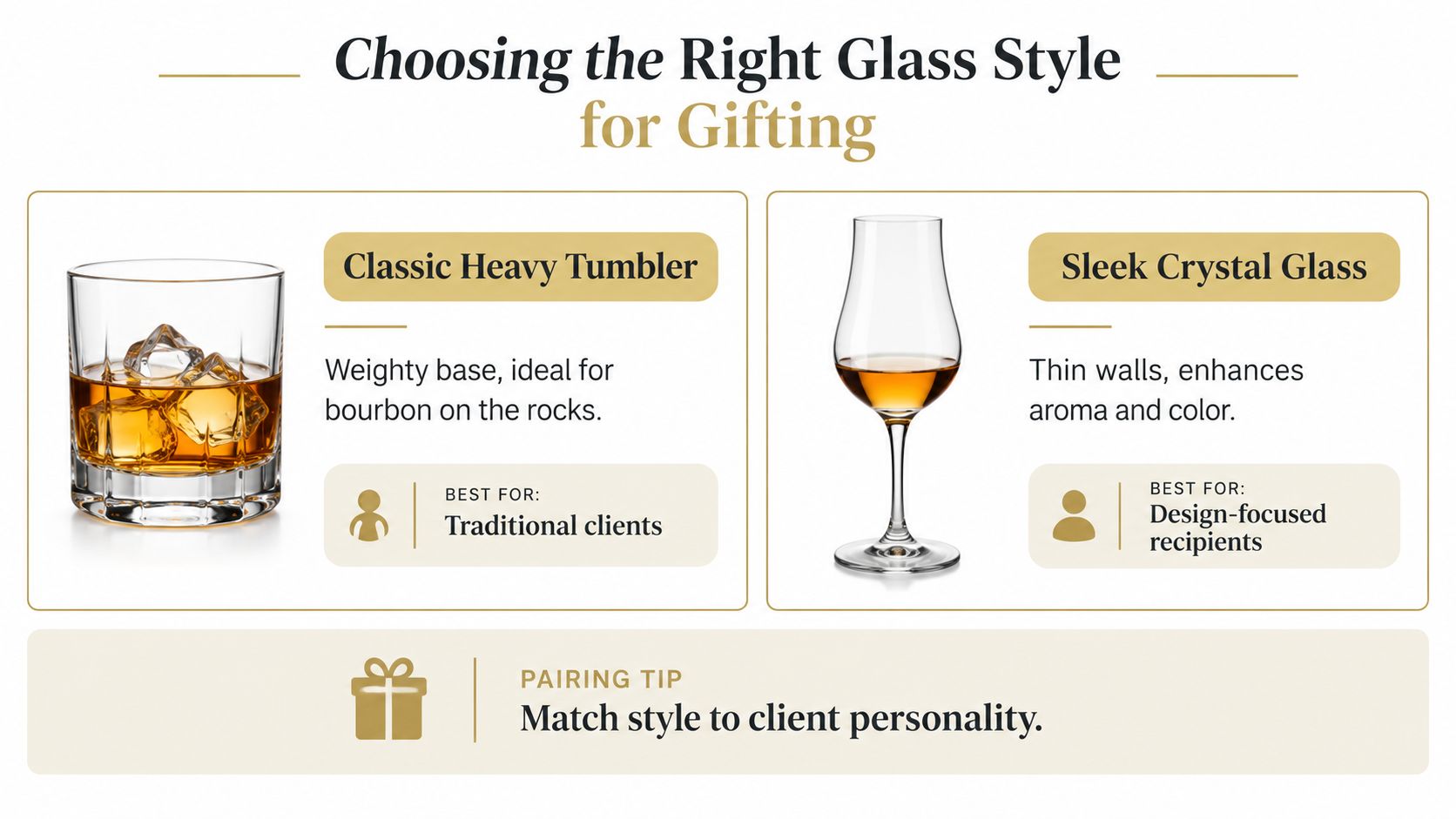
Classic heavy tumbler
A traditional rocks glass is easy to understand and easy to use. Its broad opening suits bourbon on the rocks, mixed whiskey drinks, and casual pours. A substantial base gives the glass a stable, deliberate feel, which makes it suitable for employee rewards, holiday gifts, company dinners, and larger client programs.
The format also works for a mixed audience. Recipients do not need to study aroma or maintain a dedicated home bar. A tumbler feels familiar without looking ordinary when it has clean proportions, a well-executed finish, and an engraving area that supports restrained branding.
Choose it when:
- The audience is broad: Employees, event guests, and mixed client groups can use the format without special knowledge.
- The gift needs versatility: A rocks glass can serve whiskey, cocktails, water, or other drinks at home.
- The quantity is substantial: One consistent tumbler design is easier to standardize across a larger program.
- The message should feel relaxed: It suits appreciation gifts that are warm rather than ceremonially formal.
A low-cost tumbler can undermine the gift if it feels thin, poorly balanced, or visually generic. Request a physical sample and assess the base, rim, clarity, decoration area, and overall balance in the hand. Confirm that the supplier can engrave or print cleanly on the chosen surface, and ask how replacement pieces will be handled if cartons arrive damaged. Product photographs rarely show these details reliably.
Sleek crystal tasting glass
A tapered or nosing-style glass creates a more intentional impression. Its shape directs attention toward aroma and color, making it a stronger fit for whiskey enthusiasts, executives, collectors, and clients who value a focused tasting ritual. The design can feel like a personal gift rather than promotional merchandise.
That refinement narrows the audience. A tasting glass may be unsuitable for a large conference giveaway where recipients expect an everyday tumbler. Its proportions also require more careful packing and presentation. A fitted box, protective insert, and decoration method suited to the glass can matter as much as the vessel itself.
Use it when:
- The recipient is a known enthusiast: A tasting-focused vessel fits someone who already enjoys spirits.
- The occasion is relationship-led: Executive thank-yous, milestone recognition, and VIP client gestures suit a distinctive format.
- Presentation carries weight: A fitted gift box and complementary accessory can make the glass feel complete.
- The brand favors restraint: A small logo or name generally suits an elegant silhouette better than a large promotional mark.
For a refined option, The Connoisseur's Set - Nosing Glass Edition pairs a crystal whiskey nosing glass with round solid granite stones designed to cool a drink without dilution from melting ice.
The practical choice is direct. Select the tumbler for broad usability and dependable familiarity. Select the tasting glass when the recipient and occasion justify a specialized expression of value. For a deeper comparison of vessel shapes and gifting fit, see our guide to glassware for whiskey. Whichever style you choose, confirm the physical sample, engraving readiness, packaging fit, and breakage terms before approving the bulk order. The final assortment should feel intentional, not like leftover stock assembled around a low unit price.
Navigating MOQs and Lead Times
A low per-piece price can still produce the wrong order. Corporate gifting campaigns often fail when the supplier's minimum applies to each design, decoration method, or packaging format rather than to the total number of recipients.
Wholesale terms vary sharply. Some vendors sell by case, with typical case packs of 12 to 36 pieces and no site-wide minimum. Others set an MOQ of 500 pieces per SKU and quote 25 to 35 days for production on larger custom runs, as shown in this wholesale tumbler procurement reference. That difference affects whether you can support several recipient tiers, test a new style, or keep the same design across offices.
Ask four questions before requesting a quote
Ask for the commercial structure in writing, not only the price per glass.
- What is the minimum by design and decoration method? Plain stock may be available in small quantities, while laser engraving, printing, special finishes, or custom packaging may require a higher quantity.
- Does the minimum apply per SKU? An executive tumbler and an employee gift may count as separate SKUs. A per-SKU MOQ can push the purchase well above the total headcount.
- Can the supplier mix cases? Mixed-case flexibility helps when you need several styles, different recipient tiers, or a combination of personalized and logo-only pieces.
- When does production time begin? Confirm whether the clock starts at payment, sample approval, artwork approval, or final packaging approval. Each milestone creates a different delivery date.
A case pack of 12 to 36 can suit a smaller event, a pilot order, or gifts divided among several offices. A 500-piece-per-SKU requirement calls for a different purchasing plan. Consolidate recipients, use one universal design, or select a vendor with flexible stock. Ask whether unused cartons, spare blanks, and replacement pieces count toward the quoted quantity.
Build a deadline backward
Start with the date recipients must receive the gifts. Work backward through internal approvals, sample review, artwork correction, production, inspection, freight, receiving, and replacement units. The supplier's production estimate covers only part of that schedule.
Decoration can create another production stage. One custom glassware source states that vector files are preferred for strong engraving results and that production can take 7 to 10 business days plus shipping, according to its custom glassware guidance. Prepare the editable logo file, approved brand colors, recipient list, and final wording before placing the order. Confirm whether a revised proof restarts production timing.
For the complete assortment, wholesale barware guidance can help compare accessories and presentation requirements alongside the glass itself. A lower glass price may lose its advantage once gift boxes, inserts, stones, or separate packing are added.
Supplier question worth asking: “If I approve the artwork today, what exact date will the decorated and packed order be ready for dispatch?”
A reliable vendor should separate sampling, decoration, production, inspection, and shipping. That answer gives procurement a date to test against the event schedule and exposes an optimistic arrival promise before payment is made.
Designing Custom Engraving That Lasts
A logo can look polished on a proof and still fail on the finished glass. Corporate gifts expose every weakness: a mark placed on a curved edge becomes hard to read, fine lettering disappears at normal viewing distance, and shallow decoration can lose definition after repeated washing. Choose the marking method and placement for how recipients will use the glass, not only for how the artwork looks on screen.
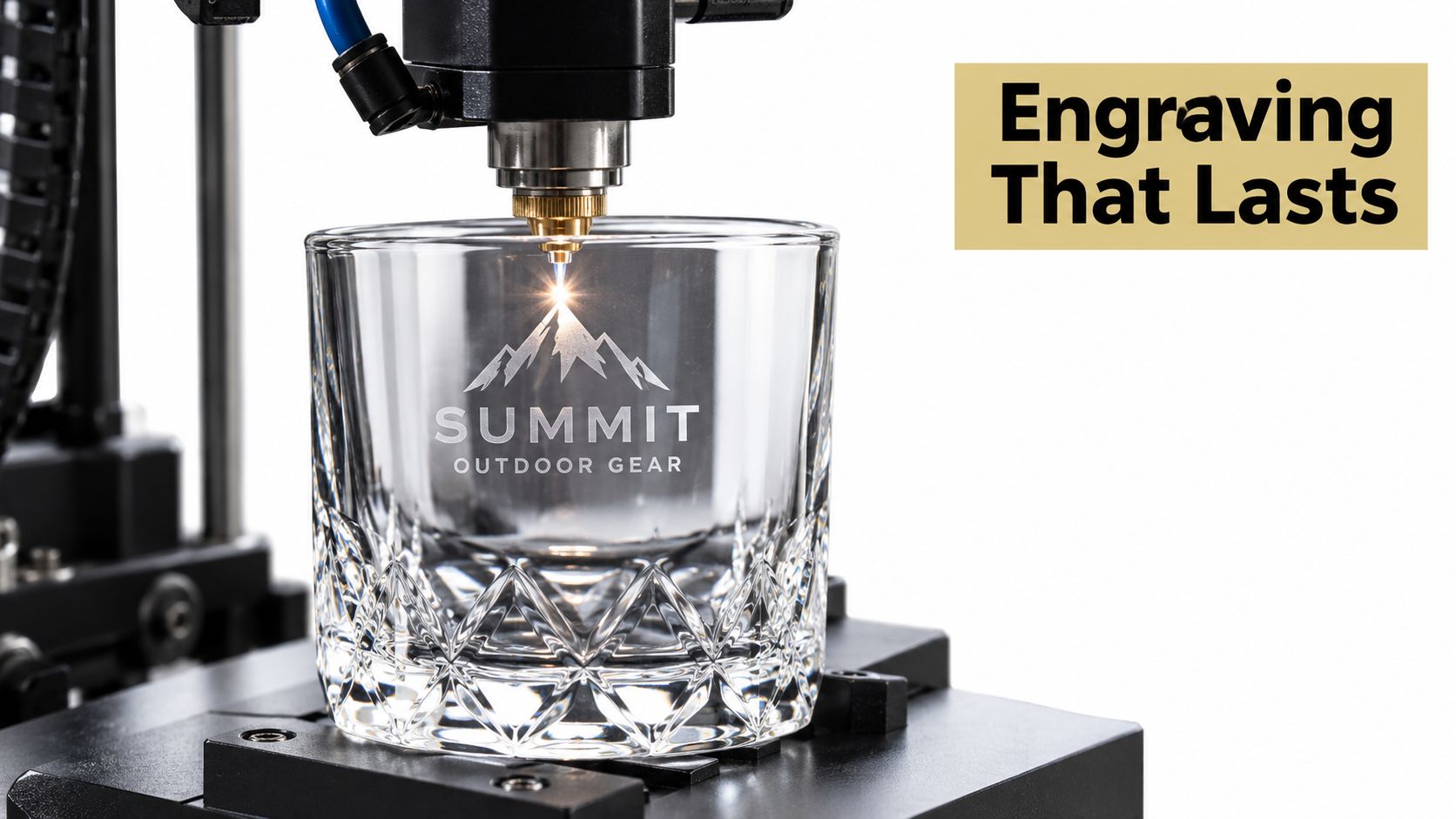
Prepare artwork for the production method
Send vector artwork whenever possible. It keeps edges clean when the decorator scales a logo and avoids the softness or pixelation common in low-resolution raster files. Supply the correct orientation, brand colors, final wording, and the intended decoration area, whether that is the front, back, base, or another defined surface.
For a full walkthrough of artwork preparation and marking methods, see this guide to custom engraved whiskey glasses.
Request a digital proof on the actual glass profile. A flat mockup may hide curvature, reflection, and the limited space around the mark. Review how the logo sits above the liquid line and whether it remains visible when the glass is held. For names or short messages, check letter spacing, line breaks, and the smallest details rather than approving the wording alone.
A restrained layout usually produces the stronger corporate gift:
- Use a small logo: Leave enough glass visible for the vessel to feel like a considered gift, not event merchandise.
- Choose clean typography: Names and short messages need readable letterforms without decorative clutter.
- Keep the placement consistent: Identical positioning makes a mixed recipient order look deliberate.
- Separate brand and recipient details: A discreet company mark beside a recipient name feels more personal than an oversized logo.
Choose durability over novelty
Ask the supplier to quote the marking technique by name. Deep laser engraving and sand carving create a tactile finish that generally suits a long-term gift better than shallow etching. “Custom logo” is not a specification. Confirm the expected depth or finish, the decoration area, and whether the method works on the selected glass shape.
Order a decorated sample before approving the full run. Inspect the edges of letters, fine logo details, contrast against the glass, and the feel of the mark under a fingertip. Ask how the decoration is expected to hold up through ordinary washing and handling, then record the agreed method on the purchase order. A supplier that cannot provide a decorated sample creates avoidable risk for procurement.
The strongest result pairs a well-proportioned vessel with a quiet mark. If recipients notice the glass's craftsmanship before the logo, the decoration is doing its job.
Protecting Your Order During Shipping
A pallet of whiskey glasses can leave the factory in perfect condition and arrive with enough breakage to disrupt a client-gifting campaign. Packaging design, carton strength, internal separation, pallet stability, and replacement terms determine whether your delivered quantity matches the purchase order.
Industry guidance for well-packed drinkware commonly targets under 2% breakage, while stronger cushioning systems are often expected to perform in the 0.5% to 1.5% range for higher-value orders, according to drinkware packaging and durability guidance. Use these figures as negotiation benchmarks. Require the supplier to describe the packaging system rather than accepting a general promise of “safe shipping.”
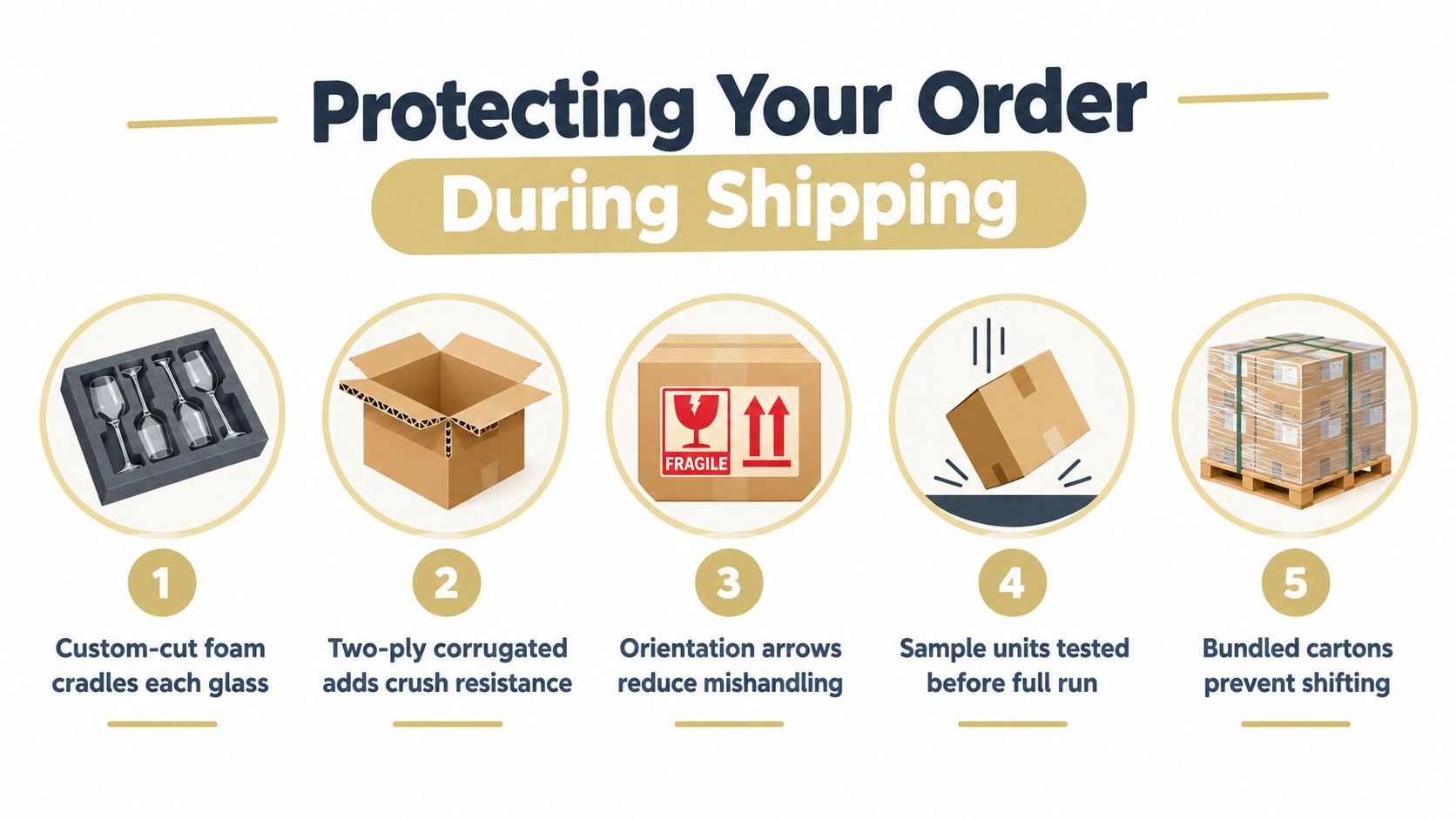
Specify the protective system
“Export packaging” leaves too many questions unanswered. Ask how each glass is separated, what prevents movement inside the carton, how many cartons are placed on each pallet, and whether the outer box can withstand stacking and handling.
A practical shipping specification may include:
- Individual separation: Dividers or molded inserts should prevent glass-to-glass contact.
- Cushioning mass: The system needs enough protective material to absorb movement rather than merely fill empty space.
- Outer-carton strength: A weak master carton can collapse even when the internal dividers are well designed.
- Pallet stability: Wrapped and secured cartons should not shift during loading or unloading.
- Inspection access: Receiving staff need to open and check cartons without damaging the remaining stock.
For a closer explanation of carton construction, review why choose heavy duty boxes before approving the specification. The heaviest box is not automatically the right choice. Match the carton, inserts, and stacking method to the glasses' fragility and the shipment's value.
Test before decorating the full run
Decoration can complicate replacement, especially when a supplier treats damaged branded units as a custom exception. Approve the glass shape and packaging with sample units before committing to the full decorated order. Request packing photographs, the carton configuration, and a shipment inspection record.
If the supplier uses independent glass testing, ask which impact, thermal-shock, or internal-pressure checks apply to the selected shape. A glass may pass a visual inspection and still fail after transport impact or temperature cycling, so packaging evidence matters alongside the product sample.
Put the breakage arrangement in the purchase terms. Define the acceptable allowance, evidence required for a claim, notification window, replacement responsibility, and whether freight for replacements is covered. Unit price matters less when the supplier refuses to take responsibility for predictable transport loss.
Finalizing Your Bulk Gift Selection
A polished sample can hide production problems. Before approving a bulk whiskey-glass order, confirm that the full lot will match the approved shape, decoration placement, measurements, and packaging standard. A practical inspection plan gives procurement and the supplier the same reference point.
Define critical-to-quality dimensions before sampling: rim or finish diameter, overall height, body diameter, perpendicularity, and capacity. Record target measurements, acceptable variation, defect photographs, and the severity assigned to each defect. This prevents disagreements after production has started.
Inspect the details recipients feel
Small inconsistencies are obvious in a client gift. An uneven rim changes the drinking experience, while a glass that sits crooked looks careless on a table. Capacity can also create disputes if the fill height is not defined.
Use an inspection record that covers:
- Rim and finish diameter: Compare the opening with the approved sample and check that it feels even around the circumference.
- Overall height and body diameter: Confirm that the silhouette remains consistent across the lot.
- Perpendicularity: Check that each glass sits straight without leaning.
- Capacity definition: State the fill height used for measurement, rather than relying on an unexplained volume description.
- Visual defects: Separate cosmetic marks from chips, cracks, sharp edges, and other functional faults.
- Decoration position: Match the logo or name against the approved proof and sample.
An ISO 2859-1 AQL acceptance plan can provide a repeatable lot-acceptance framework when it includes clear accept and reject examples. The label alone is not enough. Add a defect photo library, severity tiers, sampling records, and traceability so both parties assess the same evidence.
Approve the experience, not just the item
Open a packed sample as the recipient will. Review the carton, insert, tissue, card, engraving, and glass together. A sturdy tumbler in weak packaging can feel less premium than a simpler glass with a carefully planned presentation.
For higher-value orders, request first-article, in-process, and shipment-level measurement logs. These records can expose dimensional drift before decoration or packing, when correcting the issue remains practical.
Your final selection should align four decisions: a style suited to the recipient, engraving that represents the brand, packaging that protects the shipment, and a supplier whose MOQ and timeline match the campaign. That combination makes whiskey glasses bulk suitable for client appreciation, employee recognition, company events, and premium promotional programs.
Our assortment combines whiskey glasses and gift-ready barware with options such as ROCKS Whiskey Chilling Stones. Visit ROCKS Whiskey Chilling Stones to review gift options and match the presentation to your recipients and deadline.


