

You're comparing a plain decanter, an engraved glass, and a polished gift set for someone who already seems to own everything. A bottle of whiskey may be enjoyed and finished, but a monogram whiskey decanter can remain on a bar cart, office shelf, or dining-room cabinet long after the occasion has passed. The challenge is choosing personalization that feels considered rather than promotional, glass that suits real use, and packaging that survives delivery in perfect condition.
The right purchase isn't a piece of barware. It's a relationship gift, whether you're thanking a client, recognizing an employee, celebrating a wedding, or marking a family milestone.
Why a Monogram Whiskey Decanter Is a Relationship Gift, Not Just Glassware
A corporate buyer planning a client event often starts with the wrong question: “Which decanter looks most expensive?” The better question is, “What will this recipient still feel comfortable displaying after the event?” A discreet monogram can communicate recognition without turning the gift into an advertisement. For a partner celebrating an anniversary, the same object can carry initials or a date that makes it personal without filling the glass with text.
Personalization changes the meaning of the vessel. A plain decanter is useful. An engraved decanter records who it belongs to, why it was given, or which relationship it represents. That distinction matters for client appreciation, employee recognition, weddings, anniversaries, housewarmings, and milestone birthdays, where the emotional value often depends on evidence of thought rather than the object's price.
The tradition is older than modern corporate gifting. The Metropolitan Museum of Art documents a whiskey decanter made by the Boston & Sandwich Glass Company in 1867, with faceting and engraved fruit decoration that made it ornamental as well as functional. The museum also connects richly colored, cut, and engraved glass with American consumers' interest in Bohemian-style glass during the nineteenth century. See the Metropolitan Museum of Art's documented 1867 whiskey decanter for the historical context.
Practical rule: Choose the personalization before choosing the decoration. The glass should support the message, not compete with it.
That's why our assortment is a good fit for buyers who want more than a generic bottle accessory. A decanter can stand alone, pair with engraved glasses, or become part of a coordinated barware gift. For broader inspiration on personalized presents that work beyond whiskey, check Grainmark Leather's curated list, especially when you're comparing keepsakes for different recipients.
The strongest gifts usually make one clear point. They say “this belongs to you,” “we value the relationship,” or “this date matters.” They don't try to say all three in oversized lettering.
Choosing the Right Decanter Style and Glass Composition
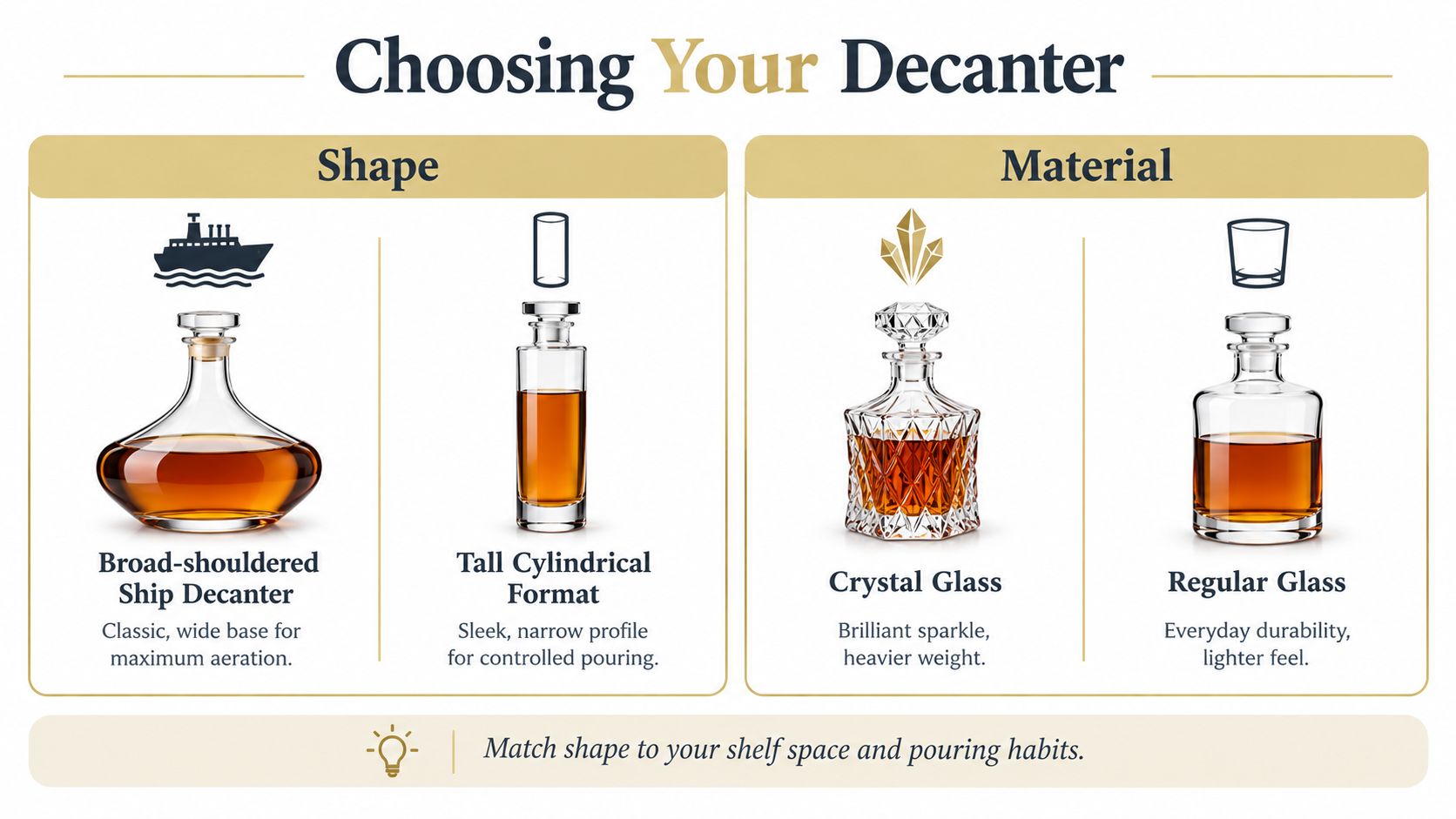
Start with the recipient's surroundings and habits. A wide, broad-shouldered ship decanter has a traditional presence and a substantial base, making it suitable for a home bar or executive shelf. A tall cylindrical format takes less visual space and works well where controlled pouring and a narrow profile matter. Globe and diamond-cut designs create more visual drama, while a simple square silhouette gives engraving a clean, readable field.
Stopper design matters more than many buyers expect. A substantial glass stopper reinforces a formal presentation, but it needs to fit securely and should be handled by the stopper rather than the neck. A minimalist stopper suits a contemporary office or home bar. If the gift will travel to an event, prioritize protective packaging over an unusually elaborate silhouette.
Match the material to the intended use
“Crystal” isn't a complete specification. It may describe leaded crystal, lead-free crystal, or a retailer's broader luxury wording. Cooper Hewitt records George Ravenscroft's patent for crystal glass in 1674, and describes the sparkle and brilliance associated with leaded glass. The same source notes the importance of Irish leaded-glass production, including the Cork Glass Company, founded in 1783 and operating until 1818. Read Cooper Hewitt's history of crystal and engraved glass.
- Leaded crystal: Usually selected for brilliance, weight, and a formal presentation. Ask the maker whether it's intended for brief serving rather than prolonged storage.
- Lead-free crystal: A strong choice for buyers who want clarity and a premium appearance while avoiding uncertainty about lead content. Confirm the stated composition rather than relying on the word “crystal.”
- Soda-lime glass: Practical, familiar, and often lighter in feel. It's a sensible option for everyday use and larger gifting programs where durability and consistency matter.
- Borosilicate glass: Known for resistance to thermal shock, but the product specification still needs to confirm food-contact suitability and intended use.
European labeling distinguishes crystal categories, including traditional crystal containing at least 24% lead oxide, as described in the EU-focused crystal safety guidance. That doesn't make the buying decision automatic. Ask whether the decanter is intended for serving or storage, whether food-contact documentation is available, and what care instructions the manufacturer provides.
For a coordinated option, The Whiskey Decanter Gift Set combines a star-cut decanter and glasses with granite whiskey chilling stones. It's designed for whiskey, bourbon, brandy, or cognac presentation and is a good gifting option when the recipient will appreciate a complete bar-cart experience rather than a standalone vessel.
What to Engrave So the Gift Still Feels Right Years From Now
Engraving is a design decision, not an empty field to fill. The most durable choices are usually the most restrained.
Single initials suit executives, wedding attendants, and recipients whose names may change professionally. They're discreet and easy to display in a home or office. A traditional monogram can feel more formal, but confirm the letter order before approval because first, last, and middle initials aren't always arranged the same way.
Full names work when the gift should be unmistakably personal, especially for employee recognition or a family member. Names with a date are better for weddings, anniversaries, retirements, and milestone birthdays because the date explains the occasion without requiring a long message. A short phrase can work on a wooden presentation box or rear panel, but crowded front-facing text is one of the fastest ways to make a premium decanter look like promotional merchandise.
Company logos require a sharper judgment. A small, single-color mark can identify the giver while preserving the recipient's ownership. A large logo, slogan, department name, or event title can make the same object feel like conference swag. If the recipient might change jobs, avoid combining a personal name with a prominent employer identity unless the gift is explicitly tied to that role.
The best corporate engraving often looks personal first and branded second.
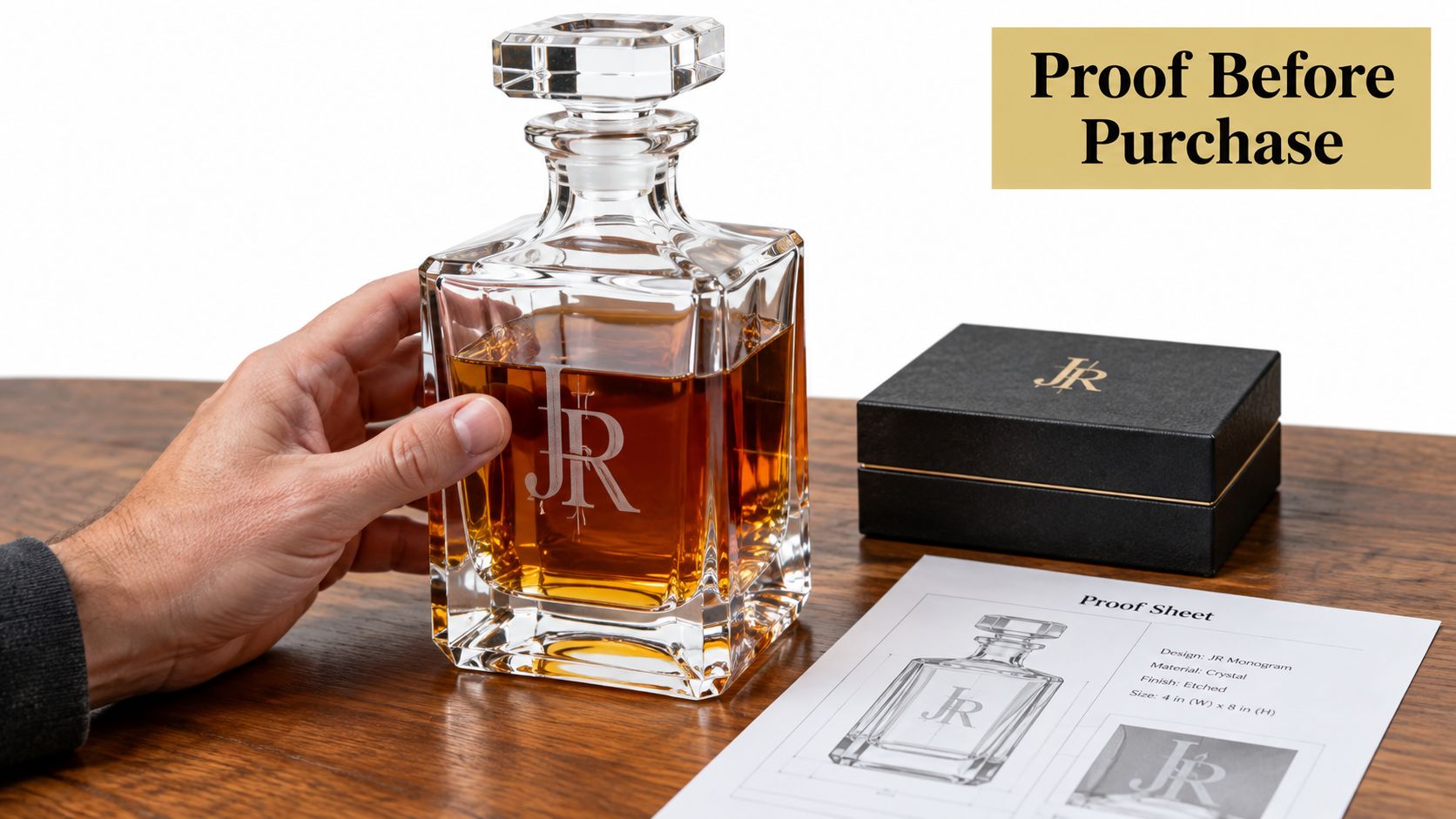
Before approving artwork, ask the engraver to confirm the available character count, minimum letter height, placement area, and whether the design will be etched, laser engraved, or printed. Request a proof at close to the actual size. A logo that looks balanced on a screen can become muddy on a faceted surface or disappear across a curved shoulder.
For the technical side of engraving glass, this guide to engraving glass can help you understand why line weight, contrast, and placement affect the final result.
My recommendations are straightforward:
- Wedding: Couple's initials plus the wedding date.
- Client anniversary: Recipient's initials or name, with a discreet date or relationship marker.
- Executive promotion: Initials or full name, not a job title that may become outdated.
- Employee recognition: Name and achievement date, with the company mark kept subtle.
- Housewarming: Family name or initials, especially when everyone in the household will use the decanter.
More engraving isn't more thoughtful. It's usually just more difficult to read.
Ordering, Proofing, and Packaging a Monogram Whiskey Decanter
A successful order follows a simple sequence. First, decide whether one person will receive the gift or whether a corporate batch needs identical treatment across multiple recipients. Then collect the exact spelling, initials, dates, logo files, and delivery addresses before submitting artwork. Don't rely on names copied from an old spreadsheet.
Approve the proof before production
A reliable engraver should show the placement and scale before cutting the glass. Check:
- Text accuracy: Names, initials, dates, punctuation, and capitalization.
- Placement: Front face, shoulder, or back panel. The front is visible, the shoulder can feel more discreet, and the back panel suits a private message or secondary mark.
- Legibility: Thin strokes and intricate logos may lose clarity on curved or faceted surfaces.
- Consistency: Every unit in a corporate batch should use the same font, alignment, artwork size, and relative position.
- Packaging fit: Confirm that the finished decanter still sits securely in its insert or presentation case.
A single wedding gift can tolerate a personal review and one carefully considered proof. A corporate batch needs a locked master proof, a recipient list, a correction checkpoint, and a delivery plan that accounts for engraving, inspection, packing, and transit. Ask for the production lead time before promising a presentation date. Personalization adds handling steps, and last-minute changes can affect the entire batch.
Treat the box as part of the gift
A branded gift box works well for corporate events when the unboxing needs to feel polished and consistent. A wood presentation case adds warmth to weddings, retirements, and personal milestones. A velvet bag offers a softer presentation but may provide less protection unless the inner packaging is rigid. Protective inserts are essential for any shipment containing a glass stopper, especially when the gift will travel directly to a client or event venue.
A good box should prevent movement, protect the engraving from abrasion, and keep the decanter upright. For more ideas on protecting and presenting glassware, see this guide to gift boxes for glassware. The box isn't a cosmetic extra. It controls whether the recipient experiences a careful reveal or opens a damaged object that has to be returned.
Matching the Decanter to the Occasion and the Recipient
Use this matrix to make the decision quickly. If you know the recipient's habits, let those habits outrank the occasion. A whiskey enthusiast who entertains frequently may value a coordinated set, while a senior client may prefer a quieter piece that fits an office shelf.
Monogram Whiskey Decanter Pairings by Occasion
| Occasion | Glass Type | Engraving Style | Packaging |
|---|---|---|---|
| Corporate client gift | Lead-free crystal or clearly specified glass | Recipient initials, with a discreet company mark | Structured branded box with protective insert |
| Employee recognition | Soda-lime or lead-free crystal | Full name and recognition date | Wood presentation case |
| Wedding | Crystal or lead-free crystal | Couple's initials and wedding date | Wood case or formal gift box |
| Anniversary | Lead-free crystal or crystal with documented composition | Two initials and meaningful date | Presentation case with a private message inside |
| Housewarming | Durable soda-lime glass or lead-free crystal | Family name or household initials | Protective gift box |
| Milestone birthday | Crystal or lead-free crystal | Name, initials, or birth date, kept concise | Wood case or padded premium box |
The table's practical lesson is simple. Corporate gifts need restraint, weddings need permanence, and housewarming gifts need broad household appeal. Don't put a job title on a gift meant to live in a private home. Don't give a family a single person's initials if everyone will use the barware.
Pairing expands the occasion without forcing more engraving onto the decanter. Engraved glasses make a wedding or anniversary set feel complete. A wooden presentation tray adds structure for a corporate event. Whiskey stones suit recipients who enjoy chilled pours without dilution, while a standalone decanter works better when the vessel's shape or inscription is the central statement.
The U.S. gifting market already treats alcohol as a familiar holiday category. One report citing CivicScience data says 40% of Americans were likely to gift alcohol during the holidays, and reports U.S. whiskey sales of $5.1 billion in 2022, after a 10.5% increase that year, within a distilled-spirits market valued at $37.6 billion. Review the cited alcohol gifting and whiskey market context. The decanter remains an accessory gift for legal-age drinkers, so follow local rules and don't assume the recipient wants alcohol included.
For wedding-related event planning, B.R. Cohn Winery's winery wedding packages offer useful context for how presentation, ceremony, and hospitality fit together. A personalized decanter can complement that atmosphere without becoming the centerpiece of the event.
Caring for a Monogram Whiskey Decanter So the Engraving Lasts
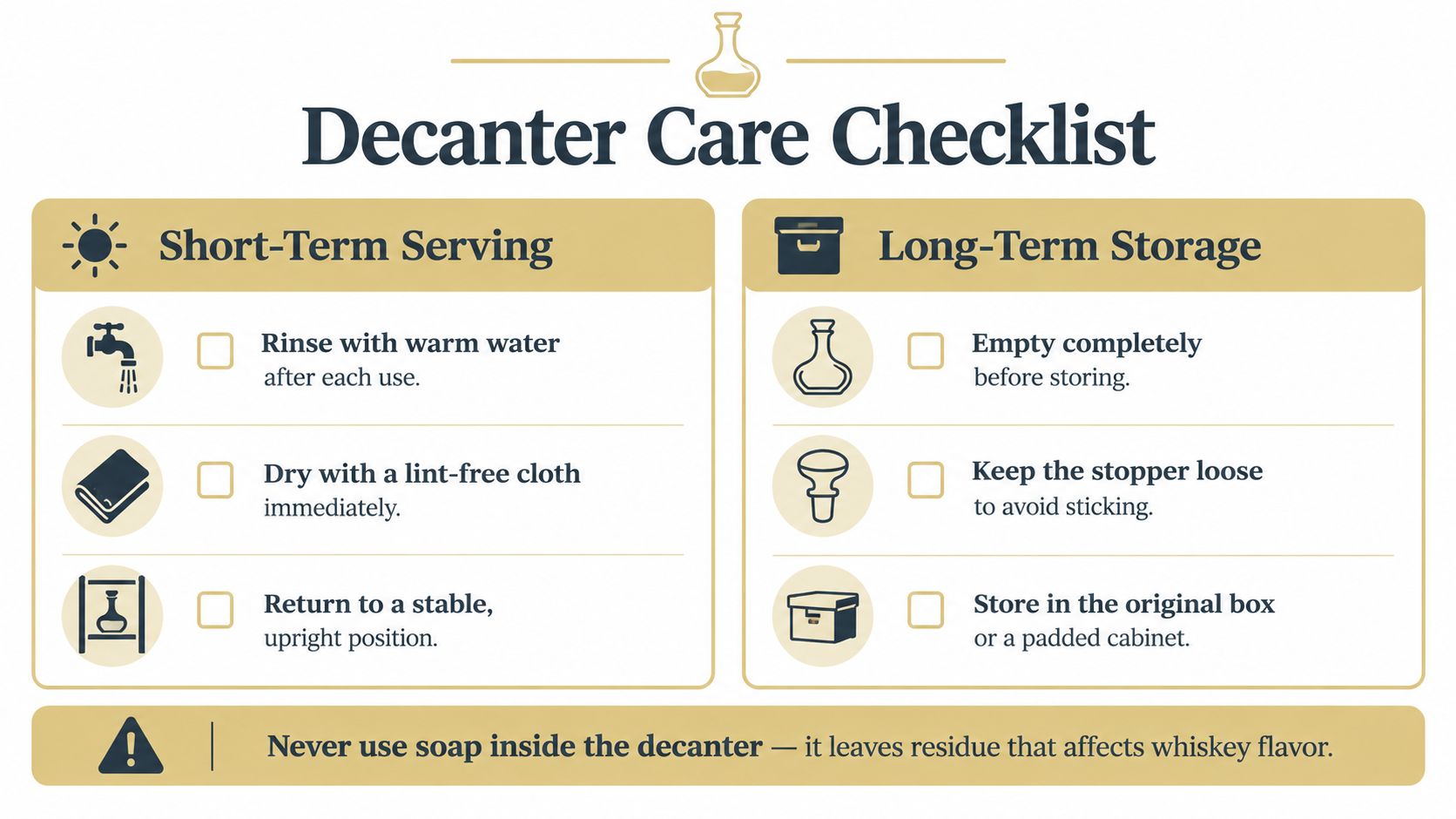
A decanter used for serving needs different handling from one displayed on a shelf. For routine use, rinse it with warm water after pouring, drain it fully, and dry the interior as far as possible with a lint-free cloth. Handle the engraved area gently, and never place a heavy stopper on a hard counter where its edge can chip.
Serving is not the same as storage
Whiskey left in a decanter for weeks or months creates a different use case from brief presentation. The relevant questions are the glass composition, stopper fit, exposure to sunlight, and the manufacturer's food-contact guidance. Don't assume that a product labeled “crystal” has the same composition or storage recommendation as another product using the same word.
Ask the seller:
- What is the glass composition? Get a direct answer about leaded crystal, lead-free crystal, soda-lime glass, or borosilicate.
- Is it intended for food contact? Request documentation when your corporate purchasing process requires it.
- Is extended storage recommended? If the answer isn't clear, keep whiskey in its original bottle and use the decanter for serving.
- What does the maker recommend for cleaning? Follow product-specific care instructions.
A stopper that sticks can be damaged by force. Keep it clean, don't twist it aggressively, and avoid sealing a damp decanter. Inspect the neck, base, and stopper for micro-chips before each use. Retire the piece from active serving if you find a sharp edge, crack, unstable base, or damaged stopper.
For a practical cleaning routine, use this whiskey decanter cleaning guide. Include the care note with a corporate gift so the recipient knows the decanter is intended to be enjoyed, not treated as disposable display glass.
Quick Answers for First-Time Monogram Decanter Buyers
A strong purchase comes down to three decisions: what to engrave, what glass to choose, and how to package it. Initials or a date usually outlast a large logo. Clearly specified glass is better than an unexplained “crystal” label. Protective packaging matters just as much as the decanter's appearance.
Personalization also affects how recipients judge the thought behind a gift. A 2023 survey of more than 500 U.S. consumers found that 39% preferred personalized gifts, while 51% highly appreciated receiving a personalized message. The same research reported that 85% said a holiday gift's thoughtfulness influenced their perception of a brand, and 70.7% said perceived value or uniqueness increased brand loyalty. See the PPAI summary of the gifting survey. Those findings support personalization, but they don't justify covering the decanter in branding.
Frequently asked questions
How long does engraving take?
It depends on the maker, artwork, quantity, proofing process, and delivery method. Ask for a production schedule before ordering, and allow time for proof approval and inspection.
Will a corporate logo make the gift feel promotional?
It can. Keep the logo small, use a personal recipient name or initials where appropriate, and avoid combining the logo with a slogan, campaign title, and event date.
What if the recipient changes jobs?
Use personal initials, a full name, or a relationship date instead of a job title. If a company mark is needed, place it discreetly or on the packaging rather than making it the dominant feature.
Should the decanter arrive with whiskey inside?
Usually, no. A decanter can be gifted empty and paired with a bottle separately where lawful and appropriate. Confirm shipping and alcohol rules before adding spirits to a corporate delivery.
For corporate orders, approve one sample or master proof before authorizing the complete batch. For personal gifts, choose the inscription you'd still be happy to see on a shelf years from now. That's the standard our gifting assortment is built around, from personalized glassware to coordinated whiskey accessories.
ROCKS Whiskey Chilling Stones offers whiskey gift sets and barware for whiskey fans, cocktail enthusiasts, wedding shoppers, corporate buyers, and client appreciation programs. Visit ROCKS Whiskey Chilling Stones to explore decanter-friendly gifts, whiskey glasses, chilling stones, and customizable presentation options.


