


When you get right down to it, the biggest difference between Irish v Scotch whisky comes from how they're made and what that does to the final taste. Irish whiskey is famous for its smooth, light, and often fruity character, which is largely thanks to being triple-distilled and made with unpeated barley. This approachability makes it a superb choice for gifting, especially in corporate settings.
On the other hand, Scotch is a different beast altogether. It's usually double-distilled and can be made with barley that’s been smoked over a peat fire. This gives it a much broader, more complex range of flavors—anything from delicate and floral to intensely smoky and powerful, offering a world of options for a truly personalized gift.
Your Guide to Choosing the Perfect Spirit

Stepping into the world of whiskey can feel a bit overwhelming, especially when you’re trying to pick out a distinguished gift for a client, colleague, or friend. This guide is here to cut through the noise, demystifying the real differences between these two legendary spirits so you can find a bottle that perfectly suits their taste. Whether you're a seasoned pro or a corporate buyer on the hunt for a memorable gift, getting a handle on these details is the key.
The journey from a field of grain to the spirit in your glass is a story steeped in tradition, craft, and place. Every single step—from the type of barley used to how many times it’s run through the still—shapes the final product. Let's break it down so you can make a choice you’re confident in, turning a simple bottle of whiskey into a truly thoughtful gesture.
Key Distinctions at a Glance
To make this simple, let’s get right to the core differences. For busy professionals who need the bottom line without a deep-dive, this table gives you a quick, scannable summary of what sets these two spirits apart, helping you select the perfect gift.
Key Distinctions: Irish Whiskey vs Scotch Whisky
| Attribute | Irish Whiskey | Scotch Whisky |
|---|---|---|
| Spelling | Whiskey (with an 'e') | Whisky (without an 'e') |
| Origin | Must be distilled and aged in Ireland | Must be distilled and aged in Scotland |
| Distillation | Typically triple-distilled for smoothness | Typically double-distilled, can be more robust |
| Key Ingredient | Often includes unmalted barley | Primarily malted barley; peat is often used |
| Flavor Profile | Generally smooth, light, fruity, and approachable | Wide range from light and floral to rich and smoky |
Think of this as your foundation for picking the perfect bottle. For instance, that famous Irish smoothness makes it a fantastic starting point for someone new to whiskey or an elegant, crowd-pleasing corporate gift.
The Growing Appeal of Irish Whiskey
Those differences in flavor and approachability are making waves in the market. Irish whiskey is seeing some serious growth, with global sales recently hitting 16.15 million cases. This boom shows just how popular it's becoming, especially in the USA, which now snaps up over a third of all sales.
Meanwhile, Scotch whisky's export value recently dipped to £5.4 billion, hinting at a shift in what drinkers are looking for and highlighting the momentum behind Irish whiskey. You can get more of the story from the Irish Whiskey Global Trade Report.
No matter which spirit you land on, the right accessories always take the experience up a notch. Pairing a premium bottle with our elegant ROCKS whiskey stones keeps the drink perfectly chilled without watering it down, so the recipient can enjoy the exact flavor the distiller intended. It’s a simple touch that creates a sophisticated, complete gift package for any occasion.
A Tale of Two Spirits, Their Storied Histories
The stories of Irish and Scotch whisky start in the same place but take dramatically different turns. Think of them as two branches of the same family tree. Both trace their roots back to the monks who brought the art of distillation to the British Isles. For centuries, a rustic, unaged spirit called uisce beatha—Gaelic for "the water of life"—was being made on both sides of the North Channel.
For a long time, Ireland was the undisputed king of the whiskey world. In the 19th century, Dublin's distilleries were industrial giants, and their whiskey was famous for its quality. But then came the 20th century, and with it, a perfect storm of disaster: Irish independence led to a crippling trade war with Britain, and American Prohibition wiped out their biggest export market. The industry collapsed, with hundreds of distilleries dwindling to just a small handful.
The Scottish Ascent
As Ireland's whiskey industry faltered, Scotland’s producers were ready to step in. They were smart, adopting new tech like the column still to make production more efficient. They also got serious about exporting their product and establishing strict legal definitions that cemented Scotch whisky’s reputation for quality around the globe.
This history is exactly what makes giving a bottle of Scotch so meaningful. When you hand someone a fine single malt, you're not just giving them a drink; you're offering a piece of a legacy built on savvy, resilience, and global ambition. For anyone new to this world, a good https://www.rockscs.com/blogs/rocks-whiskey-chilling-stones/scotch-for-beginners can be a fantastic starting point. It’s the story that elevates the gift.
Ireland's Resurgence
Irish whiskey was the quiet underdog for decades, but the late 20th century kicked off an incredible comeback. A new wave of distillers emerged, bringing fresh ideas while still honoring the old ways. The result? A full-blown renaissance that has made Irish whiskey one of the fastest-growing premium spirits on the planet.
Today's Irish whiskey boom isn't just a recovery; it's a reinvention. Distillers are exploring new cask finishes, reviving old recipes, and re-establishing Ireland's place as a powerhouse of world-class whiskey, making it an exciting choice for both connoisseurs and newcomers.
This comeback adds a powerful narrative to a gift. Choosing a modern Irish whiskey—maybe presented in a handsome ROCKS decanter set—is like celebrating a triumphant return. It's a gift that says something about perseverance and quality. To get a real feel for the spirit's journey, you can even explore the rich history of Ireland, the very land that shaped it.
In the end, the very different histories of Irish and Scotch whisky are bottled in every drop. One is a story of a powerful global brand built with strategic precision. The other is a tale of a dramatic fall and a spectacular rebirth. Knowing this doesn't just help you choose a bottle; it turns that bottle into a memorable gift of history and legacy, perfect for any client, colleague, or special occasion.
The Art of Production: From Grain to Glass
The unique character of a whiskey isn't an accident. It's the deliberate result of a centuries-old process where every single choice—from the grain to the cask—sculpts the final spirit in your glass. When you pour an Irish whiskey versus a Scotch, those subtle yet critical differences in craftsmanship are why one feels smooth and light while the other hits with complexity and smoke.
Understanding this journey from field to bottle is the key to choosing a truly thoughtful gift.
This visual timeline traces the shared Celtic roots and diverging paths of Irish and Scotch whisky, mapping their journey to modern-day icons.
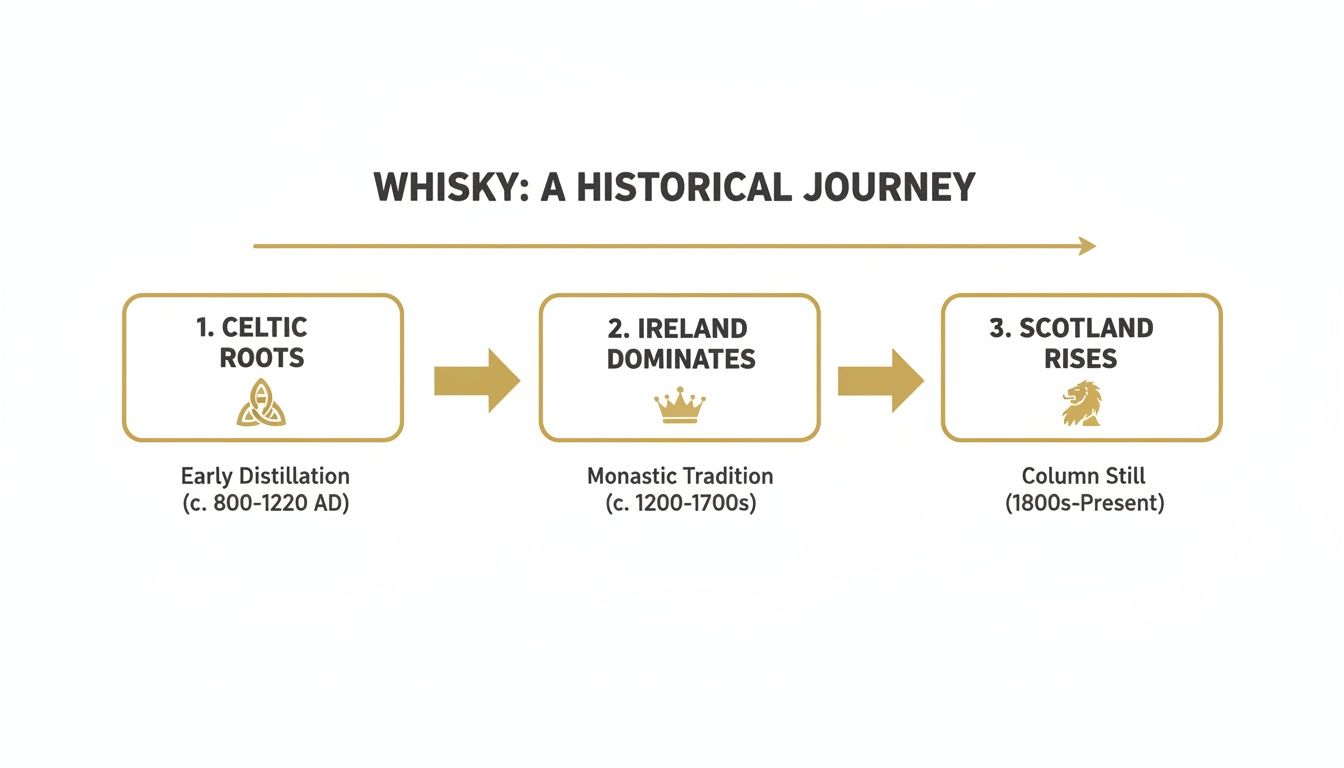
The infographic shows how history shaped each spirit. Ireland was an early pioneer, but Scotland made brilliant strategic moves to capture the global market, creating the landscape we know today.
The Foundation: Grains and Malting
It all starts with the grain. While both spirits use barley as their foundation, their recipes are fundamentally different. Scotch, at least single malt Scotch, is bound by law to use 100% malted barley. Malting is the classic process of tricking barley into germinating by soaking it, then halting it with a blast of hot air.
Irish whiskey, on the other hand, often features the unique "single pot still" style, which uses a mix of both malted and unmalted barley. This tradition actually started as a crafty way to dodge a British tax on malted barley back in the 19th century. Today, it’s a defining feature, giving Irish whiskey its distinctively creamy mouthfeel and a spicy, biscuity character you won't find anywhere else.
The Smoky Question: To Peat or Not to Peat?
The drying process is where a major fork in the road appears. In Scotland, especially on islands like Islay, the kilns used to dry the barley are often fired with peat—a dense, soil-like turf cut from local bogs. As the peat smolders, it infuses the grain with a powerful, smoky, and sometimes medicinal character.
The use of peat is arguably the most recognizable flavor differentiator in the world of whisky. It's the signature of many iconic Scotches, creating a bold, assertive profile that connoisseurs adore but can be a bit of a shock for newcomers.
Irish whiskey almost always takes the other path, using unpeated barley. The drying is done with clean, hot air from a furnace, which preserves the barley's natural, grainy sweetness. This results in a spirit that’s smoother, lighter, and more focused on fruit and grain—a fantastic and approachable choice for corporate gifting.
The Distillation Difference
Once fermentation is done, the liquid "wash" heads to the copper stills. This is where another crucial divergence happens, because the number of distillations directly impacts the spirit's final texture and taste.
Scotch whisky is typically double-distilled in those beautiful copper pot stills. This method retains more of the original congeners—the compounds that create flavor and aroma—which gives the final spirit more body, weight, and a robust character.
Irish whiskey is famous for its triple-distillation process. Running the spirit through the stills a third time purifies it, stripping out heavier oils and compounds to create a noticeably lighter and smoother product. This extra step really lets the delicate fruit and floral notes sing. It’s this signature smoothness that makes Irish whiskey a perfect recommendation for those starting their whiskey journey or for clients who appreciate refined elegance.
For a gift recipient who values this kind of purity, you want to preserve it. Using our granite ROCKS whiskey stones chills the spirit without the dilution from melting ice, allowing those subtle notes created by triple-distillation to shine through. It’s a perfect partner for a premium Irish whiskey gift.
Maturation and the Magic of the Cask
Both Irish and Scotch whiskies have to legally age in wooden casks for at least three years to earn their name. But the type of cask used during maturation is what really builds the final flavor profile.
- Scotch Casks: The Scotch industry leans heavily on ex-bourbon barrels from the U.S., which lend those classic notes of vanilla, caramel, and oak. Sherry casks from Spain are also a popular choice, adding rich layers of dried fruit, spice, and nuts.
- Irish Casks: Irish whiskey also relies mostly on ex-bourbon casks, which helps build its sweet and smooth character. However, Irish distillers are famous for their adventurous spirit, experimenting with a much wider variety of cask finishes—including rum, port, Madeira, and even tequila casks—that introduce exciting new layers of complexity.
This willingness to play with different wood influences makes the world of Irish whiskey incredibly dynamic. For a corporate gift, a special cask-finished Irish whiskey offers a unique tasting experience that really stands out. Paired with a set of personalized whiskey glasses from our collection, it becomes a sophisticated and memorable gesture of appreciation.
Decoding the Flavor Profiles: A Palate Comparison
The real story of any whiskey is told in the glass. All the differences in grain, distillation, and aging lead to this moment—the taste. And while you should always be wary of generalizations, Irish and Scotch whiskies offer two distinct journeys for the palate.
Think of it this way: understanding these profiles is like learning a new language. It lets you pick a bottle that doesn't just look good, but truly speaks to the person you're giving it to.
The Approachable Charm of Irish Whiskey
If there's one word that captures the essence of Irish whiskey, it's smoothness. That signature triple-distillation process does a fantastic job of stripping away harsh, heavy notes, leaving a spirit that’s light, clean, and incredibly easy to drink.
This approachability is its secret weapon. It makes Irish whiskey a brilliant choice for corporate events or as a gift when you're not quite sure of someone's taste. Its gentle nature is almost universally welcoming.
When you take a sip, you're greeted with bright, accessible flavors. The unmalted barley, a hallmark of single pot still styles, lends a wonderfully creamy texture and a distinct spicy, almost biscuity character.
Common notes you'll find in Irish whiskey include:
- Fruit-Forward Notes: Think fresh green apple, crisp pear, and a bit of citrus zest.
- Sweet Undertones: Look for hints of honey, vanilla, and light caramel, often a gift from the ex-bourbon casks they're aged in.
- Delicate Spices: A subtle warmth from cinnamon or nutmeg often lingers in the background.
A bottle of Redbreast 12 Year, for instance, is the quintessential single pot still. It’s all about that creamy mouthfeel and a perfect harmony of fruit and spice. On the other hand, a classic like Jameson offers a lighter, blended profile dominated by vanilla and a touch of floral sweetness. This is the kind of whiskey for someone who appreciates subtlety and elegance, and pairing a bottle with a set of our custom-engraved ROCKS glasses elevates it into a truly personal gift.
The Diverse and Complex World of Scotch Whisky
Scotch isn't just one flavor; it's a whole world of them. You can't just talk about "the taste of Scotch" because its character is so deeply tied to the specific region of Scotland it calls home. This incredible variety means there's a Scotch out there for just about any palate, from the most delicate to the most powerfully robust.
This diversity is exactly what makes exploring Scotch so rewarding. It also means a gift of Scotch can be incredibly personal. Knowing whether your client prefers something smoky and intense or something rich and sweet shows you’ve really paid attention.
Choosing a Scotch is about matching a personality. Is your recipient a traditionalist who would appreciate a classic Speyside, or an adventurer ready for a bold Islay? The answer guides you to the perfect bottle.
You can pretty much map out the flavors of Scotland by region:
- Speyside: This region is famous for elegant, fruity, and often nutty malts like The Glenlivet or Macallan. They are typically unpeated, with rich notes of apple, honey, and vanilla shining through.
- Highlands: As the largest region, the styles are varied, but many Highland drams strike a beautiful balance of gentle smoke, fruit, and a touch of heather.
- Lowlands: Often triple-distilled and unpeated, these whiskies are closer in spirit to their Irish cousins. They're typically light, with grassy, floral, and citrusy notes.
- Islay: This is the home of peat. Whiskies from distilleries like Ardbeg or Laphroaig are an unapologetic celebration of smoke, with powerful notes of brine, iodine, and campfire. They are a bold statement for the confident drinker.
For a gift-giver, this variety is a huge advantage. An elegant Speyside single malt is a sophisticated nod to a key client. A peaty Islay bottle, paired with our granite whiskey stones to chill it without diluting that powerful flavor, makes a very strong impression.
To really get the most out of these complex spirits, it helps to know what you’re looking for. Our guide on how to properly taste whiskey offers fantastic insights for everyone, turning a simple drink into a full sensory experience.
Choosing the Perfect Gift for Every Palate
Alright, so we've journeyed through the history, production, and tasting notes of Irish whiskey and Scotch whisky. Now for the fun part: translating all that knowledge into picking the perfect bottle for someone. Whether it's for a client, a colleague, or a friend, matching the spirit to their personality is what turns a good gift into a great one.
This is about more than just grabbing a bottle off the shelf. It's an opportunity to show you've been paying attention. A thoughtful choice, whether for a seasoned expert or someone just starting their whiskey journey, says a lot.
For the Refined and Elegant Palate
Know someone who appreciates the finer, more subtle things in life? A premium Irish whiskey is a fantastic call. Its hallmark smoothness and delicate, fruity character make it incredibly approachable yet sophisticated. It's a choice that feels both classic and impressive.
A single pot still Irish whiskey, for instance, delivers a wonderfully creamy mouthfeel with complex spice notes that never overwhelm the palate. It’s a bottle that quietly communicates quality and class.
Gifting Idea: Think about pairing a top-shelf single pot still Irish whiskey with one of our elegant crystal decanter sets. It’s a combination that elevates the simple act of pouring a dram into a ritual, creating a beautiful centerpiece for their office or home bar.
There's also a real buzz around Irish whiskey right now, making it a very current and savvy gift. The market is projected to hit USD 9.5 billion by 2033, growing at a faster clip than Scotch. This isn't just hype; it's driven by its rising popularity in high-end cocktails and as a premium sipper, marking it as a modern, dynamic choice.
For the Bold and Adventurous Drinker
On the other hand, if you're buying for someone with a bold personality who enjoys a drink with a real story to tell, a distinctive Scotch whisky is the way to go. The sheer variety in the world of Scotch means you can find a bottle with a character as big as theirs—from rich and fruity Speysides to intensely smoky Islays.
An Islay single malt, with its powerful peat smoke and salty, maritime tang, is a brilliant and gutsy choice for the connoisseur who isn't afraid of a little complexity. It’s a real conversation starter. For more ideas on this front, our guide to picking the right scotch whisky gift has you covered.
Elevating the Gift with Perfect Accessories
A great bottle is the main event, but the right accessories can really complete the experience. We've put together a collection of barware designed to make any dram of whiskey or whisky that much better, turning a nice gift into a full-blown experience. Our assortment is a perfect fit for any corporate or personal gifting needs.
- For Employee Recognition: A set of our personalized whiskey glasses—engraved with a company logo or their initials—is a genuinely meaningful touch to go with a bottle of smooth Irish whiskey.
- For Key Clients: To make a lasting impression, consider a complete barware set. A decanter, matching glasses, and our granite ROCKS whiskey stones is a top-tier gift that communicates real appreciation.
- For Holiday Gifting: A festive, sherry cask-finished Scotch paired with whiskey stones makes for a wonderfully warm and memorable holiday present for partners and staff.
And if you know they have a particular love for the Emerald Isle, you could even branch out into other thoughtful, Irish-themed products. By taking a moment to consider their personality and pairing the perfect spirit with quality accessories from our collection, you'll give a gift that truly stands out.
Your Top Questions, Answered
When you dive into the world of Irish vs Scotch whisky, a few questions always seem to pop up. Let's clear the air so you can pick your next bottle—whether for yourself or as a standout corporate gift—with confidence.
So, Which Is Actually Better: Irish or Scotch?
Honestly, neither is "better" than the other. It really just comes down to personal preference, which is key when selecting a gift.
Irish whiskey is famous for its smooth, easy-drinking character, often with lovely fruity notes. This makes it a brilliant starting point for anyone new to whiskey or for those who simply prefer a gentler spirit. It's a safe but sophisticated choice for corporate gifts or for someone whose taste you don't know well.
Scotch, on the other hand, is a wilder ride. It runs the gamut from light and floral Lowland malts all the way to the powerful, smoky beasts from Islay. The "best" one is whichever best matches the recipient's palate.
How Should I Be Serving These Whiskies?
Both are fantastic neat, which lets you appreciate them just as the distiller made them. A small splash of water can also be a great move, as it often opens up the aromas and flavors in surprising ways.
If you prefer your drink chilled, a set of high-quality whiskey stones is your best bet. They cool the spirit down without diluting it.
Chilling stones are key to keeping that carefully crafted flavor profile intact. It means you get to enjoy the subtle fruit in a smooth Irish whiskey or the complex, smoky layers of a single malt Scotch without water getting in the way. Our ROCKS whiskey stones make an excellent and practical addition to any whiskey gift.
What's a Good Go-To Whiskey for a Gift?
If you're buying for someone just starting their whiskey journey, you can't go wrong with a classic Irish whiskey. Its trademark smoothness and lack of aggressive smoke make it incredibly approachable and easy to enjoy right off the bat.
A bottle from a respected Irish distillery, especially when paired with a sharp set of our premium whiskey glasses, makes for a truly thoughtful gift. It’s the perfect all-in-one package to welcome someone into the wider world of whiskey and an excellent gifting option for clients and colleagues alike.
At ROCKS, we know the right accessories can turn a great drink into an unforgettable experience. Take a look through our collection of whiskey stones, decanters, and custom glassware to find the perfect finishing touch for your next gift. Our assortment is an ideal source for corporate buyers and gift seekers. Stop by https://www.rockscs.com to see how we can help elevate your gifting.


