

Drinkware is the second-largest promotional product category in the U.S., behind only apparel. That ranking matters for one practical reason: every supplier you shortlist already has the decoration lines, gift packaging, and production capacity to build your order.
Scale helps you, and it can also hide weak production. Putting a logo on a blank glass is easy. A glass that still looks premium after a year of dishwashers and daily use takes more: the right personalization method, an order size matched to the program, and evidence behind the spec sheet. Ask for thermal-shock testing, decoration durability results, and food-contact declarations before anyone approves art. Custom drinkware wholesale pays off when those answers arrive before production starts.
Why Custom Drinkware Wholesale Works for Corporate Gifting
Because the category is already this established, you are choosing between suppliers, not inventing a production line. Decoration capacity, gift cartons, and compliance files already exist for whiskey glasses, cocktail glasses, decanters, tumblers, and the rest of the barware corporate buyers put in front of clients and employees. Business gifting and brand awareness are baked into how these programs get purchased. Your job is to pick the supplier whose proof matches the second year of the gift, not the unboxing photo.
Two readers should use the same buying standard.
Gift seekers building one present for a client, a wedding, or a milestone need a piece that feels chosen. A name and a date on crystal do that work. Corporate buyers and promotional distributors sourcing 50 to 1,000 units for events, rewards, and brand campaigns need the same finish to survive freight, a dishwasher, and a crowded bar cart. Our assortment of engraved glasses, decanters, and gift sets is built for both of those moments, which is why teams looking for a personalized corporate gift keep coming back to drinkware instead of another pen.
The route is practical. Personalization method first, because that decides how the gift ages. Order size next, matched to the program rather than to a supplier's favorite tier. Then the ordering sequence, the specifications that protect the gift's second year, and the programs where drinkware earns its budget.
Practical rule: If two quotes can't be lined up on the same glass, the same decoration, and the same documents, you don't have two quotes. You have two different products.
Before you email anyone, write a one-page specification you can send unchanged. Ask for glass type, capacity, decoration method and placement, packaging, compliance declarations, and the in-hand date. Suppliers who already finish bottles and glass the way drink bottles from Simply Merchandise are finished will answer that page. Suppliers who can't are telling you the gift will be improvised after you pay.
Comparing Personalization Methods Side by Side
The split that decides everything else is simple. Engraving removes or frosts the surface. Printing adds a layer on top. One becomes part of the glass. The other sits on it, and eventually the hands, the ice, and the dishwasher vote on whether it stays.
Engraving reads as a keepsake
Laser engraving is the method I send most client gifts toward. It marks glass, crystal, wood trays, and slate with a frosted or darkened line that doesn't peel. It's permanent and dishwasher-safe, it takes digital artwork with no screen, and it's workable from around 24 units. On clear crystal the contrast can look faint unless you place the mark where light hits it, often low on the bowl or on a thicker base.
Sandblasting cuts a deeper matte frost. It looks handcrafted on thick glass, decanters, and heavy tumblers, which is why it belongs on a gift someone will pick up slowly. It needs a mask per design, setup is higher, and it starts to make sense from about 50 units. A unique name on every piece means a unique mask, and that cost climbs fast. Use it for a shared crest or a short phrase, not a 200-row guest list, unless the budget is premium.
A recipient's name engraved on a whiskey glass reads as a keepsake. A one-color logo printed on a tumbler reads as advertising. Both can be right. They are not interchangeable, and buyers get into trouble when they price one and expect the other.
Printing is for reach, not for heirlooms
Ceramic-fired screen printing puts a durable, dishwasher-safe ink on glass and ceramic, including full-color logos. Each color needs its own screen, so it turns economical from 100 to 250 units and gets punished every time someone adds a second Pantone. Pad printing is the inexpensive mark for small curved areas. Setup is low and runs often start near 50 units, but the ink layer is thin and abrasive washing fades it. UV digital print skips screens, which makes it the short-run choice for photographic, multicolor logos. The color is bright because it sits on the surface, and heavy use can chip the edges. Kiln-fired decals fuse fine crests into the glass. The finish is premium, production is slower, and you should plan from around 100 units.
| Method | Best on | Look and durability | Setup and quantity considerations | Watch out for |
|---|---|---|---|---|
| Laser engraving | Glass, crystal, wood trays, slate | Frosted or darkened mark, permanent, dishwasher-safe | No screen setup, digital artwork only, workable from around 24 units | Low contrast on clear glass unless placement is planned |
| Sandblasting (frosted etch) | Thick glass, decanters, tumblers | Deep matte frost, premium handcrafted look | Needs a mask per design, higher setup, best from 50 units | Mask cost per unique name pushes price up |
| Screen printing (ceramic fired) | Glass and ceramic, full-color logos | Fired ink, durable, dishwasher-safe | Screen setup per color, economical from 100 to 250 units | Every added color adds a setup charge |
| Pad printing | Small curved areas, tumblers | Thin ink layer, wears faster than fired ink | Low setup, economical from around 50 units | Fades with abrasive washing over time |
| UV digital print | Full-color and photographic logos, short runs | Bright full color sitting on the surface | No screen setup, suited to short runs | Can chip at the edges with heavy use |
| Kiln-fired decal | Fine detail and multicolor crests | Glass-fused, durable, premium finish | Decal artwork plus firing, from around 100 units | Longer production time |
Placement and the name file
Keep decoration on the outside body, not the rim and not the lip. That choice keeps food-contact questions simpler and keeps lips off the mark. The corporate combination I trust is a small logo on the base and the recipient's name on the front. The logo is there when someone turns the glass over. The name is what they see when they use it.
Per-name work needs a spreadsheet, one row per recipient, with spelling checked by the person who owns the relationship. Ask for a proof of each variation, not one sample name stretched across the order. Variable data is where "John" becomes "Jhon" on a gift you can't easily swap.
The Advertising Specialty Institute's 2026 ad impressions study found that 68% of consumers in the United States, Canada, Mexico, and much of Europe would view an advertiser more favorably after receiving a personalized promotional item. The same research found that 80% would keep promotional drinkware for more than one year, with an estimated 1,300 lifetime brand impressions. That is the whole argument for cutting a name into glass instead of printing a slogan that washes off.
Matching Order Size and Format to Each Gifting Program
Start with the people receiving the gift. Count confirmed guests or employees, allow spare pieces for transit damage and late additions, then compare the available price tiers. Keep replacement stock separate from gifts already assigned to recipients. A spare glass helps only if its decoration works for the person who needs it.
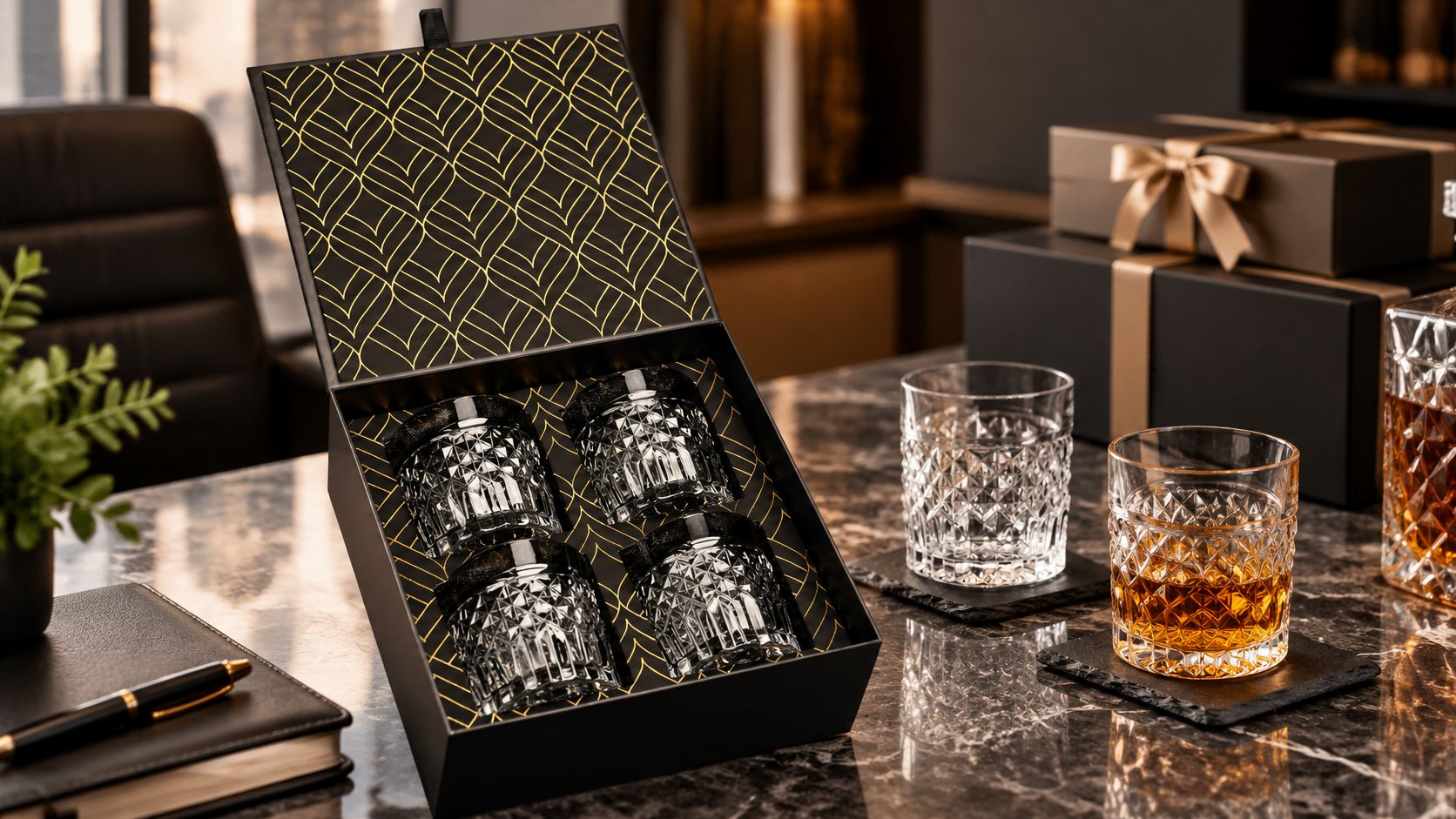
For executive gifting, The Privilege Collection - Prestige Glasses offer crystal glassware in a gift-ready presentation. The Whiskey Decanter Gift Set pairs a decanter and glasses with granite whiskey chilling stones. ROCKS also offers the Gentleman's Set and Cocktail Kit, with company-logo customization available on wood trays and whiskey glasses for corporate and bulk custom orders. Every Privilege Collection set arrives gift-ready, reducing the packing work your team needs to arrange.
Use the program to choose the format before asking for a quantity discount.
| Program | Best drinkware formats | Personalization approach |
|---|---|---|
| Executive and key-client gifts | Crystal whiskey glasses, decanter gift sets | Request recipient names plus company mark |
| Employee holiday gifts | Glass sets, cocktail kits, boxed gift sets | Company logo, offer a choice of formats |
| Conference and event gifts | Tumblers, barware accessories | Simple logo, request bulk packing |
| Prospect and sales incentives | Decanter sets, premium crystal glassware | Request name and occasion date |
| Weddings and milestone events | Custom etched whiskey glasses | Names and dates, matched to the design |
| Retail and distributor wholesale | Core glassware and gift sets | Request retail-ready packaging, no personalization |
| New-hire and onboarding kits | Glass sets, cocktail kits | Company logo, request a welcome message |
Match the program, then the count
Executive and key-client gifts deserve a focused recipient list. Ask for named crystal glasses or a decanter set, with a restrained company mark. Confirm which pieces can be decorated before committing to the presentation. A well-engraved glass feels chosen for its recipient and earns its place on a client's bar cart.
Employee holiday and onboarding gifts benefit from choice: 82% would value a gift more if personalized, while 52% preferred a choice among several options, according to a 2025 survey of 1,051 U.S. adults working at companies with more than 10 employees. Offer a glass set and a cocktail kit, with consistent branding across both. Keep the same options available for new hires so onboarding does not become a separate sourcing exercise.
Conferences need simple decoration and practical distribution. Request a single-color logo and packaging suited to handing gifts out at the venue. Avoid individual names when the attendance list is still changing.
Prospect gifts call for a decanter set or premium crystal glassware matched to the relationship and occasion. Weddings and milestones suit custom etched glasses, with the glass chosen around the customer's idea and design. Retail and distributor wholesale needs sellable stock: confirm retail packaging and leave recipient-specific decoration off the order.
Bigger is not automatically cheaper
ROCKS corporate gifting and bulk custom orders have no minimum order quantity, with quotes available on request. That gives a small client program room to buy for its actual recipient list. Ask suppliers to separate decoration setup from per-piece charges, especially when names change across the order. Do not assume personalized work follows the same pricing as one repeated logo.
Compare the total delivered cost.
A large event shipment with individual cartons and venue delivery can carry different costs from a smaller client order delivered to one office. Have the quote identify inner packaging, gift presentation and freight. Ask how damaged pieces and personalized replacements are handled before choosing the cheaper unit price.
Bulk to one address makes inspection and distribution easier to coordinate. Ship-to-home requires clean addresses, time for packing and someone responsible for delivery exceptions.
Order size also needs a quality threshold. Ask for thermal-shock testing evidence, decoration-durability information and food-contact declarations relevant to the proposed glass and finish. A gift-ready box cannot compensate for decoration that loses its finish with use.
A 2017 industry summary published by LogoSoftwear reported 90% brand recall among promotional-product recipients, 83% greater likelihood of doing business with the brand afterward, and an average return of $6.41 per $1 spent. Treat those figures as context for promotional products, not a forecast for your order. Buy for continued use: sound glassware, durable decoration and packaging that gets it there intact.
The Wholesale Ordering Process Step by Step
An order goes wrong in the gaps between emails. Close each gap with a document you can point at later.
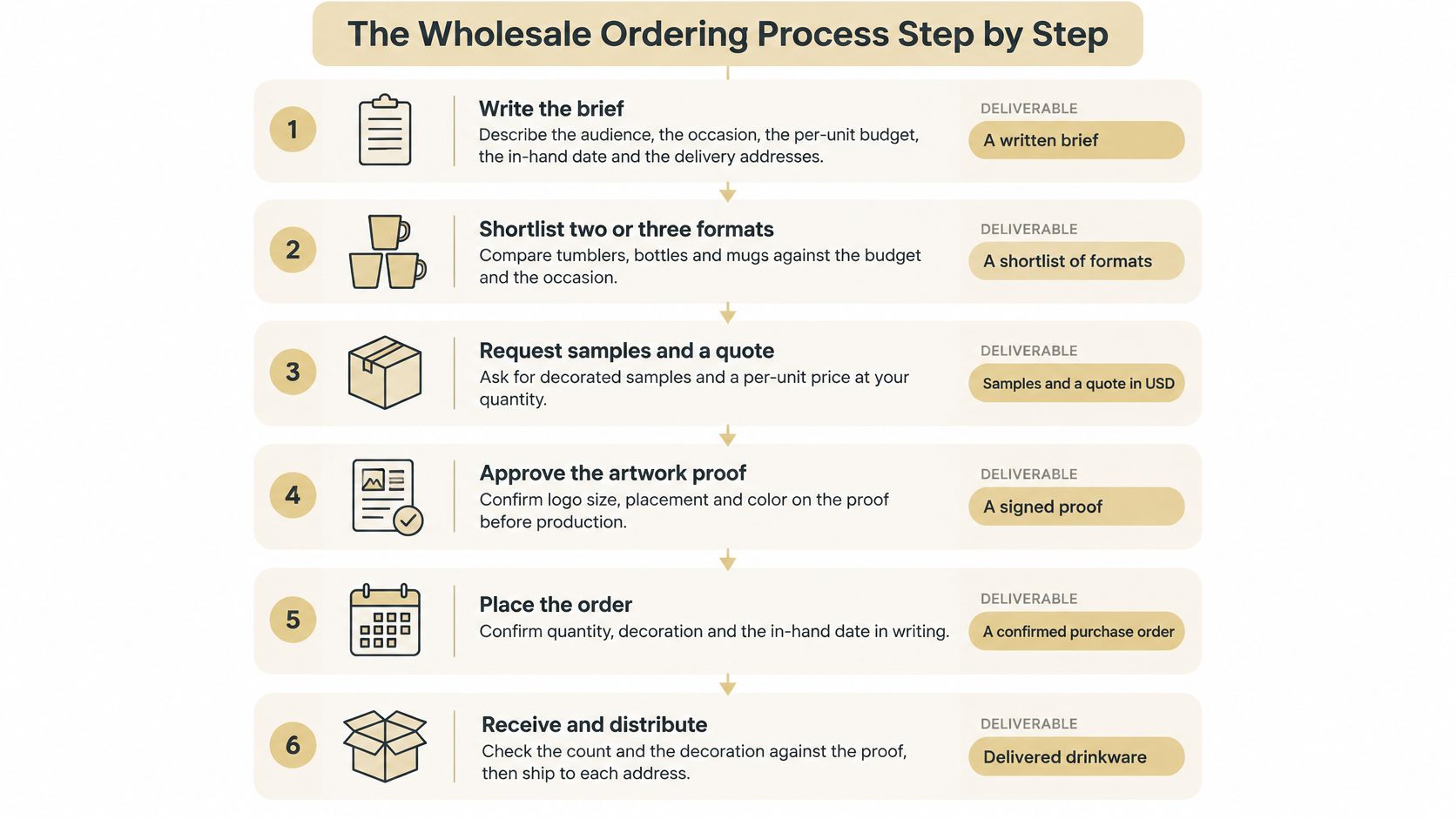
The picture compresses the path. The working sequence is longer on purpose, because samples, a locked specification, and an incoming inspection are where premium gifts are saved. If you also buy undecorated goods to hold on the shelf, the same paperwork habits apply to wholesale barware.
The nine documents
- Write the brief. Name the audience, the occasion, the per-unit budget, the in-hand date, and every delivery address. Deliverable: a one-page brief. Without the date, every later promise is a guess.
- Shortlist two or three formats in the packaging you will hand over. A naked tumbler is not the same product as that tumbler in a rigid box with a care card. Deliverable: a shortlist with pack shots, not just glass shots.
- Request tiered quotes at 25, 50, 100, and 250 units. Decoration, packaging, and freight must be separate lines. A single blended number makes a cheap glass with expensive freight look like a deal. Deliverable: comparable quotes.
- Send artwork as vector files, plus the name list in a spreadsheet. Flag one-color versus full color in the same email. A flattened JPEG will come back as a fuzzy proof and a delayed ship date. Deliverable: an art package.
- Approve a digital proof that shows exact placement, size, and orientation on that specific glass, not on a generic cylinder. Deliverable: a signed proof. If the logo wraps the curve, ask for a view from the angle a guest sees.
- Approve a physical pre-production sample with the actual decoration on the actual product. Digital white never matches fired ink or a laser on crystal. Deliverable: a signed sample you keep, not a sample you throw in a drawer and lose.
- Lock a specification sheet covering glass type, capacity, decoration method, packaging, compliance declarations, and the care card. FDA foodware guidance is clear that the Food Additives provision of the FD&C Act does not permit harmful migration from a food-contact surface, and it addresses toxic elements such as lead and cadmium in ceramicware and related hollowware, so the decoration has to be assessed on the finished piece, not waved through because the blank was fine. Deliverable: a spec both sides initial.
- Confirm production and payment terms in writing. Quantity, decoration, in-hand date, and what happens if the sample and the run don't match. Deliverable: a purchase order that repeats the spec, not a PO that says "as discussed."
- Inspect a sample of the finished run for legibility, chips, and carton crush before anything leaves. Open more boxes than feels polite. Deliverable: an inspection note and a release, or a hold.
Pay attention to the difference between a laser, which changes the surface, and a printed or metallic mark, which adds material. Added material carries the thicker compliance file, and it belongs in the spec sheet from step seven.
Time you should refuse to compress
Proofing takes 2 to 5 business days when the art is clean. Pre-production samples take 5 to 10. Production runs 2 to 4 weeks. Ocean freight for larger wholesale volumes takes 4 to 6 weeks before the goods are even in the building you will kit from. Domestic runs can move faster. They still can't absorb a week of "can we see another font" unless you built that week in. Work backward from the in-hand date, never forward from the quote.
Approve the sample that will embarrass you if the bulk matches it, because the bulk will match it.
Specifications to Check Before Production Starts
A glass in regular use meets ice, chilled stones, hot rinsing, and a dishwasher. That is the life you are buying. A showroom photo does not survive it. Cheap sourcing shows up as a cracked base, a logo that silvers, or a name you can no longer read.
Thermal shock is the failure you can't gift-wrap away
ASTM C149 is the comparative method that matters here. It moves commercial glass specimens between controlled hot- and cold-water baths on a timed apparatus, built for products that see sudden temperature changes in service, washing, or a move from warm to cold. Ask for documented C149-style testing or an equivalent internal protocol. Specify the temperature differential and the pass/fail rule. Insist the test piece is a decorated sample, not a blank. Engraving and printing change how the surface behaves, and a blank that passes does not speak for the gift you will ship.
The ASTM C149 standard also sits apart from decoration durability. Alkali and acid resistance, plus a stated dishwasher-cycle count, are separate requirements for a printed, coated, or metallic logo. Breakage resistance does not prove the crest will still be there after a year of citrus and detergent.
Documents that make quotes comparable
State these requirements in the request for quotation. Suppliers then bid the same gift. A supplier who cannot produce the documents is answering a different question, usually "how cheap can the blank be?"
Use the quality control standard for barware as a reference point for the level of detail to expect. Any supplier decorating glass in your name should be able to answer line by line.
| Check | What it proves | What to request |
|---|---|---|
| Thermal shock | The glass survives ice, chilled stones and hot rinsing | Documented ASTM C149-style test or equivalent, with temperature differential and pass/fail criteria |
| Decoration durability | The logo survives dishwasher cycles and acidic drinks | Alkali and acid resistance results plus a stated dishwasher-cycle count |
| Food-contact safety | Decoration and glaze do not migrate into the drink | Specification-specific declarations, with the document list from step 7 |
| Packaging protection | The gift arrives intact after shipping | Drop and vibration test results plus the inner-pack specification |
| Engraving legibility | Names and logos read cleanly at final size | A decorated production sample checked against the approved proof |
| Capacity and weight | The set matches the product description | Tolerance range for volume and weight per unit |
| Care instructions | The recipient knows how to keep it looking new | A printed care card inside the gift box |
Packaging is part of the product. A crystal set in a thin mailer fails even when the glass specification is excellent. For the carton itself, see Mylarmen's carton production advice on how a tuck box is made, then ask your drinkware supplier which board, insert, and fit they will use. Drop and vibration results belong in the file next to the thermal-shock report.
Applied color, metallic accents, and glaze need the food-contact declarations already listed in step 7. Keep this section focused on the tests that decide whether the finish survives use. Plain engraving does not add ink. It still needs the legibility sample, because a beautiful font at 4 millimeters becomes a smudge. Put the tolerance for volume and weight on the spec so a "12 ounce" glass cannot arrive noticeably smaller than the one you approved. A well-engraved glass earns its place on a client's bar cart for years. Vague specifications waste that opportunity.
Request Quotes and Lock Your Specification
Send suppliers the same brief, then judge the answer against the same lines. List the product and format, quantity tiers, decoration method and placement, packaging, the compliance documents from the checklist, the in-hand date, and the delivery addresses. Ask two or three suppliers to quote that exact brief.
Compare total delivered cost, not the unit price of the glass. A cheap glass with a vague carton and no thermal-shock note becomes expensive once broken or faded pieces need replacing. The specification evidence is what protects the gift a year after delivery, so keep thermal-shock testing, decoration durability, and food-contact declarations beside the price.
What to send, and when
Corporate gifting and bulk custom orders can carry the company logo on the wood tray and the whiskey glasses, and quotes are available on request. Those orders have no minimum order quantity, which suits a 12-name account list as well as a conference drop. Teams can order through our corporate gifting page. Use the same spec sheet you would send to any supplier, and include the exact name, date, address, and placement instructions.
Put the calendar on the quote request.
- Ocean freight: place the order about 12 weeks before the event. That leaves room for proofing, the physical sample, and the production and freight steps already outlined in the ordering process.
- Domestic delivery: 8 to 10 weeks is the window, and only if artwork is already clean.
- Reorder control: use the approved sample as the reference for the next run. Compare glass weight, engraving size and placement, and carton fit against that kept piece, so a reorder does not drift because a salesperson remembers it differently.
Pick the format. Fix the date. Request the quote against the written spec, and reject any bid that skipped a line.
ROCKS Whiskey Chilling Stones offers whiskey chilling stones, crystal glasses, decanters, and gift sets for corporate buyers and gift seekers. If you want custom drinkware wholesale that still looks right on a bar cart a year later, start with a specification and a quote rather than a blank logo slap. Visit ROCKS Whiskey Chilling Stones and tell us the date, the count, and the name you want on the glass.


