

A 2025 market report estimated the global personalized-gifts market at $31.37 billion and projected it to reach $57.65 billion by 2034, at a 7.0% compound annual growth rate (Market Reports World). That scale changes how buyers should evaluate an engraved whiskey glass. A personalized whiskey snifter isn't merely a decorative novelty. It's a functional tasting vessel, a keepsake, and a practical corporate gift that can carry a recipient's name, a milestone date, or a company identity.
For gift seekers, the appeal is immediate. A snifter suits birthdays, weddings, anniversaries, housewarmings, and retirement gifts because it combines an everyday ritual with a permanent personal detail. For corporate buyers, it offers a more considered alternative to generic promotional merchandise, particularly for client appreciation, employee recognition, executive events, and premium prospect gifting.
The Rise of the Personalized Whiskey Snifter
Approximately 68% of online shoppers had shown interest in customized goods during the previous 12 months, demand for personalized products had increased nearly 47% since 2020, and more than 71% of U.S. consumers purchased at least one personalized gift annually, according to a 2025 report from Market Reports World. Buyers want gifts that acknowledge the recipient directly, and those figures show that expectation has become mainstream.
A personalized whiskey snifter meets that demand through the object itself. An engraved name makes a birthday gift deliberate. A date turns wedding or anniversary barware into a memento. A company logo or short message gives a client gift a visible identity while preserving the feel of premium drinkware rather than disposable advertising.
The whiskey category gives this format broad commercial reach. IWSR Drinks Market Analysis estimated the global whiskey industry at approximately $74.3 billion in 2024, with volume sales of about 1.92 billion nine-liter cases, as reported in an IWSR market briefing. Scotch consumption in India increased 6% by volume and 7% by value, with IWSR forecasting India to become the world's largest Scotch market by 2027. A well-designed personalized snifter can serve local gift shoppers, international whisky enthusiasts, and corporate programs with recipients across different markets.
Buyer's position: Choose the personalized whiskey snifter when the gift needs to feel premium, usable, and personally assigned.
The vessel's geometry strengthens that positioning. A rounded bowl and narrower opening support aroma concentration, making the snifter appropriate for recipients who treat whiskey as a tasting experience rather than only a mixed drink. Buyers seeking to deliver personalized shopping experiences should apply the same standard to barware procurement: personalization works best when it deepens the recipient's relationship with a functional object.
For a related selection guide, review this personalized whiskey glass. ROCKS Whiskey Chilling Stones' product assortment suits gift seekers and corporate buyers who want premium barware connected to names, dates, logos, and occasions. The right snifter therefore combines sensory purpose with scalable customization, giving a personal gift enough utility to remain in regular use.
Glass Shapes and Aroma Geometry
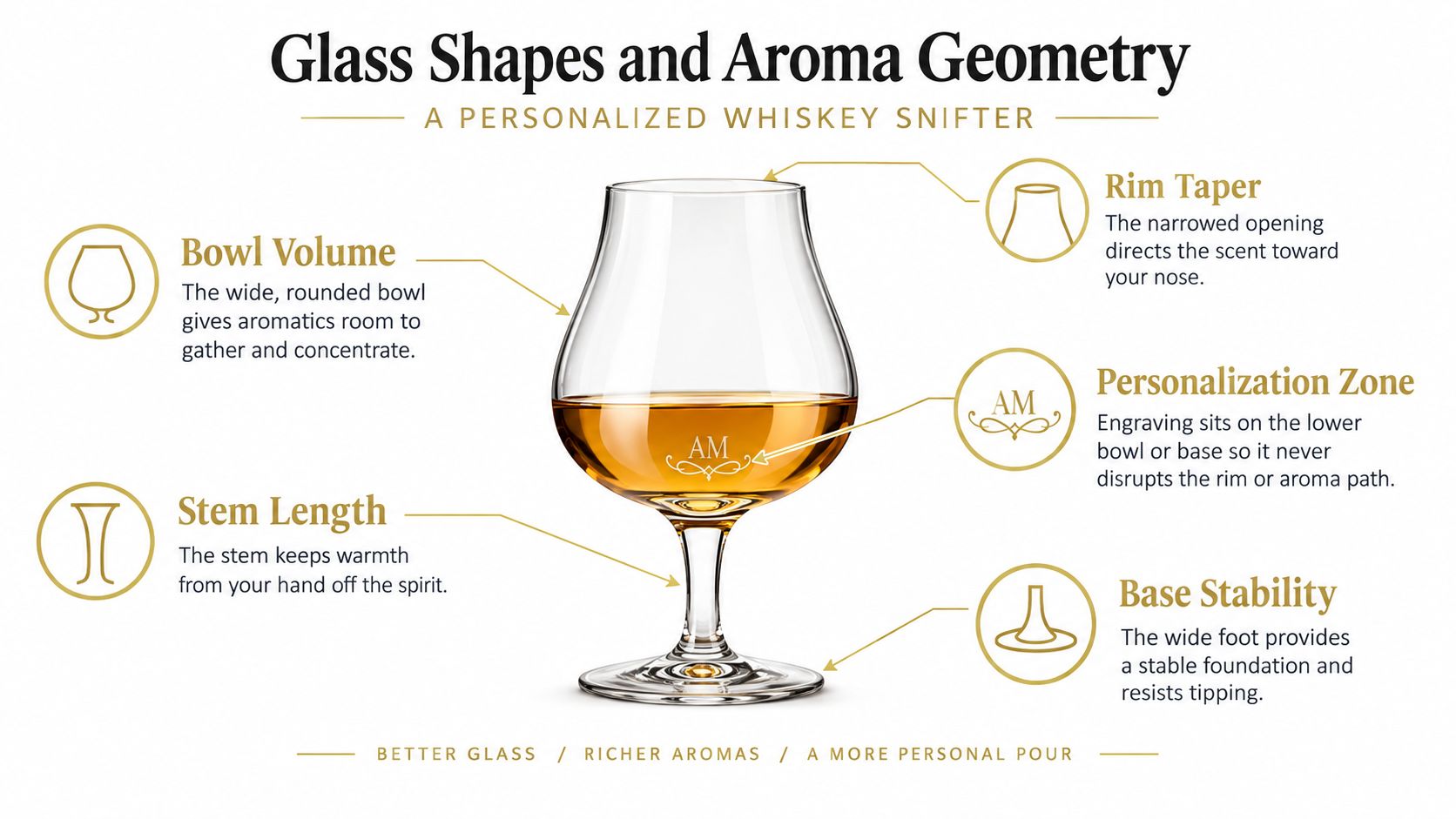
A personalized whiskey snifter earns its place as premium barware through geometry first, personalization second. The engraving should never interfere with the rim, usable headspace, or swirling action that releases aromas.
Start with the bowl and rim
The rounded bowl gives the spirit room for its aromatics and supports controlled swirling. The inward-tapered upper wall narrows the opening, directing scent toward the nose instead of dispersing it across a broad mouth. A stable foot keeps the vessel steady while the drinker checks color, noses the whiskey, and takes a measured sip.
Independent sensory research comparing three glass vessels found that snifter shape increased perception of wood aromatics in Scotch, while aroma profiles varied by spirit category (sensory research study). For corporate gifting, that finding supports a clear buying rule: select the snifter for recipients who value neat tasting, and match the spirit category to the intended experience. Geometry that emphasizes oak and wood-derived notes in Scotch may produce a different emphasis with bourbon, Cognac, or smoky whiskey.
Keep personalization on the lower exterior bowl and the base. These zones remain visible while leaving the drinking surface, opening, and swirling area clear. Exclude the rim and interior. Contact with the mouth creates avoidable wear and weakens the refined experience the gift is meant to deliver.
Match the vessel to the use
Use the shape as a procurement criterion, not only as a design preference. A snifter suits neat tasting and aroma-focused service. A traditional rocks glass is more practical for mixed drinks or large ice. For a premium recipient gift, the snifter creates a stronger link between the glass and the tasting ritual.
Use this large snifter glass guide to compare proportions and serving preferences. For a polished personal gift, The Privilege Collection - Soleil Glass Edition offers crystal clarity suited to neat Scotch or bourbon service.
For quality control, test the finished glass with a consistent pour of 25–30 mL at the intended serving temperature. Compare aroma identification immediately after pouring and again after 5 minutes, covering the glass between nosing intervals when possible, following the same sensory study cited above. This check helps confirm that personalization has not altered the practical drinking experience across a production batch.
Engraving Methods and Surface Placement
Laser engraving is the strongest default for a personalized whiskey snifter when the buyer needs repeatability, readability, and a permanent-looking mark. Industrial glass-engraving guidance describes laser engraving as a thermal process that creates a frosted appearance through controlled micro-fracturing, making it suitable for digitally repeatable logos, names, small text, serial layouts, and variable corporate artwork (industrial glass-engraving guidance).
Other decoration methods can look attractive at first, but they require closer scrutiny. Surface prints and applied decals may offer color flexibility, yet they place the identity mark on the exterior surface rather than into the glass. Paint and similar coatings can also introduce a different maintenance profile. For a client gift or employee award expected to remain in a home bar, durable surface treatment is the more defensible choice.
Compare the practical trade-offs
| Method | Strength | Main buyer concern |
|---|---|---|
| Laser engraving | Frosted, digitally repeatable marking suited to names and logos | Curved glass requires careful artwork control |
| Surface print | Can support colorful visual treatments | Surface wear and cleaning resistance need validation |
| Applied decal | Useful for temporary or highly variable decoration | It may feel less permanent and less premium |
| Painted mark | Can create visible contrast | Coating durability and contact exposure require testing |
The most important decision isn't the machine. It's the placement and proofing process. Request a digital proof that shows the minimum character height, line thickness, contrast against the glass, and exact logo safe area. On a curved bowl, dense fills, abrupt corners, and very fine strokes can appear uneven. A clean name, initials, date, or simplified logo usually produces a more elegant result than an overcrowded design.
Practical rule: Keep the personalization on the lower exterior bowl or base, and keep the rim completely free of decoration.
Corporate buyers should submit vector artwork and use a defined template for names, dates, and logos. That approach reduces variation across a large order and makes it easier to approve recipient data before production. Gift seekers should use the same discipline on a single order. A short message with generous spacing will generally read better than a long inscription forced into a small curved area.
The glass engraving guide can help buyers understand the difference between a meaningful mark and an overcrowded one. Our assortment is a good gifting option because engraved glassware can support both one-off celebrations and branded corporate programs without sacrificing drinking ergonomics.
Strategic Use Cases for Gifting and Branding
A personalized whiskey snifter earns its place in a gifting program because it solves two problems at once. It gives the recipient a functional barware item, and it gives the buyer a durable way to show that the gift was selected for a specific person or relationship.
A 2025 Custom Ink survey of more than 1,000 employees and managers found that 82% of employees considered personalized gifts more meaningful, while 77% said receiving a gift they liked would make them more likely to stay with their company (Custom Ink survey summary). Those results give corporate buyers a clear reason to reject anonymous drinkware. A name, achievement date, or carefully sized company mark makes the item feel assigned rather than issued.
Match the mark to the relationship
For personal gifting, the format should reflect the occasion:
- Birthday gifts: Use a full name or initials for a lasting, personal finish.
- Wedding and anniversary gifts: Add a date or shared initials rather than a large brand-style mark.
- Housewarming gifts: Choose a name or short phrase that suits the recipient's home bar.
- Retirement gifts: Combine the recipient's name with a concise recognition message.
- Gifts for men and whiskey lovers: Pair the snifter with complementary accessories when the occasion calls for a fuller presentation.
Corporate buyers should make a different calculation. A client thank-you may benefit from a restrained logo and recipient name. An employee reward can use the person's name, a milestone date, or a short recognition message. An executive dinner may call for coordinated sets that carry a subtle company identity rather than a dominant logo.
Build tiers without losing consistency
A standardized assortment can still feel individualized. One tier might include an engraved snifter. A more substantial option can add whiskey chilling stones, while a senior-client or milestone package can include a wood tray or coordinated barware. This structure gives procurement teams control over the underlying product while allowing each recipient's personalization to carry the emotional value.
A useful corporate-gifting resource from FLYP's merch strategy guide can help buyers think about the relationship between branded merchandise and recipient experience. The essential principle is simple: the logo should identify the sender, but the recipient's name or occasion should make the object feel worth keeping.
Personalization also has value beyond whiskey specialists. The snifter can serve cocktails, spirits, celebrations, and home entertaining, while the engraving makes it a keepsake. That broader usability makes our product assortment a good fit for mixed employee populations, client lists, and event audiences whose exact drinking preferences aren't known.
Ordering Logistics and Corporate Procurement
The engraving file is only one part of a successful order. Corporate buyers need a process that protects recipient data, controls variation, and keeps every glass legible when names, languages, and logo formats differ.
Start by deciding what the personalization is supposed to communicate. Initials are compact and timeless. A full name feels direct but needs a character limit. A date works well for weddings, anniversaries, awards, and founding milestones. A company logo supports brand recognition, while a short message can make employee recognition feel more specific.
Use a controlled ordering workflow
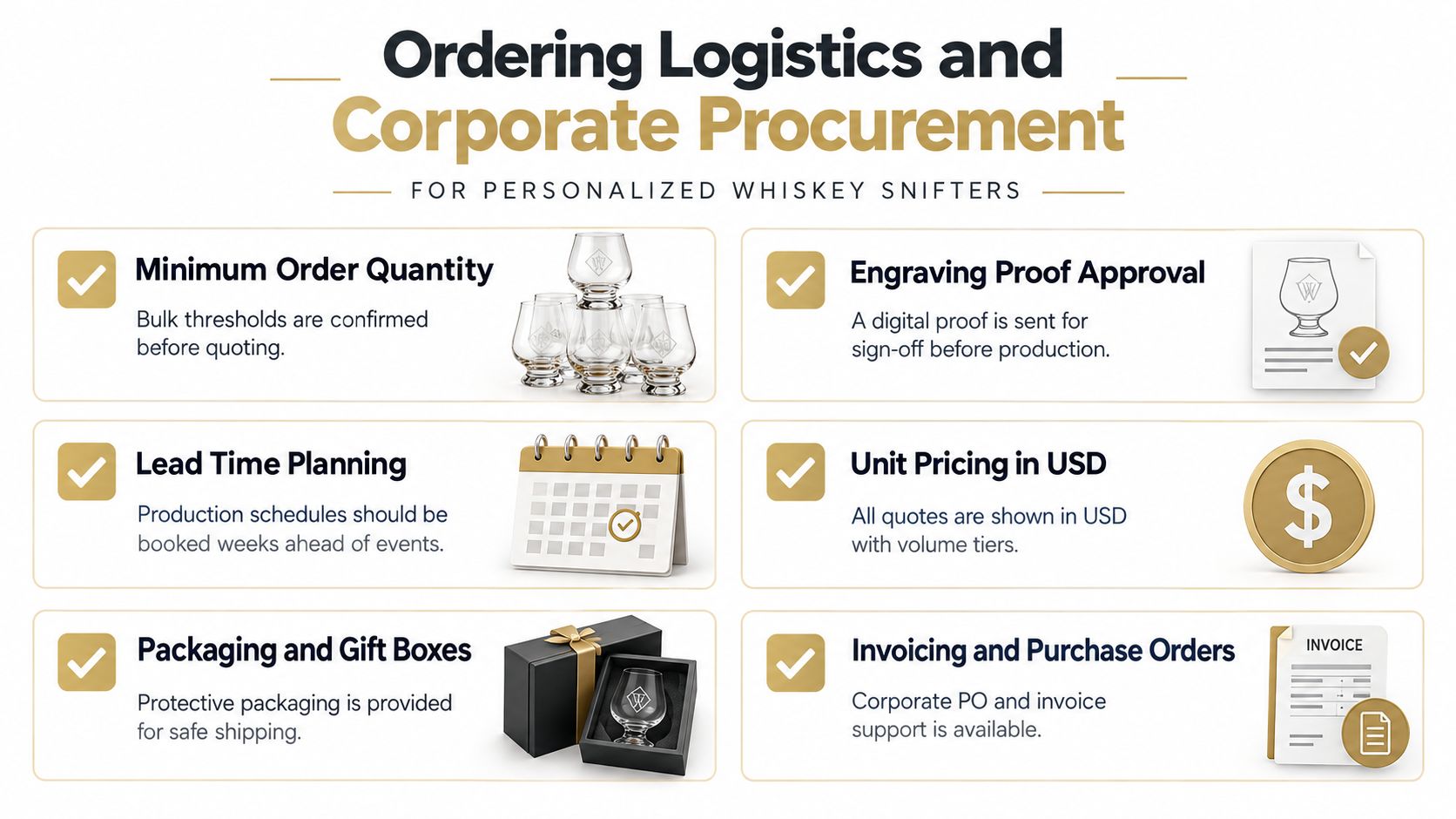
For bulk orders, put the following controls in writing:
- Set a character limit: Define the maximum length for names and messages before collecting recipient data.
- Standardize capitalization: Decide how names, initials, accents, and company names should appear across the batch.
- Review international spelling: Confirm local spelling conventions, diacritics, and the exact order of given and family names.
- Approve a proof: Require a digital proof showing the placement, size, line weight, and logo treatment before production.
- Protect the data: Limit access to recipient names, addresses, and personalization files to the people managing fulfillment.
- Confirm packaging: Specify protective packaging and gift boxes before shipping, especially for cross-border or multi-address delivery.
Recent gifting coverage reports that 71% of consumers expect personalized interactions and 76% become frustrated when those expectations aren't met (gifting coverage). For corporate buyers, that makes proof approval more than an administrative step. It protects the recipient experience.
Procurement advice: Use one neutral snifter design when preferences are unknown, then personalize the identity layer rather than trying to guess every recipient's whiskey style.
A neutral design also simplifies inventory and makes the assortment easier to deploy across birthdays, client appreciation, employee rewards, holiday gifts, and premium events. For international programs, keep the artwork simple and allow the recipient data to carry the individual character. The result is scalable customization without a factory full of incompatible designs.
Care and Maintenance for Engraved Glassware
A personalized whiskey snifter should be treated as functional glassware with a permanent identity mark, not as a fragile display object. Good care begins before the first use, with a quick inspection of the rim, bowl, foot, and engraved area.
Protect the drinking surface
The engraving should sit away from the rim and interior. Repeated contact, washing, and handling are most likely to affect areas that touch the mouth or cleaning tools, so the lower exterior bowl or base remains the sensible placement. Check the mark for sharp edges, chips, haze, or stress lines before the glass enters a gift shipment.
Hand-washing is the safer default when the manufacturer doesn't specify dishwasher suitability. Use a mild dish detergent, warm water, and a soft cloth or nonabrasive sponge. Don't scrub the engraved area with harsh pads, and don't stack glasses in a way that puts pressure on the bowl or rim.
For a corporate program, test a production sample before approving the full order. Compare legibility after repeated dishwasher cycles or standardized hand-washing, then inspect the glass for chipping, haze, or stress lines around the engraving. This wash test gives procurement teams a practical record of how the selected treatment performs under expected use.
Store for the next tasting
Dry the glass fully before storage. Keep it upright in a protected cabinet, with enough space to prevent the bowls from knocking together. Avoid storing heavy accessories inside the snifter, since point pressure can damage the bowl or foot.
The aroma geometry also benefits from clean, odor-free storage. Residual detergent, smoke, or strong food aromas can interfere with the next pour, particularly when the recipient is using the glass for neat Scotch, bourbon, or another aromatic spirit. A clean glass, intact rim, and readable engraving preserve both sides of the gift's value: the tasting ritual and the personal connection.
Our assortment gives gift seekers and corporate buyers a practical route to personalized glassware, coordinated barware, and spirit-focused gift sets. Visit ROCKS Whiskey Chilling Stones to choose a gifting option that pairs elegant drinkware with useful accessories for clients, employees, whiskey lovers, and milestone celebrations.


