

You've chosen a gift, collected the names, and opened the engraving form. Then the questions start: will the glass suit their favorite drink, will the logo fit, and will a personal message feel thoughtful or awkward? Those decisions matter more than the font. Our barware and gift-set assortment is a good gifting option when you start with the recipient's habits, then choose the glass, decoration, and presentation to match.
Match the Glass Style to the Drinker
Say you're ordering 40 engraved glasses for a client event three weeks away. Half the guests sip whiskey neat; the rest want ice and cocktails. Choosing identical narrow tasting glasses because they look polished would leave part of that audience with an inconvenient gift.
Choose the drinking experience before the engraving. An inward-tapered, tulip-like bowl gathers aroma toward the nose, while a broad opening accommodates large ice, chilling stones, and garnish, as explained in the Global Spirits Authority glassware and serving standards. The aroma effect is real but modest, not a guaranteed taste upgrade; its magnitude changes with the spirit, pour volume, temperature, bowl dimensions, and taster.
Glass styles by drinking use and gift fit
Capacity isn't fixed by a style name. Ask for the selected model's stated capacity, then check usable room with the intended ice and mixer rather than judging by brimful volume.
| Glass style | Best drinking use | Engraving room | Gift fit |
|---|---|---|---|
| Neat tasting glass | Whiskey without ice; choose capacity for a tasting pour with headspace | Small mark on mid sidewall | Whiskey connoisseurs and collectors |
| Rocks or old fashioned tumbler | Whiskey on ice, stirred cocktails; check capacity with the intended cube | Name or initials on central sidewall | Birthdays, housewarmings, bar carts |
| Double old fashioned | Large ice cube, bourbon cocktails; allow room for ice and stirring | Wide sidewall with room for a short line | Heavy-tumbler fans; check weight before gifting |
| Highball glass | Whiskey and soda, mizuwari, gin and tonic; size for mixer and ice | Tall sidewall suits a vertical name | Soda and long-drink drinkers |
| Double-walled steel tumbler | Outdoor sipping; choose capacity for the recipient's usual serving | Single-tone mark, limited by surface | Camping, hunting, outdoor gifts; steel avoids glass breakage |
| Crystal glass set of four | Sipping and occasional cocktails; confirm each glass's capacity | Coordinated initials or simple marks on matching sidewalls | Premium gift sets, including Prestige-style presentations |
Make the recipient check
Ask these questions before choosing from our gift assortment:
- Neat or on ice? A dedicated neat drinker may appreciate a nosing shape; an ice drinker needs an accessible opening.
- Short pour or mixed drink? Soda and long cocktails need room that a tasting glass doesn't provide.
- Indoors or outdoors? For travel, camping, or poolside use, consider steel rather than fragile glass.
For a single gift, match the recipient's most common pour. For a mixed client list, a rocks tumbler is the practical default because it accommodates neat spirits, ice, and many cocktails.
Our guide to what makes a rocks glass helps buyers distinguish that everyday tumbler from specialist tasting shapes. A crystal set of four can suit a premium household or client gift; confirm the exact model, engraving options, and dimensions before selecting any named edition.
Choosing Personalization Depth for Each Recipient
More personalization isn't automatically more thoughtful. A permanent joke, nickname, or oversized logo can make an otherwise useful glass uncomfortable to display.
Snappy's employee holiday-gifting insights report that 75% of employees prefer choosing their own gift, while more than 80% place higher value on gifts personalized to some degree. Those preferences fit together: offer a considered selection, then let recipients decide what belongs on their glass.
Choose the right level of familiarity
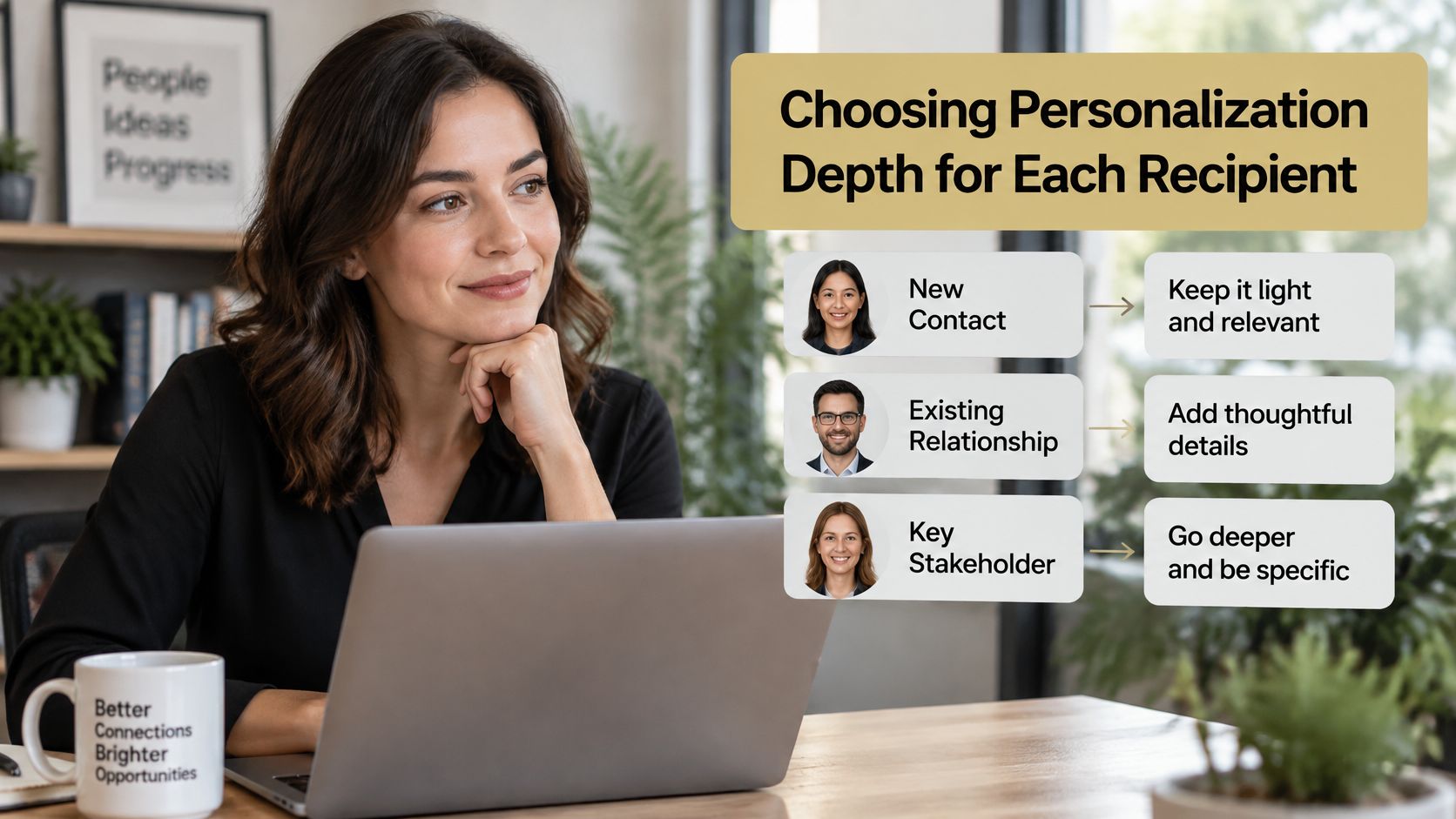
- Close personal gifts: A full name, meaningful date, or brief message suits a birthday or anniversary when you know the recipient well. Choose wording they'd happily leave on the bar cart, not something that needs an explanation.
- Client appreciation: Understated initials or a restrained company mark can work. Keep personal sentiment on an accompanying card, especially when the relationship is professional rather than social.
- Employee programs: Offer a small selection of engravable glassware and let employees opt in. Make an unengraved option available so accepting the gift doesn't require accepting permanent personalization.
Our glassware and engraved-tray assortment gives gift seekers room to adjust that level of permanence. The thoughtful choice may be a personalized tray with neutral glasses rather than lettering on every piece.
Recognize when engraving becomes presumptuous
A nickname used casually at an event isn't permission to put it on a client's glass. Use their confirmed professional name on the card instead, and leave the glass neutral.
An inside joke can also misfire when colleagues or family members see it without context. Save that wording for a private note; choose initials only if you know the recipient likes monograms.
Unknown drinking preferences require more care. Health considerations, religious or cultural practices, and workplace alcohol policies can make whiskey-specific gifting inappropriate. Offer a general drinkware option, a wood tray without spirits-specific wording, or a different gift category rather than assuming everyone wants barware.
Personalize what you know about the recipient, not what you hope they'll enjoy.
Before engraving, ask: Do we know this person well? Do they drink whiskey? Would they be comfortable with colleagues seeing this mark? If the answers are uncertain, preserve the personal touch in the card and the recipient's freedom in the product.
Engraving Methods and What Holds Up to Washing
A frosted mark can look crisp when it leaves the workshop and still develop chipped edges or abrasion after washing. Surface appearance isn't proof of durability. Nor should you accept a blanket dishwasher-safe promise without knowing whether it covers the decorated glass.
Choose the decoration method for the artwork and expected use. A name on an everyday tumbler needs a different treatment from a colorful event logo or a message engraved into a presentation tray.
Engraving methods compared for rocks glasses
| Method | Look | Durability through washing | Detail limit | Best for |
|---|---|---|---|---|
| Laser engraving (CO₂) | Frosted white mark | Good when validated; test dishwasher cycles | Fine strokes can break; keep text bold | Names, initials, short messages |
| Sandblasting | Matte, deeper frost | Good with suitable depth and sound glass | Moderate; avoid dense filled areas | Larger logos on tumblers |
| Acid etching | Soft, even frost | Etched surface won't peel; validate the finished glass and care instructions | Moderate; fine lines can blur | Simple logos in larger runs |
| Enamel or ceramic decal print | Full color possible | Can chip or fade under heavy dishwashing; confirm firing and care | Fine detail and color | Colored logos, shorter-life pieces |
| Wood tray engraving | Mark on tray, not glass | Wood wears over time; glass unaffected | Moderate | Gift tray and glassware sets |
For our glassware and tray gifts, don't treat these methods as interchangeable or assume every finish is offered on every product. Confirm the available process before preparing artwork.
Ask for evidence before approving production
Laser Mark Tech's engraving guidance describes a controlled workflow using a 10×10 test matrix of speed, power, and resolution, with a practical CO₂ starting range of 200–300 mm/s, 12–20% power, and 300–400 DPI. These are calibration starting points, not universal settings; the machine, lens, glass composition, curvature, and artwork all matter.
Turn that technical workflow into supplier questions:
- Identify the glass: Is it annealed or tempered? Annealed glass is more predictable during engraving; tempered glass can fracture unpredictably.
- Inspect the trial: Has the supplier compared settings and inspected the result under magnification? Ask to see edge quality, not just a flattering product photograph.
- Validate use: Request wet and dry rub checks and dishwasher-cycle checks before approving a washing claim.
- Retain the record: Keep the approved sample, artwork proof, parameter sheet, and glass-lot reference for replacements.
Damp masking and multiple low-energy passes can reduce thermal shock and micro-chipping. The operator should also avoid fine unsupported strokes and dense fills near rims or corners.
Our explanation of how glass engraving works provides process context. When comparing suppliers, use Evright Industrial's glass engraving vendor selection guide to frame questions about capability and samples, then require evidence for your chosen glass.
Buying rule: Approve a tested physical sample, not the promise that an engraved mark is permanent.
Placing Names, Initials and Logos on the Glass
A name that looks balanced on a flat proof can look squeezed when it wraps around a tumbler. Moving it toward the rim or across a pronounced curve makes the problem worse. Placement is part of the artwork, not a finishing detail.
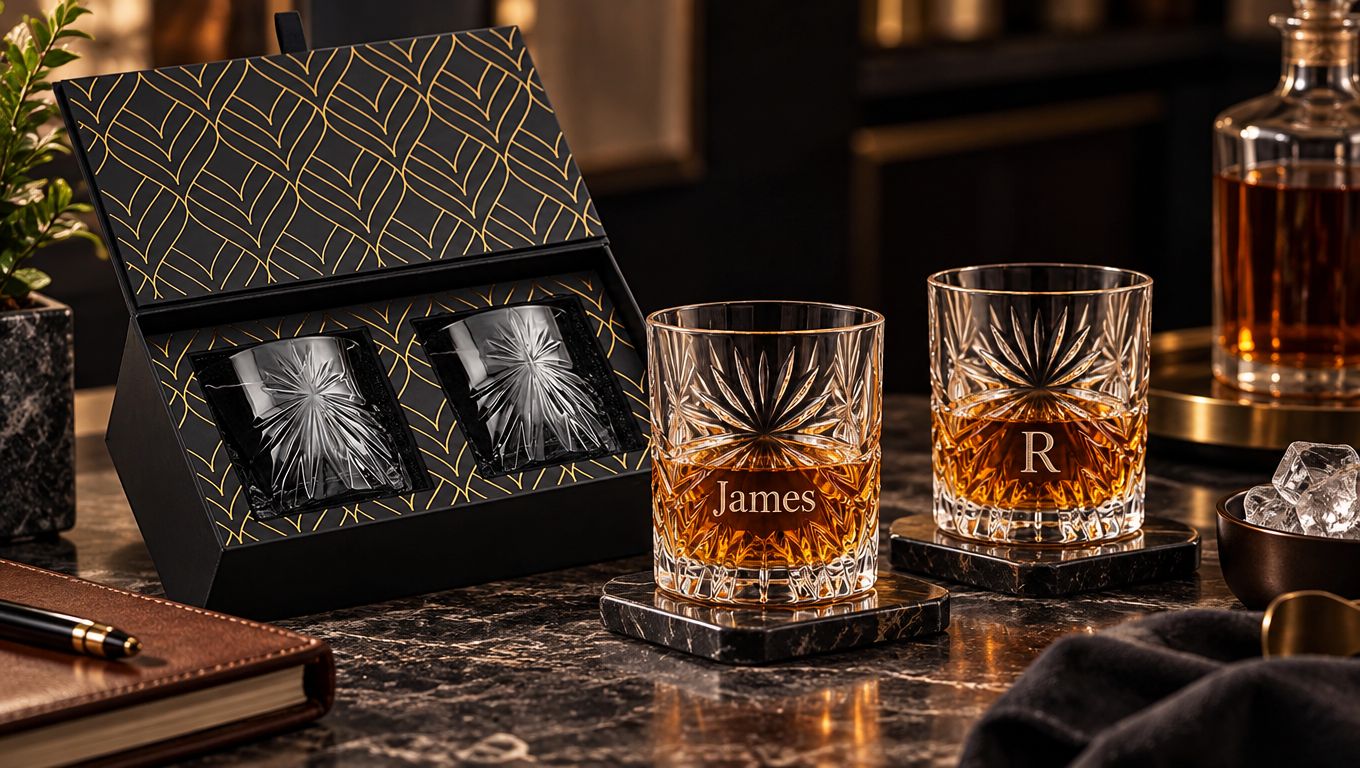
Our glassware gifts work best with restrained, readable decoration. The Privilege Collection - Soleil Glass Edition, for example, features crystal whiskey tumblers intended for scotch or bourbon; a proposed engraving should respect the glass's shape and preserve a clear view of the contents.
Build the layout around the glass
- Use the central sidewall: Keep lettering away from the rim, base contact ring, and sharp curvature transitions. Ask for a photograph showing the proposed position on the actual model.
- Shorten before shrinking: As a layout trial, a roughly dozen-character name may fit comfortably on a standard tumbler, but the physical proof decides. Switch a longer name to an initial plus surname rather than compressing every letter.
- Choose sturdy lettering: Bold sans-serif or simple serif fonts are safer starting points than delicate script. Check letter openings and punctuation at the intended engraving size.
- Confirm monogram convention: A traditional arrangement places the surname initial larger in the center, with given-name initials beside it. For a stacked design, specify the hierarchy explicitly instead of expecting the engraver to infer it.
- Simplify company artwork: Supply a single-tone version with clear outlines or a solid silhouette. Remove tiny taglines, gradients, and decorative detail that won't remain distinct.
For batches, maintain the same orientation and engraving height. Review filled glasses consistently so changing liquid levels don't disguise differences in contrast.
Approve what the recipient will see
Hold the sample at arm's length under normal room lighting beside an undecorated glass. Rotate it naturally and check whether the whole name remains readable without hunting for the right angle.
Farmhouse World's ordering checklist for personalized metal signs is a useful cross-material reminder to settle monogram order and layout before fabrication. Glass still requires its own curved-surface proof.
Before approval, confirm spelling, initial order, font, position, logo simplification, and visual consistency. Don't approve a design merely because it looks attractive when enlarged on a screen.
How to Order a Personalized Rocks Glass Step by Step
Treat the order as a sequence of approvals. A late change to the glass can invalidate the artwork placement, while a late change to the recipient list can affect packaging and delivery. Our gift assortment offers useful starting points, but the final specification should describe exactly what you're buying.
Set the specification before production
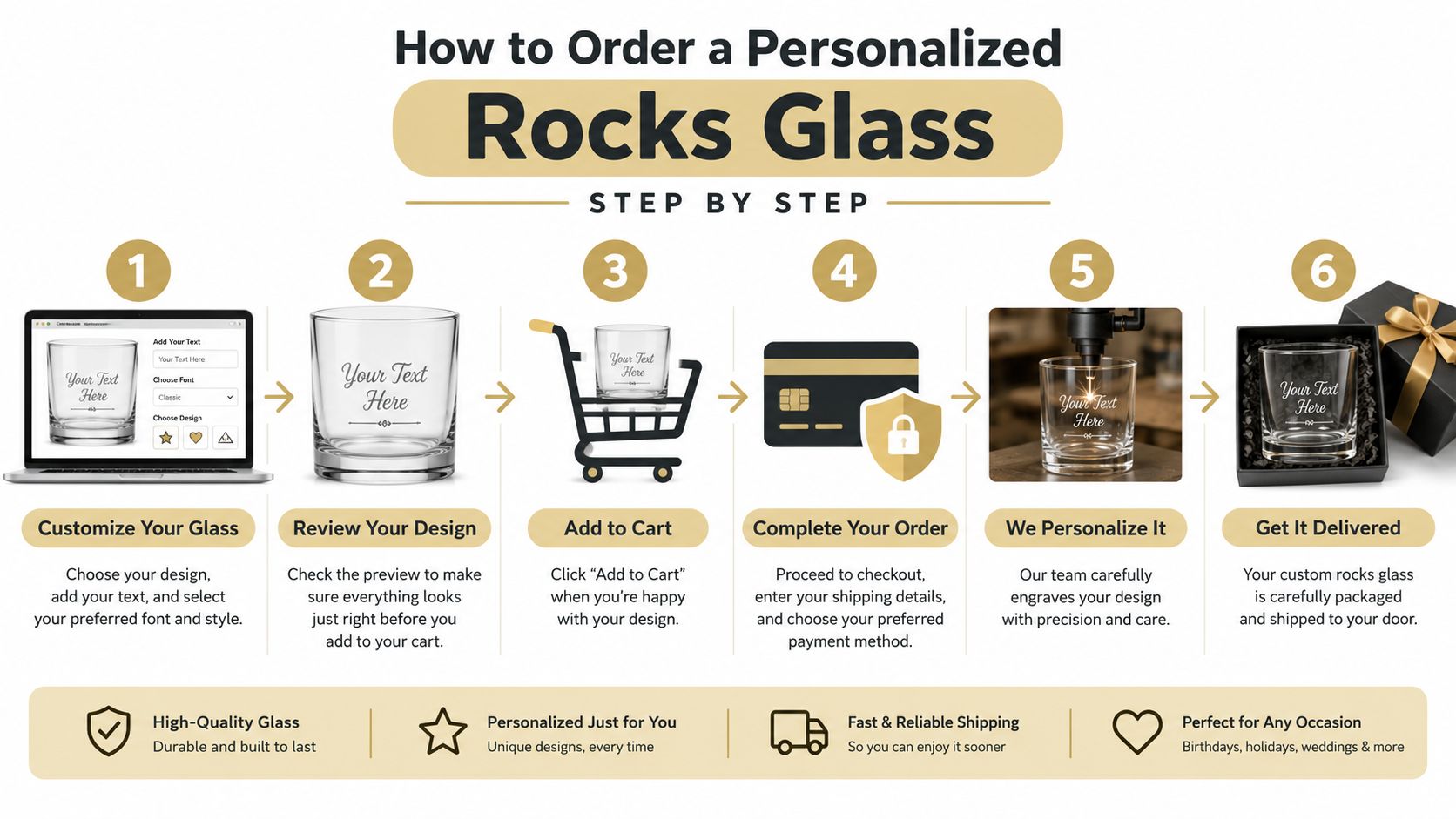
- Lock the recipient list and occasion. Keep names, gift choices, and delivery destinations in a spreadsheet with a named approver, and confirm each recipient will use an engraved glass before you commit to the wording. As a planning assumption, budget 5–10% spare glasses for breakage or late additions. Adjust that allowance once you know the supplier's replacement arrangements and how uncertain the final headcount is.
- Choose a glass for each recipient group rather than mixing models casually within a coordinated set. Record the exact product description and check dimensions, weight, and usable capacity so purchasing staff don't substitute a superficially similar glass.
- Select the decoration method and request a test piece. Send the real artwork, because small lettering and filled areas affect the result. A placeholder logo tells you nothing about how the finished mark will engrave. Confirm whether sample approval must happen before the supplier reserves or starts production.
- Prepare the personalization text exactly as it should appear. Check spelling, initials order, date format, capitalization, punctuation, and line breaks against the recipient spreadsheet, and shorten wording that needs excessive shrinking.
- Check the digital proof at actual size. Print the layout and judge lettering and mark size at the dimensions they will be engraved. Screen zoom flatters fine detail that reads much smaller on a curved tumbler.
- Approve in writing with the artwork version, glass model, quantity, decoration, and packaging identified. If individual names change, issue a revised file with an unmistakable version label and ask the supplier to acknowledge that it replaces the earlier file.
- Work backward from the event date. Agree on sample review, production completion, dispatch, and delivery deadlines, leaving time to inspect the shipment and resolve problems. Get lead times directly from the supplier rather than relying on an assumed turnaround.
Catch the expensive slip
The mistake to avoid is treating the sample as a formality and meeting the finished mark for the first time on the event table. Make the physical sample a decision gate before production starts.
Approve a specific glass and a specific file version by name.
On arrival, count the glasses and reconcile personalized pieces against the recipient list. Inspect rims for chips, look at an engraved mark under room light, and compare the shipment with the approved sample before packing gifts for the event.
Keep damaged pieces separate and photograph their condition alongside the packaging. That gives the supplier useful information for a replacement discussion without delaying distribution of the sound gifts.
Packaging That Protects the Glass and the Message
A personalized glass that arrives chipped has failed as a gift, however good the engraving looks. An oversized presentation box can also create unnecessary filler and awkward storage. Choose protection and presentation together, not after the glasses are finished.
Packaging options by protection, waste and gifting use
| Packaging option | Protection | Waste trade-off | Best gifting use |
|---|---|---|---|
| Single rigid gift box with insert | Good for one glass or a pair | Extra card and foam; right-size the box | Birthdays and one-off gifts |
| Wood tray with glassware | Holds glasses steady when fitted; needs shipping protection | Reusable if kept; heavier to ship | Anniversaries, housewarmings, bar-cart sets |
| Four-glass set box | Insert separates and holds all four | Larger box, but can consolidate a set | Corporate client gifts, employee rewards |
| Plain kraft sleeve with printed card | Light protection for sturdy tumblers; not sufficient alone for parcel shipping | Low material use; card can be retained | Hand-delivered thank-you gifts, promotional gifts |
| Branded box with logo print | Determined by box strength, fitted insert, and outer shipping carton | Extra print and ink; logo may limit reuse | Event merchandise, prospect gifts |
A fitted rigid box suits a birthday glass; a wood tray can become part of an anniversary gift rather than disposable wrapping. Our tray-and-glassware assortment is a good option when the recipient will use both components.
Judge waste over the gift's useful life
A reusable engraved glass isn't automatically a lower-waste choice. Recipient relevance, breakage, shipping, packaging, and long-term usefulness all count. Initials or a meaningful date may remain welcome, while prominent employer branding can become unwanted after a job change.
The Sales & Marketing Management corporate-gifting outlook reports that cost was the leading priority for 44% of North American respondents, while sustainability ranked prominently in Europe at 32%. Ask corporate buyers about their procurement priorities rather than assuming every market uses the same criteria.
Right-size the shipping package with enough cushioning to prevent contact between glasses. An oversized carton needs more filler; an undersized one leaves too little protection.
Our guide to gift boxes for glassware helps frame the presentation decision. Dirt Cheap Headwear's discussion of cost-effective shipping for bulk hat orders offers a cross-category logistics reference, but fragile glass requires its own protective specification.
Put campaign branding on a removable tag or printed card when possible. The message still reaches the recipient without permanently defining how they can use the glass.
Confirm the Order Before You Act
Approval fails when three people answer three emails and the supplier receives three versions. Use the style, artwork, placement and packaging decisions already made as the baseline; this pass is about authority. Pick one owner and one order record before money moves.
For personalized gifting, ROCKS Whiskey Chilling Stones offers engraving on wood trays and glassware. For a crystal set of four or a requested Reserve glass edition, make the supplier confirm the exact specification and customization options instead of relying on an informal collection name.
- Named approver: Assign one person with authority to release the run; courtesy comments stay advisory.
- Deadline: Give that approver a response cutoff and let silence hold the order.
- Late names: After approval, route additions or respelled names to spare glasses or a separate reprint.
- Uncertain recipients: If drinking context is unknown, keep those glasses neutral and solve the message outside the engraving.
- Closeout: Get the delivery commitment and inspection window in writing, with carton count matching the approved list.
Treat every post-approval change as a new approval. The old file, the old sample and the old list are closed the moment a date, initial or logo position moves.


