


“No dilution” is often presented as the whole case for whiskey stones, as if they were a better kind of ice. That misses the useful distinction: stainless-steel stones are for controlled chilling without added water, not for making a drink as cold as possible as quickly as possible.
Think of a pour of bourbon with a couple of pre-chilled stones in the glass. The whiskey cools, but the stones don't melt into it, so the drink's proof stays unchanged. The trade-off is that their cooling effect is gradual and limited. Whether that's an advantage depends on how the recipient likes their whiskey, and it's worth understanding the difference before choosing stones as a personal purchase or gift.
What Stainless-Steel Whiskey Stones Really Do
Stainless-steel whiskey stones transfer heat from the drink into the chilled metal. This is sensible heat transfer: the stones warm as the whiskey cools, until the two move toward the same temperature. Unlike ice, stainless steel doesn't melt and add water to the glass. That makes it a useful choice for someone who wants a cooler pour without intentional dilution, but it doesn't mean the stones can keep lowering the temperature indefinitely. Worldstainless' overview of stainless steel in food and beverage applications describes this heat-transfer behavior and the material's use in food-contact settings.
The familiar serving ritual still works: pour bourbon, add chilled stones, and take a sip without the watery edges that can come from melting ice. But the result isn't the same as a drink rapidly chilled by ice. Stones give up their stored cold as they warm, while melting ice continues absorbing heat as it changes state. If the goal is a very cold drink quickly, ice may suit the occasion better.
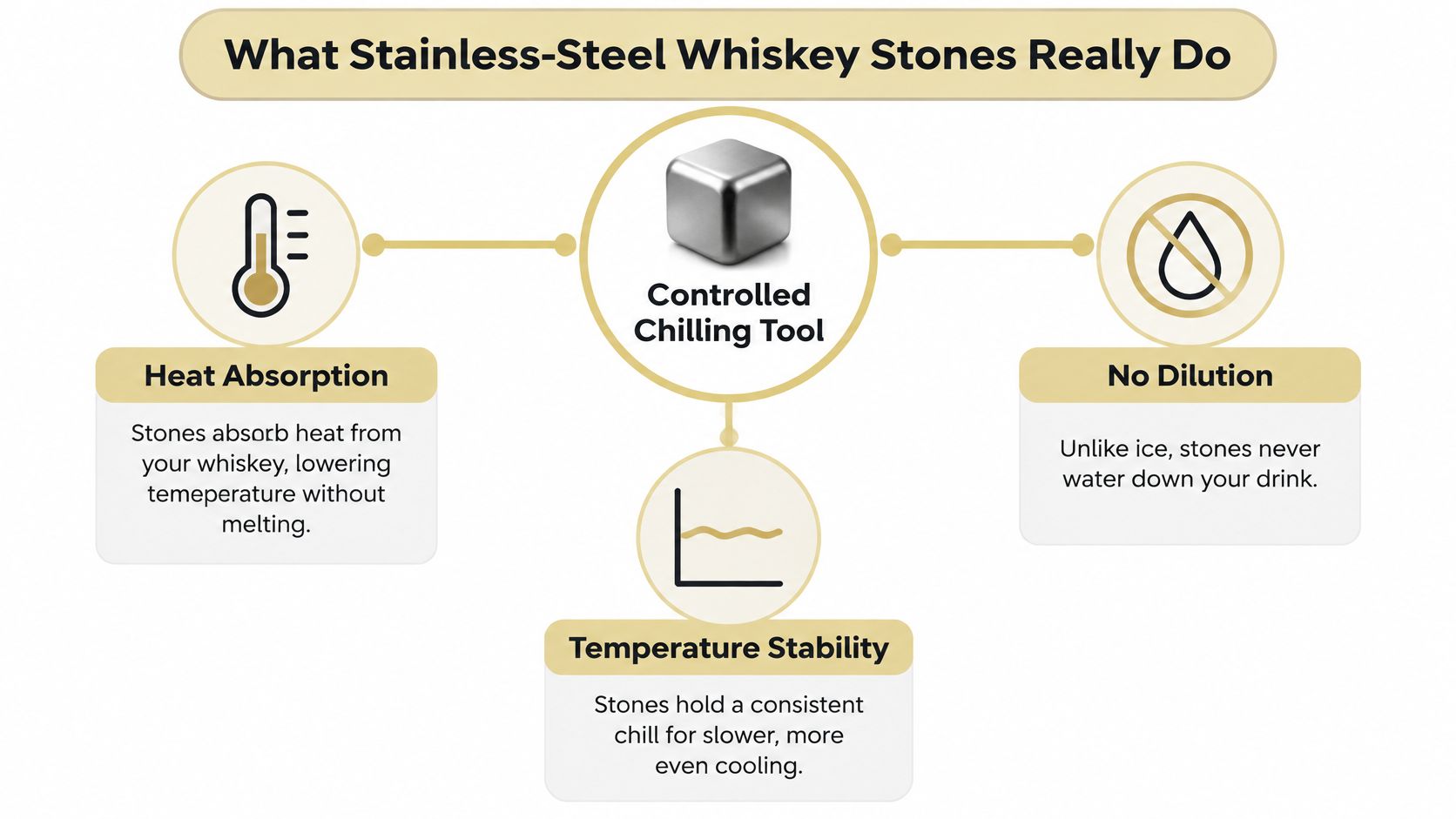
That difference makes “ice versus stones” less a contest with one universal winner and more a choice about how to serve the drink. Use stainless steel when preserving the original strength and avoiding added water matter most. Choose ice for faster, deeper chilling, or combine the two when some dilution and a colder drink are both welcome.
Serving rule: Choose the chilling method for the experience you want, not just the one that promises no dilution.
For gift seekers, this distinction helps match the set to the recipient. A whiskey fan who enjoys an undiluted pour may appreciate reusable stones, while someone who likes a very cold drink may prefer ice or a combination. Knowing that difference makes a barware gift more thoughtful, and it sets up the key questions: how the stones behave, how they compare with other materials, and what to check before buying or gifting them.
The Physics Behind the Chill
A chilled metal spoon warming in a drink is a useful comparison. The spoon takes in heat from the liquid, but it doesn't melt; it warms until the temperature difference between spoon and drink gets smaller. Stainless-steel stones work on the same principle. Ice behaves differently because it melts as it absorbs heat, which lets it keep cooling the drink during that change of state.
Three material properties help explain why a compact metal stone can still affect a pour. Density is how much mass fits into a given volume, thermal conductivity describes how readily heat moves through a material, and specific heat capacity describes how much energy it takes to warm a given mass. A physical-properties table based on BS EN 10088-1 lists density at approximately 7,900 kg/m³ for grade 304 and 8,000 kg/m³ for grade 316 at ambient conditions. It gives both grades thermal conductivity of about 15 W/m·K and specific heat capacity of roughly 500 J/kg·K at 20°C. The underlying stainless-steel properties table provides the reference values.
In plain terms, density helps a small stone hold substantial mass, but that doesn't make its chill limitless. How much heat it can absorb depends on its mass and starting temperature, along with the drink's volume, contact with the stone, and the time they spend together. Geometry matters, too: a larger exposed surface and a thinner form give heat a shorter path to travel through the metal. A heavier stone can store more thermal energy, but it also takes longer to cool down before serving.
The drinking experience follows from those properties. Stainless steel can offer a gradual chill without changing the whiskey's strength through added water, but once the stones have warmed toward the drink's temperature, their cooling effect fades. A neutral comparison reports that, in typical serving conditions, stainless-steel stones may chill more slowly than ice and often don't bring a drink below approximately 12°C (54°F). That makes them an option for controlled chilling, not the automatic pick for rapid or deep cooling. The temperature comparison and its caveats also underscore why product claims should be judged against actual serving conditions.
For a closer comparison of the serving trade-offs, see this guide to whiskey stones versus ice. The practical takeaway is straightforward: the metal grade matters, but so do size, shape, freezer temperature, and time. The drinker gets a gentler, non-diluting chill, not the ongoing heat absorption that comes from melting ice.
Stainless Steel, Granite, and Soapstone Compared
The right material depends on more than cooling. A whiskey stone sits in a glass, gets handled, needs cleaning, and may be given as a present. Stainless steel offers a modern, polished appearance and a substantial feel. Granite brings a natural pattern and a classic stone look, while soapstone appeals to people who prefer a softer, understated finish.
Cooling performance varies with a stone's dimensions, mass, and starting temperature, so the material alone can't promise a particular result. Stainless steel doesn't melt into the drink; granite and soapstone are also non-melting options when made and finished for beverage use. None should be treated as a substitute for ice when fast, sustained chilling is the priority.
| Factor | Stainless Steel | Granite | Soapstone |
|---|---|---|---|
| Cooling approach | Absorbs heat as the chilled metal warms. | Absorbs heat without melting; the experience depends on its size and preparation. | Absorbs heat without melting; a fit for drinkers who prefer a traditional stone. |
| Look and feel | Sleek, reflective, and dense in the glass. | Natural patterning gives each set a distinctive stone appearance. | A softer, more muted look and tactile feel. |
| Care | Clean and dry thoroughly; protect the surface from abrasive or chlorine-based cleaners. | Follow the maker's cleaning instructions and check for damage. | Handle with care and follow the maker's cleaning instructions. |
| Food-contact checks | Confirm the alloy, finish, and supplier documentation rather than relying on the label alone. | Check the finish, construction, and product-specific food-contact guidance. | Check the finish, construction, and product-specific food-contact guidance. |
| Gift presentation | Suits a contemporary barware set or polished presentation. | Its natural appearance works well in a classic gift box or coordinated set. | A restrained choice for a recipient who favors traditional materials. |
For buyers, the distinction between appearance and documented quality matters. Stainless steel's corrosion resistance depends on its alloy and surface, so the word “stainless” by itself doesn't verify what a particular set is made from. Granite and soapstone have their own appeal, but buyers should also look for clear product information and appropriate care instructions rather than assuming that any stone is automatically suitable for a drink.
Gift presentation can settle a close decision. Someone with a modern home bar may appreciate the clean metal finish; someone who likes natural materials may prefer granite or soapstone. ROCKS Whiskey Chilling Stones offers gift products across whiskey stones and barware, so buyers can consider how a stone set might fit a recipient's wider home-bar interests without assuming every set uses the same material.
Caring for Stainless-Steel Stones That Last
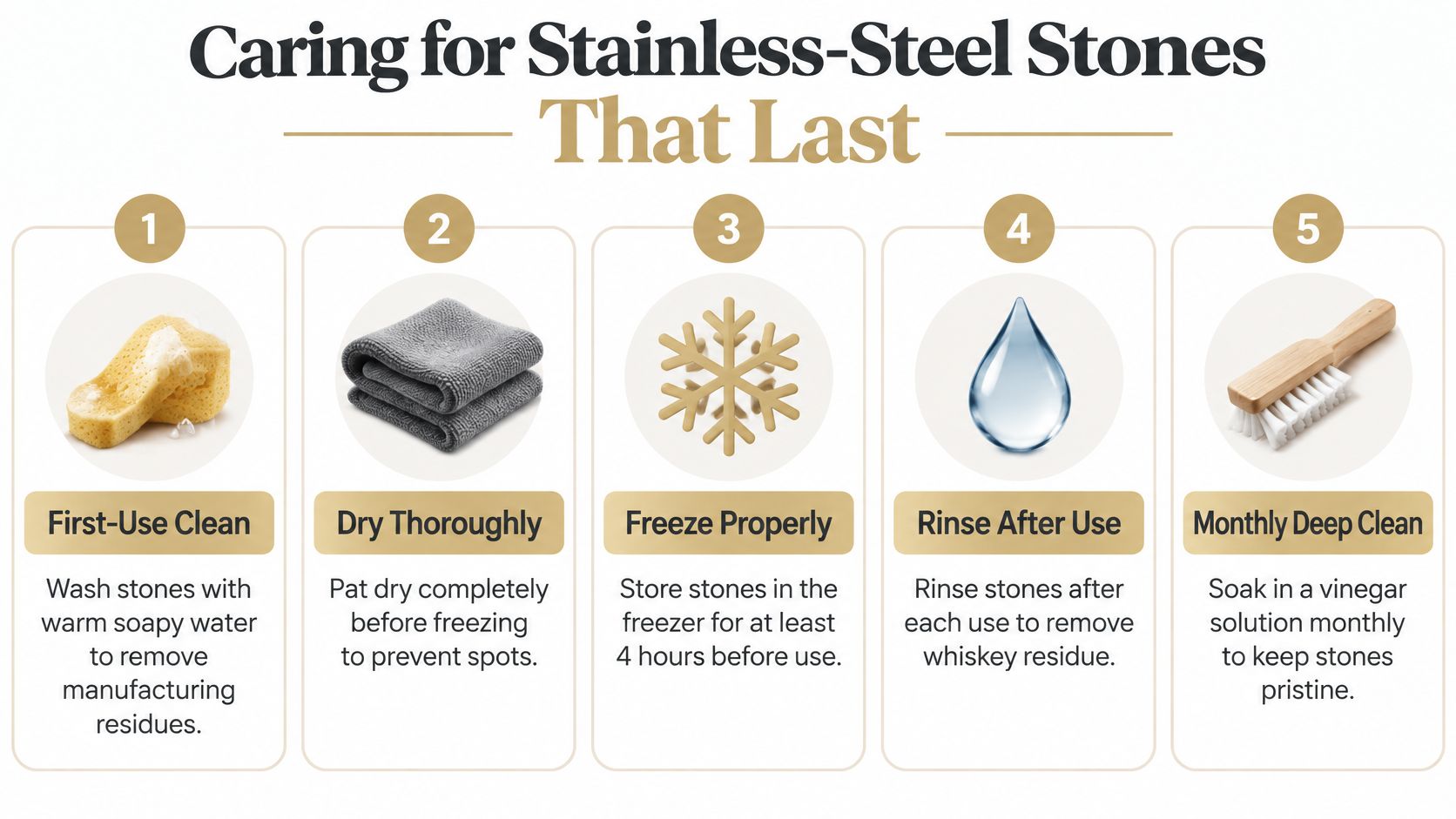
A straightforward routine helps keep stainless-steel stones clean and ready to use. Before their first pour, wash them with warm water and mild dish soap, rinse thoroughly, and dry them with a clean towel. After serving, rinse away any whiskey residue, wash if needed, dry fully, then return the stones to their freezer container or pouch. Follow the product's instructions for freezing and storage.
Stainless steel resists corrosion because chromium in the alloy forms a thin, self-repairing chromium-oxide passive layer when exposed to air. That layer helps protect the surface, but harsh treatment can damage it. Food-contact guidance notes that abrasive cleaners and chlorine-based products can compromise the layer; suitable grades and cleaning practices help keep measured metal release within established food-contact limits. The food-contact discussion of stainless-steel surface performance is a reason to treat care instructions as part of the product's safety story, not just its appearance.
A practical care routine
- Wash before first use: Remove any residues left from manufacturing, then rinse well.
- Dry before freezing: A complete dry helps prevent spots and keeps the storage pouch or container cleaner.
- Follow the maker's freezer guidance: Don't assume every set has the same recommended preparation.
- Rinse after each pour: Remove whiskey residue before putting the stones away.
- Avoid surface damage: Skip chlorine-based products and abrasive pads; use a soft cloth or sponge instead.
Dishwasher compatibility depends on the product, so check its instructions rather than assuming the answer. Minor surface marks aren't automatically a reason to discard a set, but inspect stones regularly. Pitting, corrosion, or a rough surface are reasons to stop using a stone for drinks and contact the maker about replacement or disposal.
For more practical advice on rinsing, cleaning, and storage, use these whiskey stone cleaning tips. If the stones are a gift, include the care instructions or choose a set that provides clear guidance. That small detail helps the recipient use the gift confidently and maintain it over time.
What to Look for When Buying Stainless-Steel Stones
A product page can make stainless steel sound self-explanatory. It isn't. A useful shortlist starts with material information, moves to design, then checks whether the set feels complete enough for its purpose. That order works whether you're buying a personal bar accessory or sourcing a gift for a client, employee, or event.
Check the material and finish
Look for a recognized food-contact grade and clear alloy identification. A supplier should be able to explain what steel the stones use and provide relevant food-contact compliance documentation. Don't treat a generic “stainless steel” label as proof that all products share the same alloy, surface condition, or manufacturing controls.
Examine the finish as well. A smooth, polished surface and rounded edges are more reassuring than visible burrs, rough machining, or sharp corners. Ask whether the manufacturer addresses cleaning after machining and surface treatment. If a product page gives no useful material details, that's a reason to ask before buying, particularly when the stones will be used repeatedly or distributed as a corporate gift.
Match the design to the use
Consider the stones' shape and mass in relation to the glassware and drinker. A well-designed stone should sit comfortably in the glass, and the product should have instructions for freezing, handling, and cleaning. The supplier should also confirm that the construction is intended for repeated cycling between freezer and room conditions. A material name alone can't tell you how quickly a particular design will cool a pour.
Choose the presentation, too
For gifts, the accompanying pieces can turn a single accessory into a complete barware experience. A box, coordinated glassware, or a wood tray with engraving can help make the set feel chosen for a person rather than pulled from a generic gift list. If you're purchasing for a company event, ask about personalization options and how the supplier handles the presentation across recipients.
One example is The Connoisseur's Set - Twist Glass Edition, which pairs granite whiskey stones with twist crystal glasses. The set is described as a non-diluting tasting option; it's a useful reminder to check the actual stone material when comparing products marketed under the broad whiskey-stone category. ROCKS also offers wood-tray and glassware engraving for customized gifting, so buyers can consider personalization alongside practical factors such as documented materials and care guidance.
Why Stainless-Steel Stones Work as Gifts
A barware gift works when it matches the recipient's drinking habit. Stainless-steel stones suit someone who wants a cooler pour without added water; a recipient chasing the coldest possible glass may be better served by ice. Many gift guides skip that distinction, and it is the difference between a considered gift and a generic one.
Occasions shape the details. A birthday might call for stones paired with glasses, a wedding for a shared home-bar accessory, and an employee milestone for a personalized tray that shows why this particular gift was chosen.
Corporate buyers have a documented reason to care about that difference. In a 2026 Harris Poll of 2,007 U.S. adults on corporate gifting, 82% of B2B decision-makers said a customized gift is best, while 32% reported receiving one, a 50-percentage-point gap between stated preference and experience.
A useful company gift gives the recipient something they can use and shows why it was chosen for them.
Programs with many recipients can stay within one gift category and still tailor each package. Engraved glassware or a presentation tied to a company event, a client relationship, or an employee reward turns the same stainless-steel set into something that feels selected rather than standardized.
The preference for personal gifts extends well beyond corporate programs. A 2024 survey reported by the Promotional Products Association International found that 77% of consumers consider it important for a holiday gift to reflect their individual preferences, and 39% prefer personalized gifts, a pattern that covers birthdays, anniversaries, weddings, employee rewards, and client appreciation.
Matching the product to the person completes the logic. The Connoisseur's Set - Nosing Glass Edition pairs granite stones with a crystal whiskey nosing glass, so it suits a recipient who pays attention to aroma while sipping. Someone else may respond better to cocktail glasses, cigar accessories, or a broader barware set. For help weighing those options, this guide to choosing whiskey gifts for connoisseurs covers the selection criteria.
Putting It All Together
A client thank-you shows the logic in one move: frozen stones cool a neat pour without adding water, a wash-and-dry routine keeps the set ready for the next toast, and an engraved tray turns a useful bar tool into a chosen gift.
Keep this shopping checklist handy:
- Match the serving style: Pick stones for someone who values a cooler, undiluted sip; pick ice when rapid cooling matters more.
- Verify the product: Look for clear material identification, a smooth finish, food-contact information, and care instructions.
- Plan for upkeep: Follow the maker's cleaning and storage directions, and check the surface over time.
- Make the gift personal: Choose engraving, glassware, or a tray that fits the occasion and the relationship.
The deciding question is simple: does the recipient want control more than maximum cold? If yes, stainless steel earns its place. If speed is the priority, ice still wins. The strongest sets respect that limit, then add value through materials, care, and presentation.
ROCKS Whiskey Chilling Stones offers whiskey stones, barware, and gift sets for whiskey and spirits lovers, with engraving available on wood trays and glassware for personalized presentations. Explore the assortment for a birthday, wedding, client appreciation gift, or company event at ROCKS Whiskey Chilling Stones.


