


You've found the right bottle, selected attractive whiskey glasses, and perhaps even added a decanter. Then the gift arrives, and the glasses sit loose in tissue while the recipient searches for space on a crowded bar cart. A whiskey glass rack solves that awkward final step. It protects the glassware, gives the set a defined home, and makes the entire presentation feel deliberately assembled.
For corporate buyers, that distinction matters. A rack turns separate barware pieces into a useful display, which is why our assortment is a strong fit for client appreciation gifts, employee milestones, event awards, and premium drinkware bundles.
Why a Whiskey Glass Rack Matters for Drinkers and Gift Buyers
A client opens a birthday box and finds six Glencairn glasses rattling in tissue. The host removes them carefully, sets them on the nearest shelf, and immediately realizes the bar cart has no safe space left. The gift is thoughtful, but the presentation ends as a storage problem.
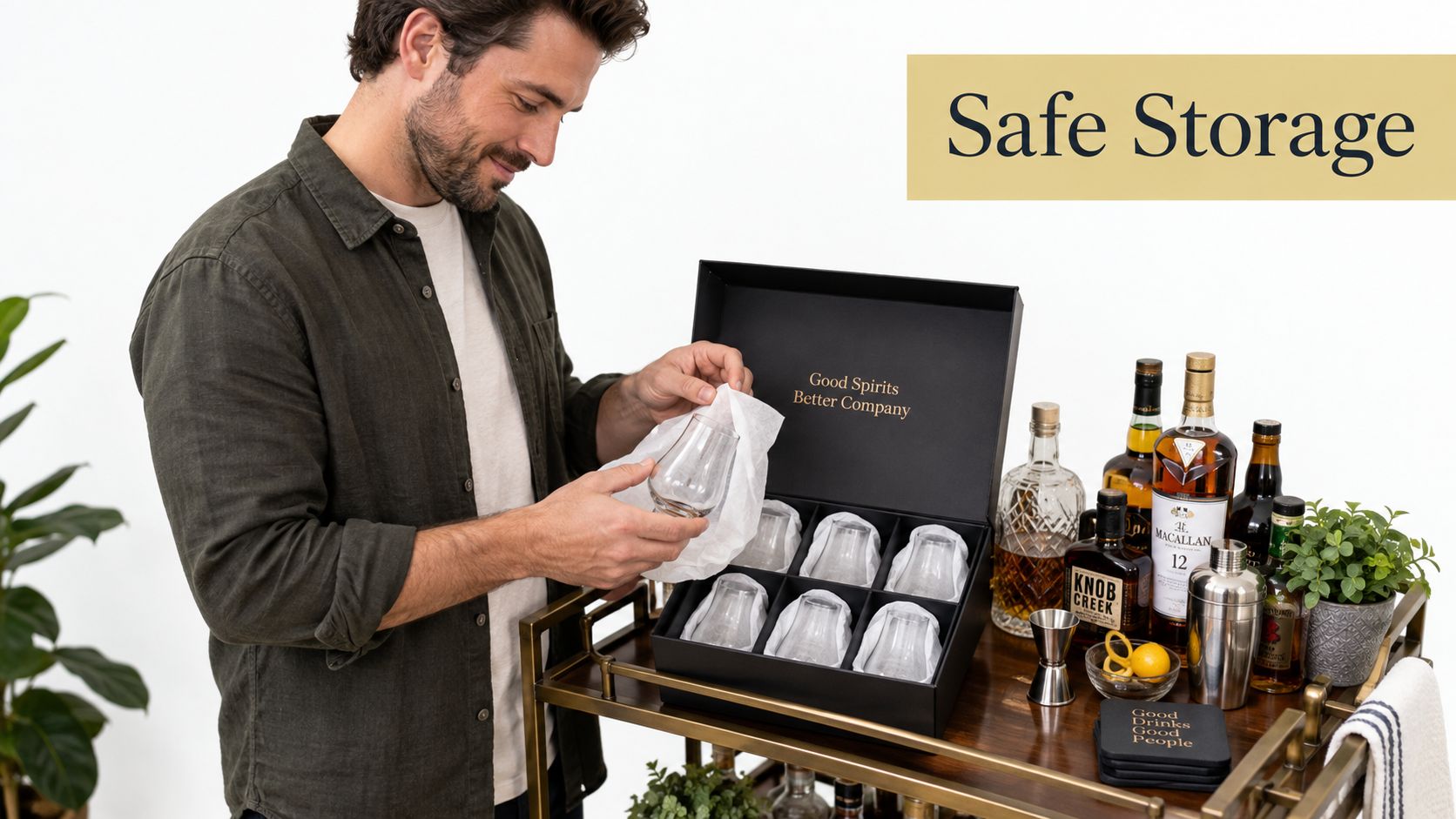
A rack changes that experience. For drinkers, it keeps rims from knocking against shelves, reduces dust settling inside bowls, and prevents the common temptation to stack glasses that shouldn't be stacked. Dedicated guidance for whisky and crystal glassware recommends isolating each piece so glass doesn't touch other glass or metal, and advises against stacking crystal inside another item. Meiko's whisky glassware guidance supports using a dedicated stemware rack when the collection includes delicate or stemmed vessels.
Storage becomes part of the presentation
Whiskey glassware has never had one fixed shape. Drinkware evolved from the 16th-century quaich, a shallow wooden cup used for whisky, to glass tumblers that became common in the 18th and 19th centuries as glass production increased and prices fell. The Glencairn whiskey glass was officially introduced in 2001, marking a modern move toward aroma-focused designs. This history of the whiskey glass helps explain why rack designs now need to accommodate everything from low tumblers to tulip-shaped tasting glasses.
For a gift buyer, the rack becomes the silent anchor of the set. A wooden base signals craftsmanship. A wall-mounted unit creates a curated bar identity. A compact freestanding rack photographs well inside an open gift box and gives the recipient an immediate display solution.
Buying rule: Give the rack a role beyond storage. It should protect the glasses and make the surrounding bottle, decanter, and accessories look like one coordinated gift.
Corporate buyers also benefit from the category's broader momentum. The global barware market was valued at about USD 6.4 billion in 2024 in one industry estimate, with a projection of USD 8.8 billion by 2034 at a 3.2% CAGR. Another forecast places the market at USD 7.16 billion in 2025, projecting USD 10.98 billion by 2035 at a 4.37% CAGR. Glass barware alone generated more than USD 2.3 billion in 2024. These figures from Global Market Insights' barware market overview place a whiskey glass rack inside a substantial market connected to premium drinkware, hospitality, e-commerce, and gifting.
The Three Main Types of Racks and Where Each Works Best
Choose the mounting format before you choose the finish. A walnut rack may look excellent in a product photograph, but it won't be a good gift if the recipient rents an apartment and can't drill into the wall.
Wall-mounted racks
Wall-mounted racks suit finished basements, dens, tasting rooms, and bar backs with usable vertical space. They keep the counter clear and turn the glasses into visible décor. Install them into studs or suitable masonry whenever possible. A wall unit gives the cleanest, most permanent look, but installation requirements make it less flexible for renters.
Use this style for an executive gift set where the recipient has an established home bar, or for hospitality spaces that want glasses displayed within easy reach. Before approving a design, measure the wall width, check the glass profile, and confirm that the mounting hardware matches the surface.
Under-shelf racks
Under-shelf models attach beneath upper cabinets, shelves, carts, or bar counters. They're practical for apartment kitchens, compact bar carts, and corporate office break rooms because they free counter space without adding a large visual feature.
This format balances access and subtlety. A recipient can reach the glasses easily, yet the rack doesn't dominate the room. Clamped versions are especially useful where drilling isn't desirable, though buyers should still verify the clamp's weight rating against the fully loaded glass set.
For broader home-bar planning, this home-bar building guide offers useful context on combining storage, serving surfaces, and drinkware placement.
Freestanding racks
Freestanding racks include tabletop bases and floor-standing columns. They're the most versatile choice for gift packaging, pop-up bars, trade show tables, and rental properties. A freestanding unit can travel with the set, sit inside an open presentation box, or move from a credenza to a bar cart as the recipient's setup changes.
The trade-off is stability. The rack needs a level surface away from vibration, pets, and busy serving paths. For corporate gifting, freestanding designs also simplify fulfillment because they avoid installation questions and can be photographed as part of the complete package.
Match the rack to the recipient's setting, not just the product photograph. Wall units prioritize permanence, under-shelf racks prioritize efficient access, and freestanding models prioritize portability.
Choosing the Right Material for Style and Longevity
Material affects more than appearance. It determines how the rack ships, how it ages in a humid basement, and whether the item feels like an executive gift or a practical organizer.
| Material | Durability | Aesthetic | Best Use Case |
|---|---|---|---|
| Wood | Strong but vulnerable to scratches and moisture; may need occasional oiling | Warm, traditional, and premium in unboxing photography | Heritage gifts, anniversaries, and executive presentations |
| Metal | High structural strength; stainless steel handles humidity well, while cheaper plated finishes may tarnish | Modern, industrial, or refined depending on finish | Wall-mounted racks, higher-capacity bars, and milestone awards |
| Acrylic | Lightweight, visually discreet, and practical for shipping | Clear, contemporary, and nearly invisible once mounted | High-volume corporate bundles, pop-up bars, and travel-friendly packaging |
Wood for heritage-led gifts
Walnut, oak, and mahogany complement the amber tones of whiskey and make a gift set feel grounded. That warmth works especially well with a decanter, tasting card, or engraved presentation tray. The disadvantages are practical: wood can scratch, may require maintenance, and adds shipping weight when a buyer is sending many units.
Wood is my first choice for a personal anniversary gift or a premium client package where presentation carries as much weight as utility. It also suits a recipient whose bar already includes natural materials.
Metal for capacity and structure
Stainless steel, matte black iron, and brass-plated wire give buyers more structural confidence for wall-mounted storage. A matte black finish works particularly well in contemporary home bars and corporate environments. Stainless steel is the safer selection for humid basement bars, while plated finishes need closer inspection because low-quality coatings can tarnish.
Metal is the sensible choice when the rack must carry a larger glass collection or remain fixed in a busy serving area. It also creates a stronger visual contrast against clear glass.
Acrylic for volume programs
Clear acrylic and resin almost disappear once mounted. That makes them effective in catalog photography and useful when a corporate buyer wants the glasses and branding to remain the visual focus. Acrylic also reduces the perceived risk of rough shipping compared with heavier, more rigid presentation pieces.
For gift shops and promotional-item programs, acrylic is a practical volume option. It won't deliver the same heritage signal as hardwood, but it keeps packaging lighter and the display visually clean.
Matching Capacity and Clearance to Your Glass Collection
Capacity starts with the actual glass, not the product title. A compact rack may be ideal for a pair of tumblers, while a tasting-room set needs more positions and a different opening profile. Buyers should never approve a rack from a capacity claim alone.
A practical benchmark comes from a hanging design that holds up to 6 Glencairn glasses within an installed envelope of either 6 in x 9 in x 5 in or 9 in x 6 in x 5 in. The CairnCraft rack specifications show that layout can change with available width or depth without changing the stated glass count.
Compare the glass profile first
Glencairn-style glasses have a narrower tasting bowl and need a different opening from a lowball. Oversized snifters need still more room. The planning dimensions below are the requested working guide for comparing profiles, not universal manufacturing standards. Always confirm them against the specific glass sample before ordering.
| Glass Type | Min Slot Width | Min Slot Depth | Best Rack Style |
|---|---|---|---|
| Glencairn-style tasting glass | About 2.25 in rim profile | At least 0.25 in breathing room around the rim | Under-shelf or dedicated stemware rack |
| Lowball or tumbler | About 3.3 in shoulder profile | At least 0.25 in breathing room around the rim | Freestanding or wide wall-mounted rack |
| Oversized snifter | 3.75 in or more | At least 0.25 in breathing room around the rim | Wide wall-mounted or freestanding rack |
The commercial fit principle is simple. A rack's quoted frame height isn't necessarily the usable opening. You need clearance above the rim and a slot gap that lets the glass slide out without binding. One practical warning is that a 1-inch gap may hold glasses, while a 2-inch gap can increase breakage risk, so buyers should treat opening geometry as a safety decision rather than a marketing detail. Backbar Home's rack guidance addresses this overlooked difference between frame dimensions and real glass clearance.
For buyers: Hold a representative sample of every glass shape against the rack before approving a wholesale SKU. Mixed crystal sets can fail even when the rack's advertised capacity looks right.
For branded programs, order branded drinkware from Custom Mark only after confirming the rack's slot dimensions against the decorated glass profile. Branding belongs on a coordinated set, but it shouldn't obscure compatibility. For broader organization ideas, this storage-box guide for glasses provides another way to think about protection during shipping and storage.
Installing Your Rack Without Damaging Walls or Furniture
Installation errors create the most avoidable breakage. A loaded whiskey glass rack has force, so the mounting surface and hardware matter more than a quick visual check.
Wall installation
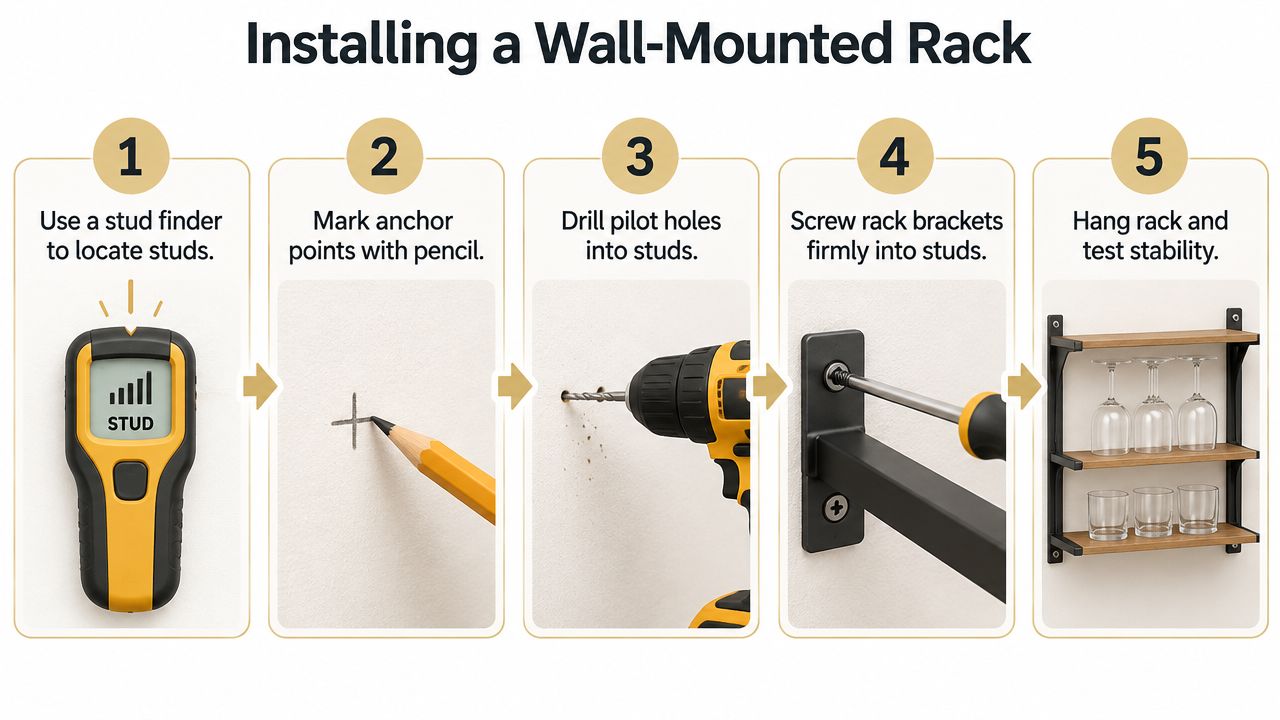
Start with a stud finder. Mark the stud locations, align the rack's mounting holes, drill pilot holes, and fasten the brackets firmly. Masonry requires suitable masonry hardware. Drywall anchors can serve as a fallback only when the rack's load rating and the anchor specification match the intended glass load.
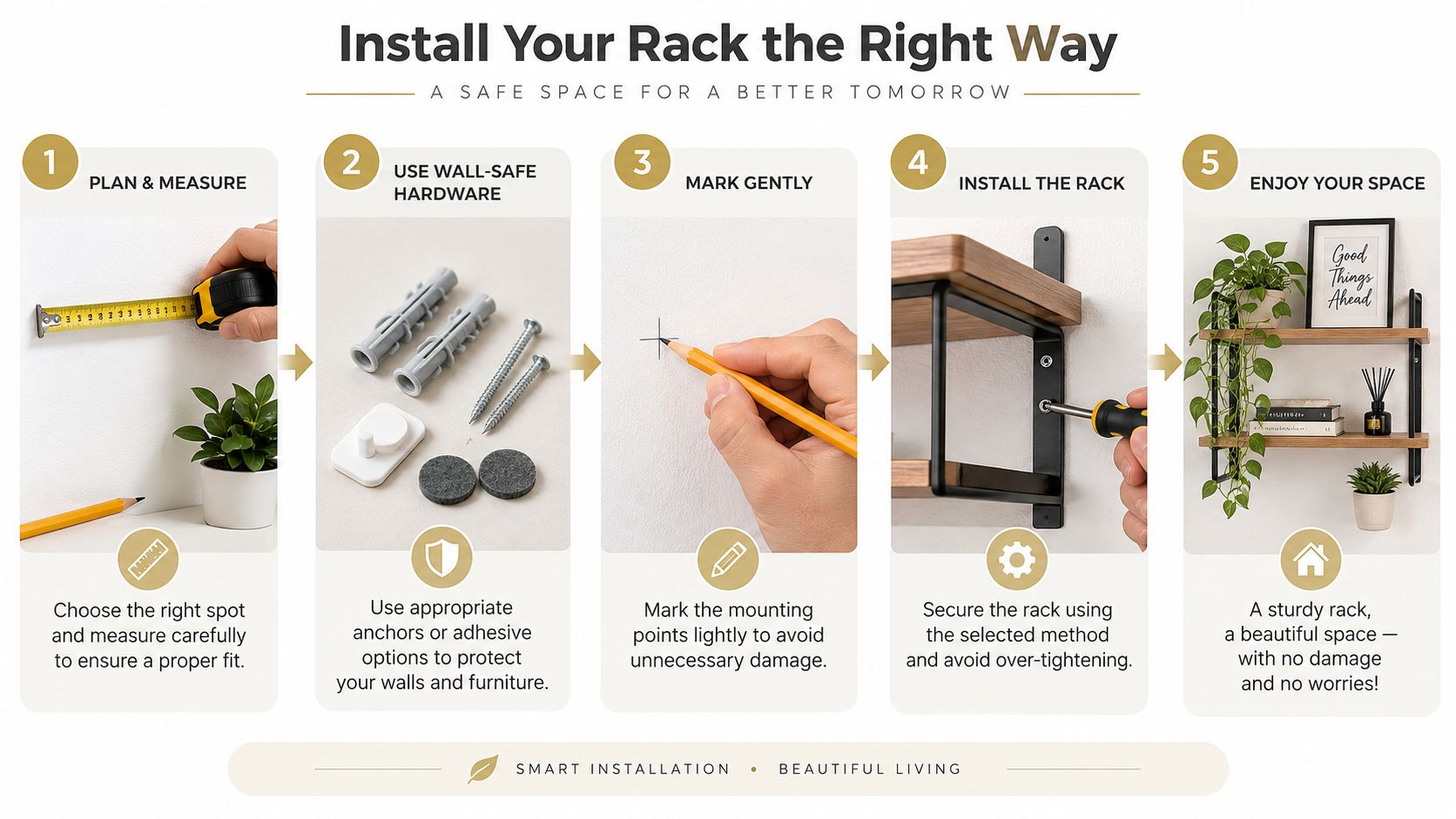
A printed mounting template improves fulfillment for corporate programs. Include the template in every box, along with two drywall anchors as a fallback, but don't present them as a substitute for stud or masonry installation when the rack carries a full crystal set.
Under-shelf and adhesive options
Under-shelf models need enough shelf thickness and vertical clearance for the tallest glass. A useful installation benchmark is a minimum shelf thickness of 0.5 inches and at least 9 inches of clearance below the shelf. Measure from the underside of the shelf to the lowest obstruction, not just to the countertop.
Clean the mounting surface with isopropyl alcohol before applying an adhesive-backed unit. That removes residue that can weaken the bond during temperature swings. Adhesive mounting still belongs only on surfaces and loads approved by the manufacturer.
Freestanding placement
Set freestanding racks on a level bar cart, credenza, or tabletop. Add felt pads beneath the base to prevent scratches, and keep the rack away from areas where people regularly bump the furniture.
Commercial glassware-care guidance recommends a dedicated glass rack rather than a flatware or plate rack. Urban Bar's crystal glassware care advice also emphasizes correct loading, space between pieces, and proper wash conditions. For a gift buyer, that means the rack should be selected as part of the glassware-care plan, not treated as decorative filler.
Building Gift Sets and Corporate Bundles Around a Rack
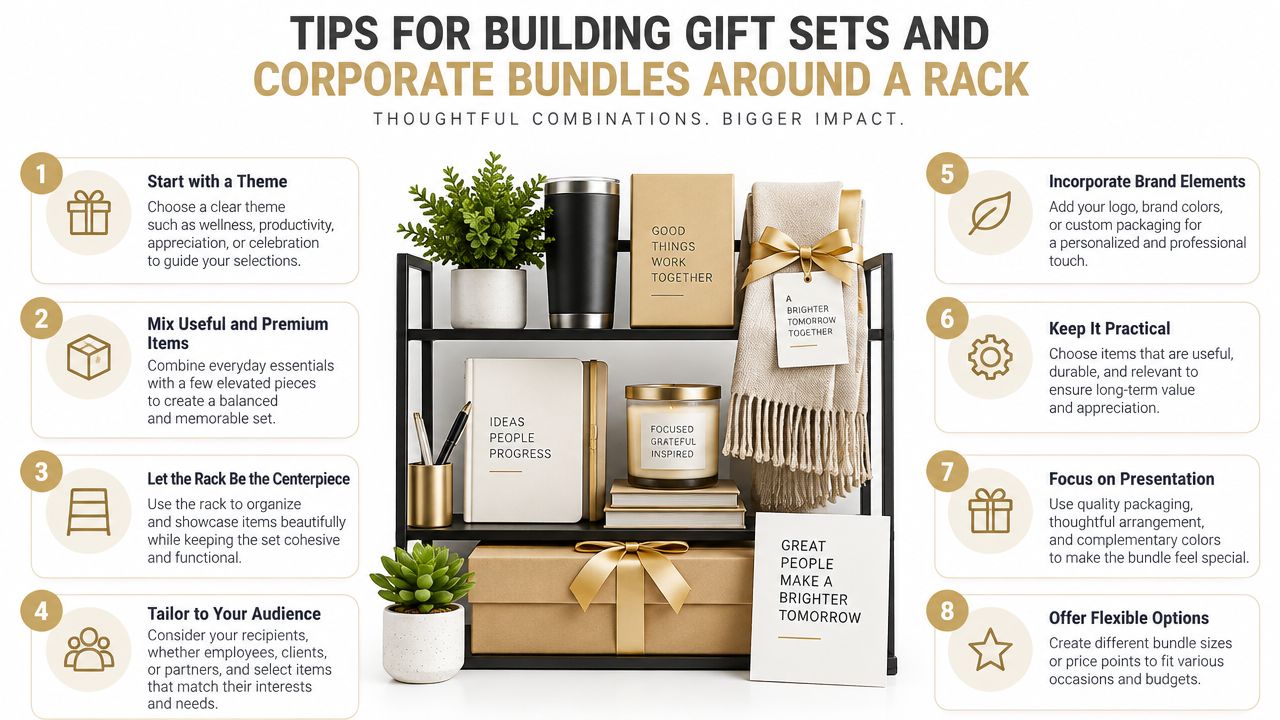
A whiskey glass rack earns its place in a gift assortment because it gives loose accessories a visual center. Without one, a bottle, glasses, and tasting tools can look like items collected from different shelves. With one, the buyer can create a presentation that feels intentional before the recipient pours anything.
Personal gifts need a clear story
For an anniversary package, pair a two-slot oak rack with two matching Glencairn glasses and a small pour bottle. The set stays compact, ships flat, and gives the recipient an immediate display piece. A wood finish adds warmth without requiring a large decanter or elaborate bar cabinet.
For a birthday or housewarming gift, a freestanding rack works better when you don't know the recipient's wall type. It can sit on a bar cart and remain useful even if the recipient rearranges the room.
Corporate sets should stay standardized
For client appreciation, build a tasting trio around a four-slot walnut rack. Combine a nosing glass, a rocks glass, and a copita, then add a printed tasting card. The unused position can hold a second tasting glass or remain available for the recipient's own piece.
Bulk buyers should standardize on two finishes per program. Warm wood fits executive gifts and relationship milestones. Matte black metal suits awards, company anniversaries, and modern office environments. Reusing those finishes across several SKUs simplifies warehousing, packaging, and approval photography.
Branding placement matters: Put the logo on the rack's base, packaging sleeve, or hangtag. Avoid decorating the glass slots, where added material or engraving can interfere with fit.
A rack also supports the broader corporate-gifting case. The global corporate gifting market was valued at about USD 765.46 billion in 2023 and is projected to reach about USD 1.11 trillion by 2028, according to the supplied market context. Corporate gifting commonly supports client acquisition, retention, employee engagement, and event giveaways, which makes a rack relevant as a useful premium item rather than a disposable promotional object.
For packaging inspiration, this gift box guide for glassware helps buyers think about protection, presentation, and the unboxing sequence together. Our assortment is a good fit for these programs because whiskey glasses, chilling accessories, and presentation pieces can be combined into a coherent barware gift rather than sent as unrelated components.
A Smart Buyer's Checklist for Picking the Right Rack
Use this checklist every time you source a whiskey glass rack, whether you're buying one birthday gift or approving a corporate gifting program.
Start with the non-negotiables
- Glass compatibility: Measure the widest part of the glass, the rim, the stem if applicable, and the usable opening in the rack.
- Clearance: Check the space above the rim and between rails. The glass should slide in and out without binding or touching neighboring pieces.
- Load rating: Confirm the rack supports the complete glass set, not just one empty vessel.
- Finish consistency: Request a production sample if the rack will sit beside a branded decanter, tray, or gift box.
- Care requirements: Check whether wood needs oiling and whether plated metal needs protection from humidity.
Match the mounting format to the recipient
A renter or apartment dweller usually needs an under-shelf or freestanding rack. A dedicated home bar can support a wall-mounted design. A trade show or event team should favor a portable format that can move between tables and storage cases.
Check the gift experience
Look for a rack that arrives protected, photographs well, and leaves enough room for the glasses to be presented without forced packing. Branded sleeves, velvet-lined boxes, printed tasting cards, and a logo on the base or hangtag can make the bundle feel complete.
Rank your decision criteria in this order:
- Glass compatibility
- Mounting format
- Material and structural reliability
- Finish, personalization, and display details
That order protects the recipient's experience. A beautiful rack that doesn't fit the glasses is a failed gift. A correctly fitted rack with a suitable finish becomes a reusable presentation asset for birthdays, anniversaries, client gifts, staff recognition, and seasonal campaigns.
If you want to build the surrounding gift set as well, ROCKS Whiskey Chilling Stones offers whiskey chilling stones, whiskey glasses, cocktail glasses, cigar accessories, and gift sets that complement a display-focused barware package. Visit ROCKS Whiskey Chilling Stones to select coordinated pieces for your next personal or corporate whiskey gift.


