

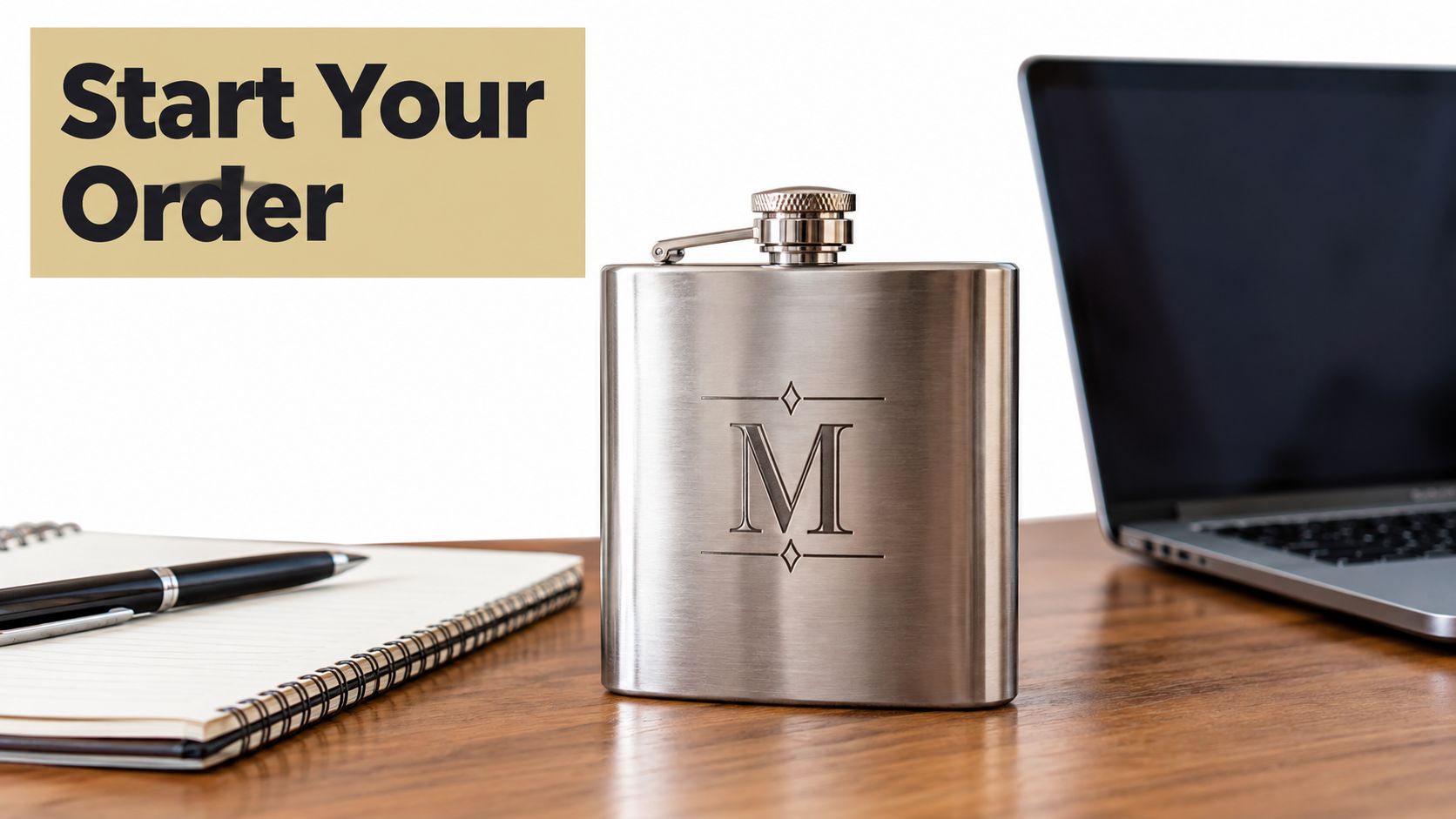
A client has everything, your team member is marking a career milestone, or an event is approaching and the usual gift card feels forgettable. A laser engraved flask gives you a more considered answer. It combines a useful barware object with a name, monogram, logo, or message that makes the gift feel selected rather than purchased.
That balance matters in corporate gifting. A well-made flask can suit client appreciation, employee recognition, wedding parties, milestone birthdays, and event gifting, while its personalization gives the recipient a reason to keep it. The important detail is that the quality of the final gift depends on more than the artwork. Material choice, laser settings, curvature, finishing, and care instructions all affect whether the flask still looks premium after repeated use.
Getting Started with Your Laser Engraved Flask Order
Start with the recipient and occasion, not the engraving machine. A restrained monogram may suit a senior client, while an employee milestone gift might benefit from a name and date. For an event, a small company mark paired with an individual's name often feels more personal than a large logo alone.
Laser engraving became commercially useful through a long development path. The first laser was invented in 1957, CO2 laser beams were introduced for cutting in 1967, and early engraving systems emerged by the late 1970s before industrial use became widespread in the 1980s, as documented in this history of laser engraving and cutting. That background explains why today's personalized drinkware can combine repeatable production with fine detail.
Set the order requirements first
Before you request a quote or approve a product, define four points:
- Recipient details: Confirm names, initials, spelling, titles, and dates before artwork preparation.
- Gift context: Decide whether the flask will stand alone or form part of a larger barware gift set.
- Brand treatment: Choose whether the corporate identity should be prominent, discreet, or absent.
- Delivery requirements: Confirm the required arrival date, packaging expectations, and whether every item needs an individual name.
For corporate orders, consistency matters more than novelty. Ask how the supplier handles repeated names, artwork variations, and quality checks across the order. A professional provider should be able to show a mockup and explain how the design will sit on the curved body.
Practical rule: Choose a simple design that looks intentional at the size it will actually be engraved. A small, clean mark usually feels more expensive than an overcrowded one.
A personalized flask works because it sits between craftsmanship and utility. The recipient can display it, carry it, or use it during a gathering, and the engraving gives the object a clear connection to the giver. That makes our gifting assortment a good fit when you want to pair personalized drinkware with complementary whiskey or cocktail accessories rather than send a disconnected collection of items.
Choosing the Right Flask Material for Engraving
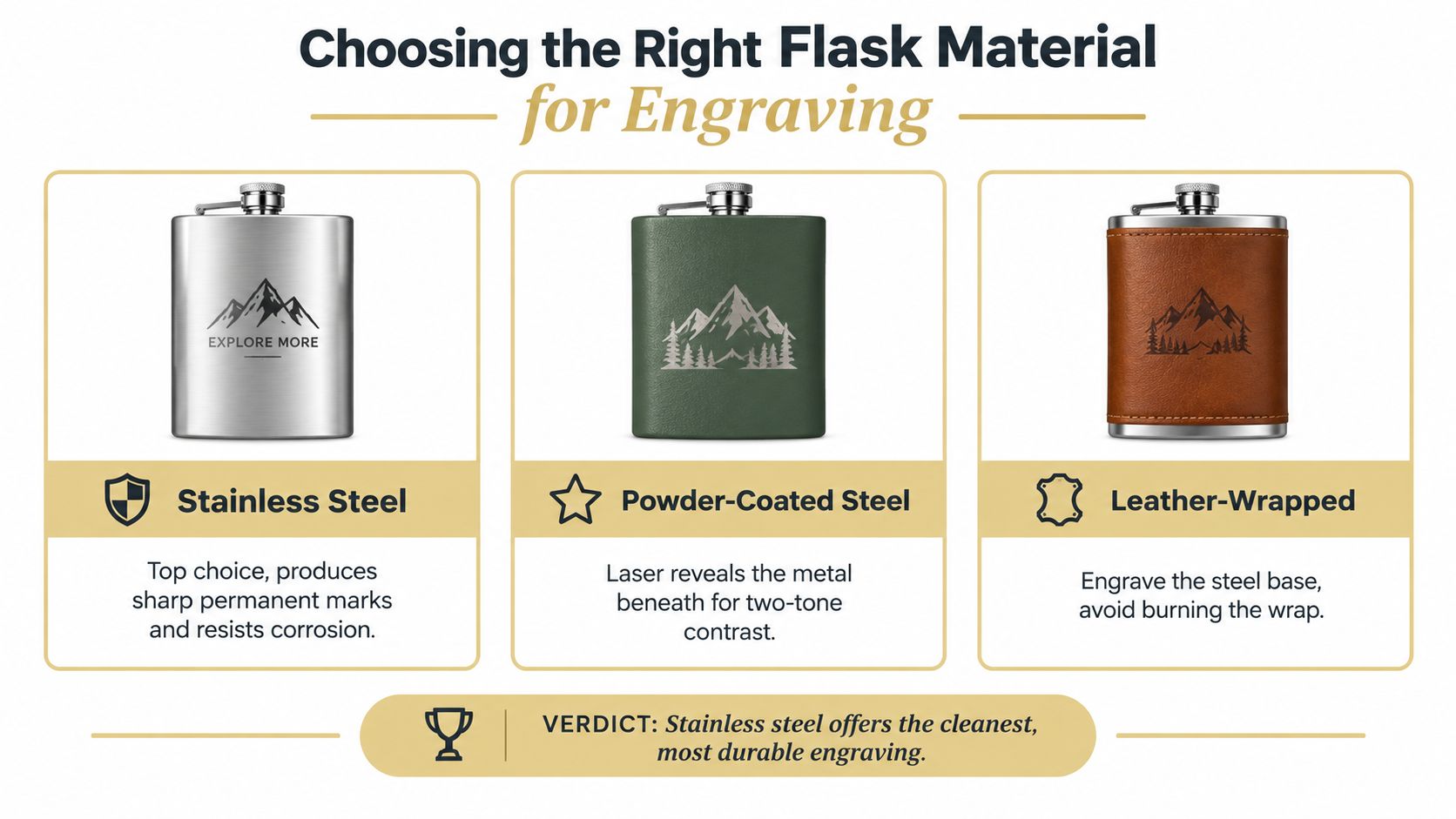
Bare stainless steel is the safest default for a premium laser engraved flask. It offers a clean surface for precise marking, supports a restrained professional look, and is better suited to repeated handling than a decorative finish that can chip or wear away. For client gifts and corporate runs, that predictability is more valuable than a flashy surface effect.
A powder-coated flask can create attractive contrast because the laser removes or changes the coating and reveals the metal beneath. That approach can work well for a company color or a bold monogram, but the result depends on the coating and the production settings. A leather-wrapped flask introduces another layer of judgment. The steel base may be suitable for engraving, while the wrap requires separate handling and shouldn't be treated as bare metal.
Compare the finish before you compare the design
| Flask surface | Engraving character | Buyer's consideration |
|---|---|---|
| Bare stainless steel | Clean, understated marking with a direct metal finish | The strongest all-purpose choice for corporate gifting |
| Powder-coated steel | Contrast between the coating and exposed metal | Confirm the coating response with a sample |
| Leather-wrapped steel | Personalization may belong on the exposed steel base or leather | Avoid treating leather and metal as one identical engraving surface |
The steel grade can influence appearance and processing, but buyers shouldn't select a flask based on grade terminology alone. Ask the supplier what the exterior surface is, whether it has a coating, and whether the intended mark is surface marking or deeper engraving. A clear production answer is more useful than a vague promise that every material behaves the same way.
Material safety also deserves attention. Guidance on laser-machine precautions warns that coated and covered products require different settings and that unknown plastics can produce hazardous fumes. In particular, PVC, polycarbonate, ABS, and unknown chlorinated or fluorinated plastics shouldn't be treated as routine engraving materials without verified compatibility and appropriate ventilation, according to this laser engraving safety guidance.
For a traditional whiskey gift, the flask can be part of a wider ritual rather than the entire presentation. Buyers comparing formats can use this guide to choose a flask for whiskey. If the recipient enjoys cocktail preparation as much as sipping, The Cocktail Smoker Kit is crafted from natural granite stone and includes apple, oak, cherry, and hickory wood chip flavors.
A leather-covered or coated flask can still be a good gifting option, but bare stainless steel remains my recommendation when the priorities are crisp detail, repeatability, and a polished appearance across a corporate order. If the design direction leans artistic, browsing ideas for glass-inspired body art can provide inspiration for line work and texture without copying a complex image onto a small object.
Preparing Your Artwork and File Requirements
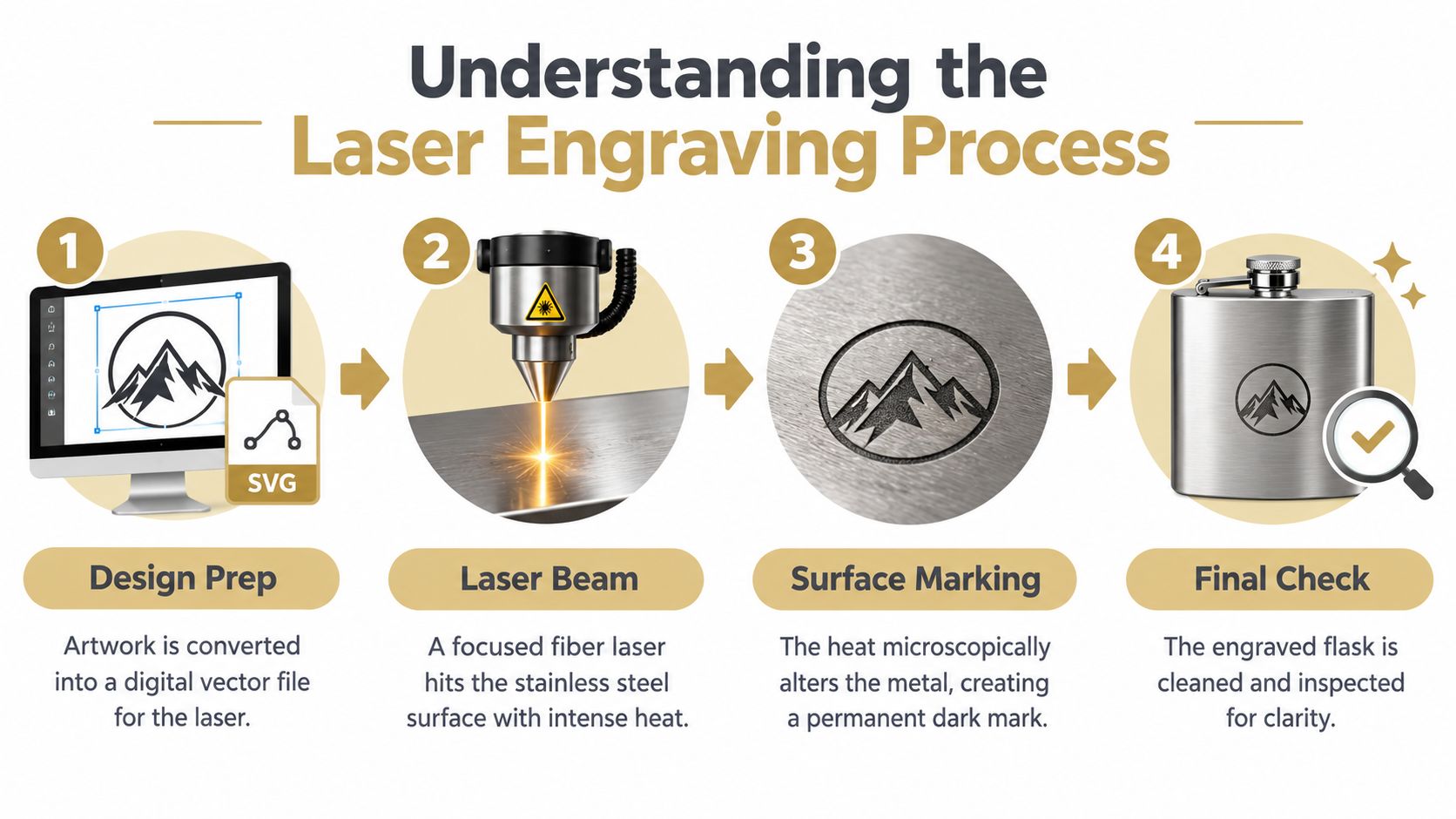
Good engraving starts with artwork that has been prepared for a marking process, not artwork designed only for a screen. Send a vector file such as SVG or AI whenever possible. Vector artwork gives the engraver defined paths and scalable shapes, which helps preserve clean edges for logos, initials, and line illustrations.
A high-resolution raster image can work when a vector isn't available, but a small JPEG is a poor starting point. Pixelation, compression artifacts, and fuzzy edges become more visible when the machine translates the image into a pattern of marks. Ask the supplier whether they prefer a specific file format and whether text should be converted to outlines before production.
Build the design around the flask
Use a short design brief rather than sending a file without context. Include:
- The exact wording, including capitalization and punctuation.
- The preferred position, such as the center front or lower panel.
- The desired visual hierarchy, such as name first and company mark second.
- A reference for the intended finish, such as a dark surface mark or a deeper tactile engraving.
- Any exclusion zones near seams, edges, caps, or hardware.
Contrast matters because the laser needs a clear distinction between the artwork and the background. A single-color design is usually easier to interpret than a full-color graphic. In practical terms, convert the artwork to black and white, remove unnecessary gradients, and inspect thin lines at the approximate finished size.
A corporate logo may look elegant on a presentation slide but lose its character on a curved flask if it contains tiny lettering or closely spaced details. Simplify where necessary. Keep the recognizable symbol, remove decorative clutter, and give the name enough breathing room to remain legible.
Treat text as a production detail
Check every personalized line manually. A misspelled name can't be corrected after engraving, and a date with inconsistent formatting can make a coordinated gift order look improvised. For a group order, create a final name list and compare it against the approved artwork before production begins.
Small text also needs practical judgment. Ask for a size that remains readable on the flask rather than forcing a long message into a narrow area. A short phrase, monogram, or recipient name generally has a better chance of retaining clarity than a paragraph.
Design advice: If the recipient needs to understand the gift at a glance, reduce the artwork until the main name or mark is unmistakable. Detail should support recognition, not compete with it.
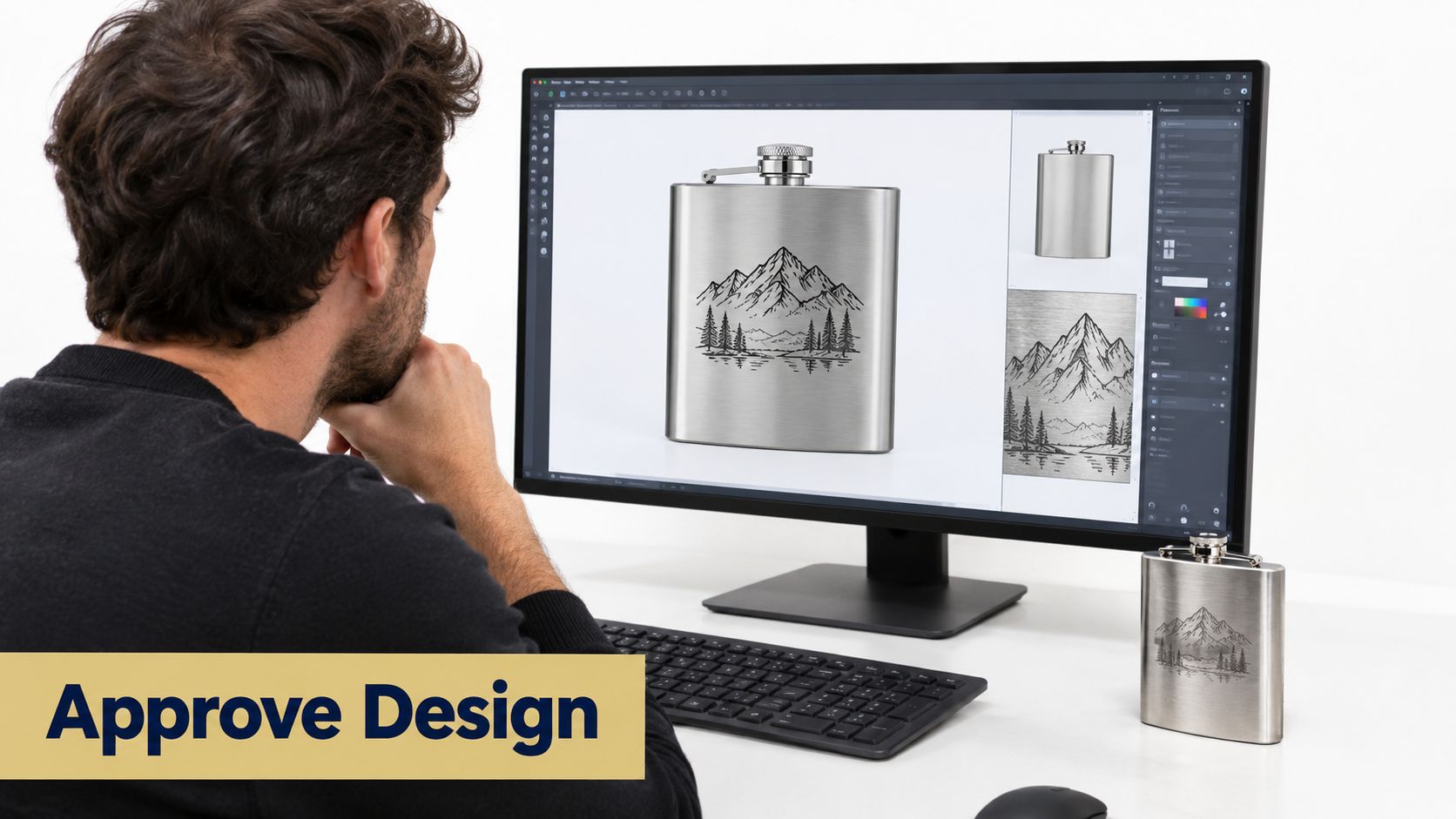
Request a digital proof that shows the design on the actual flask shape, not just as a flat logo file. That proof will reveal whether the mark sits too close to the curve, whether the text needs rotation, and whether the design has enough visual balance for the chosen surface.
Understanding the Laser Engraving Process
Professional stainless-steel flask engraving typically uses a 1064 nm pulsed fiber laser. For most marking and light-to-medium engraving, the common working range is 20 to 50 W, while deeper engraving may require more power or a longer cycle time, according to stainless-steel marking guidance from Gravotech.
The machine doesn't "draw" the design like a printer. It directs a focused beam across the surface according to the digital artwork, and the selected combination of power, pulse behavior, frequency, speed, and passes determines the resulting mark. A dark mark and a tactile groove are different production goals, so a buyer should specify the intended appearance instead of asking only for “engraving.”
Settings determine the finish
For a black mark on stainless steel, operators generally use high frequency and low pulse energy. For a deeper result, they can move toward higher pulse energy, use multi-pass hatching, and finish with a skim pass. Those choices affect contrast, texture, cycle time, and the chance of creating grooves that are harder to clean.
The flask must remain stable during marking. A fixture prevents movement, while careful focusing helps keep the mark consistent across a curved surface. Curvature is a common source of disappointment because a design that looks correct in a flat file can vary in sharpness if the working distance changes across the body.
Ask how quality is checked
For a personal gift, visual inspection may be enough. For traceable corporate products, ask the supplier how they verify mark quality and whether they can assess it against ISO/IEC 29158 when traceability matters. That doesn't guarantee that every design will suit every flask, but it gives the buyer a more concrete quality conversation than a general promise of permanence.
A sensible production workflow includes cleaning and fixturing the flask, selecting a lens for the desired feature size, testing the settings, engraving, and inspecting the final mark. Providers should also account for seams and hardware instead of placing an important logo where the surface changes abruptly.
Glass requires a different technical approach, so buyers should keep metal and glass specifications separate. This guide to engraving glass is useful when a gift order includes etched glassware alongside a stainless-steel flask. For a more social whiskey presentation, The Rocks x Trivia Quiz Set contains 100 whiskey questions and is described as a bundle for pairing with a bottle of whiskey or bourbon.
The buyer's role isn't to dictate a machine's exact settings. It is to define the finish, approve a representative proof, and require consistency checks when the order carries a company's name.
Reviewing Mockups and Approving Your Design
A corporate buyer once receives a proof showing a logo perfectly centered on a flat rectangle. The production team engraves it onto a curved flask, and the mark appears visually pulled toward one side. The issue isn't the logo file. It is the gap between a flat preview and the object.
A mockup prevents that kind of avoidable mistake. It should show the flask from a realistic angle and place the artwork on the actual engraving area. If the order includes names or individual messages, request a representative proof that demonstrates the longest name, the shortest name, and any design variation that could affect alignment.
Review the proof like a production buyer
Look at five points before you approve:
- Placement: Is the design centered on the visible face, with enough distance from the seam, cap, and edges?
- Scale: Does the name remain readable without overpowering the flask?
- Curve: Does the artwork follow the body naturally rather than looking rotated or distorted?
- Contrast: Does the proposed mark match the finish you expect?
- Consistency: Will the same logo treatment work across every recipient version?
Don't approve a proof because the artwork itself looks attractive. Approve it because the relationship between the flask, the design, and the recipient is correct. A small monogram may need more space around it than a wide corporate mark. A long surname may need a different line break from a short one.
Use one clear approval record
Send feedback in one consolidated message. Identify the exact change, attach the corrected artwork if needed, and state which version is approved. Avoid giving separate instructions through email, chat, and phone, because production teams can miss a late change when the order contains many variations.
Approval checkpoint: No production should begin until the buyer has approved both the artwork and its placement on the flask. A proof is useful only when it represents the finished object closely enough to support a decision.
For employee or client gifting, keep the approved name list with the final proof. Check the spelling one last time, especially if the supplier is importing names from a spreadsheet. Confirm whether capitalization, accents, initials, and dates should follow a single style.
Mockups also help you make a broader presentation decision. If the flask is the hero gift, keep the engraving restrained and let the object carry the moment. If it forms part of a whiskey gift set, coordinate the tone of the mark with the rest of the barware so the final package feels deliberate rather than assembled from unrelated products.
Caring for Your Engraved Flask to Maintain Quality
Engraving isn't purely cosmetic, even though buyers often treat it that way. Independent manufacturing guidance describes stainless-steel laser engraving as surface-only, leaving the underlying alloy intact, but deeper or poorly controlled marks can create grooves where staining, pitting, or residue buildup becomes more likely. The guidance on engraved flask rust and maintenance is especially relevant for flasks used with acidic spirits or mixed drinks.
That distinction changes the care advice. A shallow, well-controlled mark on a sound stainless-steel surface should be easier to maintain than a deep groove with rough edges. The engraving can remain durable while the surrounding finish loses its polish if the owner uses abrasive products, leaves residue inside, or exposes the flask to aggressive cleaning conditions.
Give the recipient practical care instructions
Recommend a simple routine:
- Empty it promptly: Don't leave spirits or mixed drinks sitting in the flask longer than necessary.
- Hand wash the interior: Use warm water and a mild detergent, then rinse thoroughly.
- Clean around the mark gently: A soft cloth or non-abrasive sponge is preferable to scouring pads.
- Dry it fully: Leave the cap off while the interior dries so moisture doesn't remain trapped.
- Store it clean: Residue and damp storage create a worse ownership experience than normal handling.
Dishwasher exposure deserves caution. Heat, detergent chemistry, and forceful water can affect the exterior finish, seals, coatings, and overall presentation, even when the engraved mark itself remains visible. For a premium corporate gift, hand washing is the sensible recommendation because it protects the whole object rather than focusing only on whether the letters survive.
Match care to the flask finish
Bare stainless steel, powder-coated surfaces, and leather-wrapped designs don't share identical maintenance needs. A coated flask can show wear where the finish has been removed, while a leather wrap should be kept away from excess moisture and unsuitable cleaning products. Tell recipients what surface they received instead of giving a generic care card.
The most important warning concerns deep engraving and residue. If the mark has a pronounced groove, clean it carefully and inspect it periodically. Staining doesn't automatically mean the flask is unsafe, but it signals that the surface needs attention and that the production depth may not have been appropriate for the intended use.
Care principle: A permanent mark isn't a maintenance-free product. The engraving can last, but the gift retains its premium appearance only when the owner cleans the flask gently and treats the finish according to its material.
This is why production quality matters in corporate gifting. A flask that looks impressive on presentation day can lose perceived value if the surface dulls, stains, or becomes difficult to clean. Include concise care guidance with the gift, particularly when recipients may carry the flask while traveling or use it during events.
Making Your Laser Engraved Flask a Standout Gift
A standout flask begins with bare stainless steel, focused artwork, a realistic mockup, and a supplier that understands curved-surface production. Keep the engraving concise, approve the placement before the order runs, and give the recipient care instructions that protect the entire finish. Those choices turn a functional flask into a keepsake with a clear connection to the occasion.
The gifting case is strong. The global corporate gifting market is estimated at $886.56 billion in 2025 and projected to reach $956.93 billion in 2026, with a 7.9% CAGR, according to The Business Research Company's corporate gifting market report. Another market report says around 58% of corporate gifting spending goes to premium gifts and nearly 33% of companies prefer custom gifts, as reported in Global Growth Insights' corporate gifting data.
Personalization also fits recipient expectations. One industry source reports that 62% of businesses focus on customized gifts, while another says more than 34% of gift orders include customization, according to Gift a Feeling's corporate gift statistics. A 2025 multi-country survey cited by a market report found that 68% of consumers in the US, UK, Germany, and Australia prefer personalized gifts for milestones, as described in Dataintelo's personalized gifts market report.
For additional gift ideas aimed at male recipients, this guide to custom apparel gifts for men can broaden the shortlist. For barware buyers, laser engraving on glassware offers a useful comparison when you're building a coordinated personalized gift rather than choosing a flask alone.
ROCKS Whiskey Chilling Stones offers whiskey chilling stones, cocktail glasses, whiskey glasses, cigar accessories, and gift sets for spirits lovers, including options suited to corporate gifting and client appreciation. Visit ROCKS Whiskey Chilling Stones to explore premium barware that can complement a carefully selected laser engraved flask.


