

You've found the right gift, but the engraving box is suddenly the hardest part. A name, a date, initials, or a company logo can turn a handsome decanter into something personal. It can also create an expensive mistake if the artwork is too detailed, the text exceeds the available space, or production misses the event.
A personalized wine decanter works when the recipient will use it, display it, and recognize why it was chosen. This guide focuses on those practical decisions, from engraving technique and character limits to packaging, delivery controls, and material choice. Our assortment is a strong fit for gift seekers and corporate buyers who want personalized barware with a clear purpose, not another anonymous accessory.
Why Personalization Turns a Decanter Into a Keepsake
You're looking at the order form and debating whether to engrave a full name or just initials. The full name feels warmer, but initials look cleaner. Add a date and the design may become crowded. That small moment of hesitation matters because engraving isn't decoration you can casually replace later. It defines what the recipient will see every time the decanter goes onto the bar.
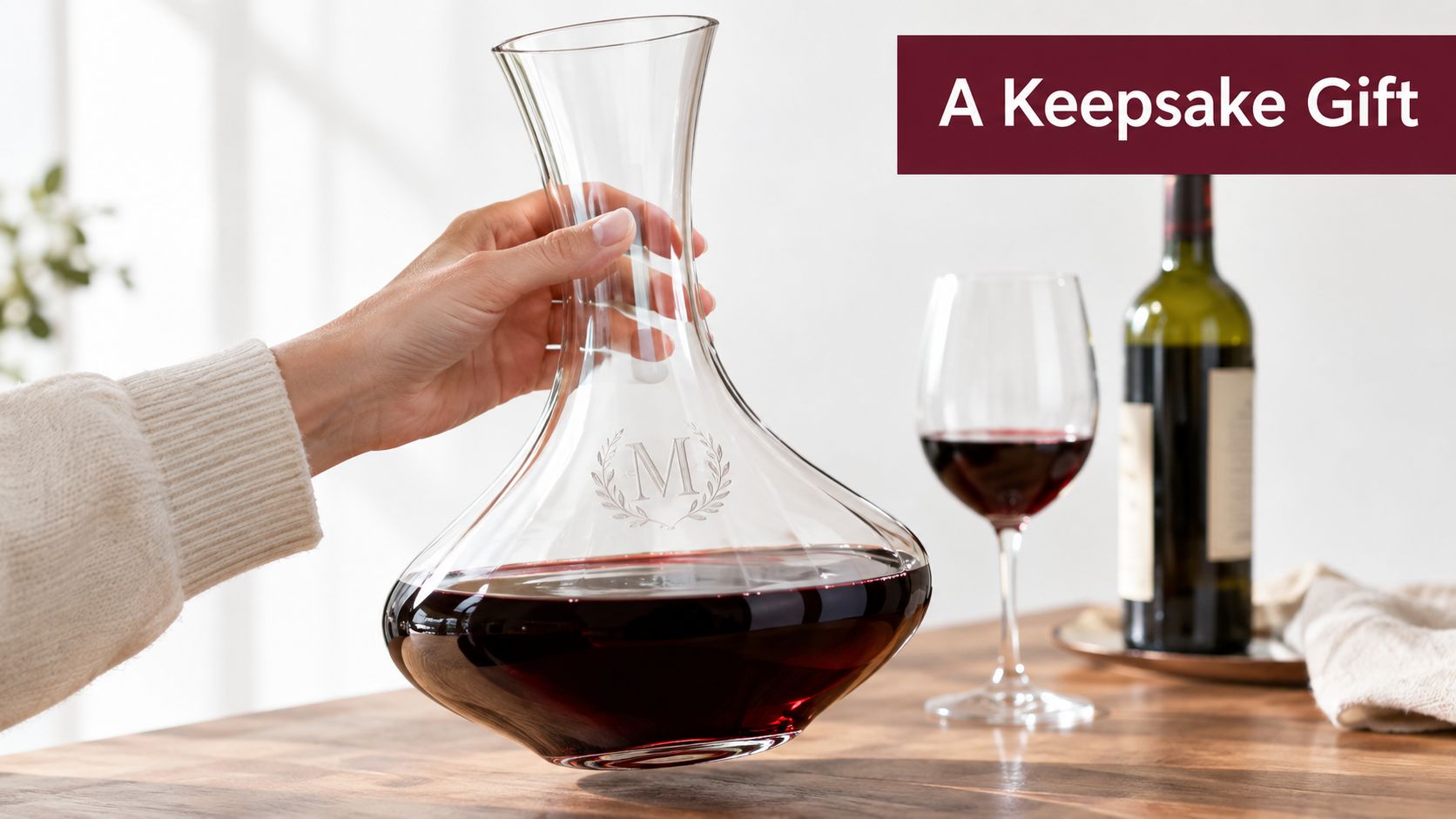
Historically, decanters became standard table vessels because wine could move from a cellar bottle into a more elegant container for handling and presentation. Modern custom versions preserve that role while adding permanent engraving for names, dates, monograms, and logos, as described by Brava Marketing's overview of decanters. The object still serves wine, but the mark gives it a specific owner and occasion.
That's why a personalized decanter fits so many gifting moments:
- Weddings and anniversaries: Use names, initials, or the celebration date.
- Housewarmings: Pair a practical serving piece with the recipient's new home.
- Milestone birthdays: Choose a restrained monogram or a meaningful year.
- Corporate gifting: Add the recipient's name, an event mark, or a company logo.
My recommendation: Personalize for the recipient, not for the product listing. A short monogram usually looks more refined than a crowded message.
The permanent nature of etched decoration also supports the price premium. A disposable bar accessory is easy to forget. A custom decanter becomes part of a bar cart, dining room, or office display, especially when the engraving connects it to a person or shared achievement. Buyers considering a broader wine presentation gift can also explore how to create a custom wine bottle, then use the decanter as the lasting serving piece.
For a related presentation idea, an etched crystal decanter shows how personalization can sit naturally alongside other premium barware. The practical takeaway is simple: engraving is what changes the gift from a bar accessory into a keepsake. The rest of the purchase is about making that engraving readable, durable, and appropriate for the occasion.
Engraving Methods Compared
Choosing the vendor before choosing the engraving method is backwards. First decide what the artwork needs to reproduce, then select the process that can deliver it without weakening the design.
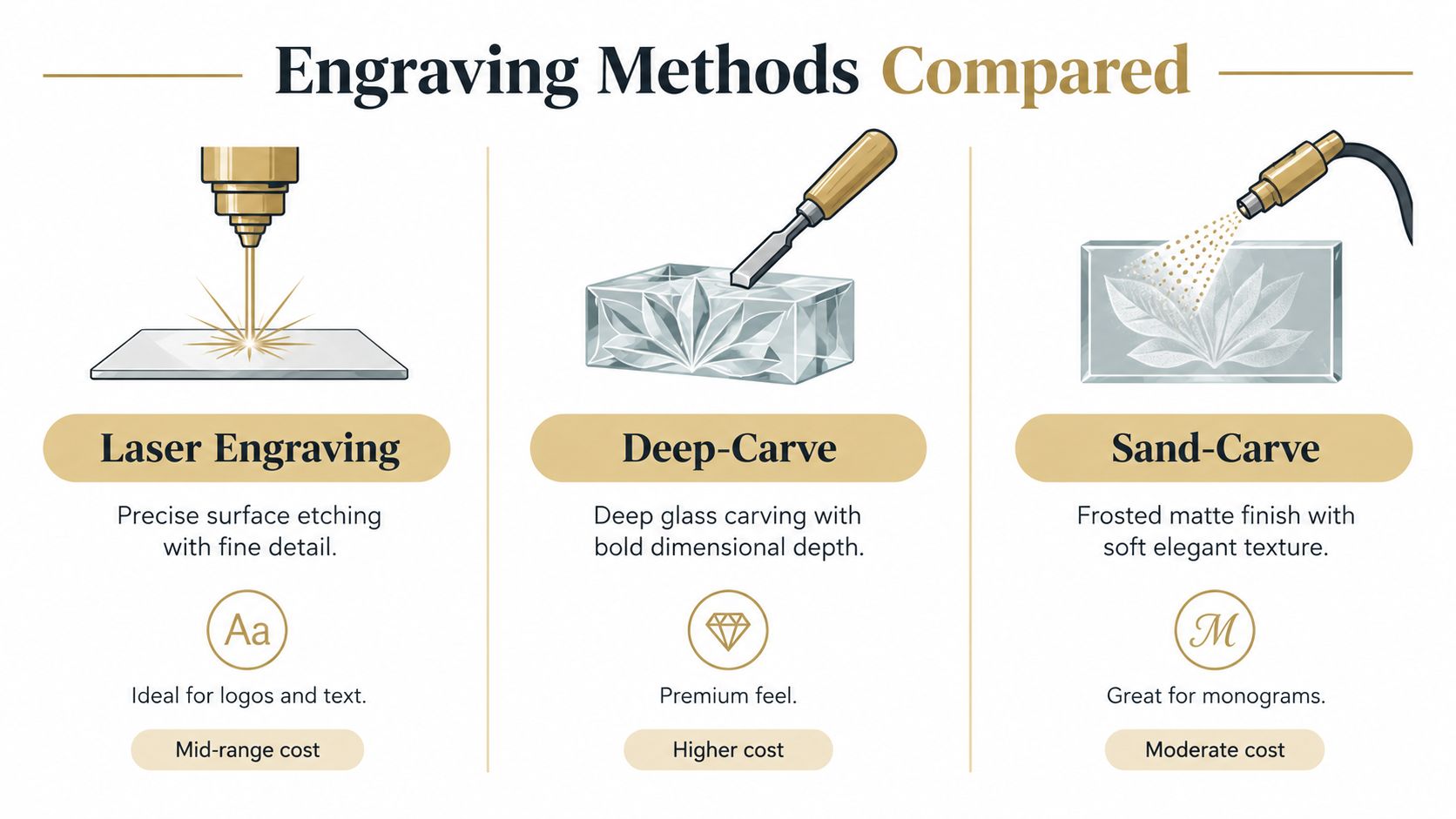
Laser engraving
Laser engraving creates a shallow surface etch with a frosted-white appearance rather than an inked or colored graphic. It's the most dependable choice for intricate logos, small text, and precise line work. It also handles the kind of detail corporate buyers often need when a logo includes several internal shapes.
The limitation is important. Laser engraving can't reproduce gradients, shading, or color fills, so a full-color logo must be simplified into monochrome line art before production. Choose laser engraving for a company mark, a detailed crest, or a compact name treatment.
Deep-carve
Deep-carve methods remove more glass around the artwork and create stronger tactile depth with a dimensional, raised effect. That extra relief gives a milestone gift a more substantial feel, particularly when the design is a bold monogram or simple emblem.
The trade-off is production complexity. Deep carving removes more material and is slower than a shallow laser mark. Dense artwork, tiny lettering, and delicate internal details are poor candidates because the design can lose clarity as the carving becomes more aggressive.
Sand-carve
Sand-carve decoration also removes glass to create a frosted, tactile finish. It's well suited to elegant monograms, broad lettering, and designs where soft texture matters more than micro-detail. Many buyers choose it for presentation-led wedding, anniversary, or executive gifts.
Sand-carve and deep-carve methods offer more depth than laser engraving, but they're less forgiving with crowded artwork and generally demand more production time.
| Method | Best for | Cannot reproduce well | Gift effect |
|---|---|---|---|
| Laser engraving | Detailed logos, fine text, intricate line art | Gradients and color fills | Crisp and precise |
| Deep-carve | Bold monograms and premium milestone designs | Dense fine detail | Strong tactile depth |
| Sand-carve | Soft monograms and elegant lettering | Very small or crowded artwork | Frosted, understated texture |
The glass engraving guide from ROCKS Whiskey Chilling Stones is useful if you want to understand the broader process before submitting artwork. My rule is straightforward: use laser engraving for precision, and choose deep-carve or sand-carve when depth is the primary part of the gift experience.
Preparing Names, Monograms, and Logos for Engraving
A good glass blank can still produce a poor gift if the artwork arrives unprepared. Laser engraving permanently etches the crystal or glass, so the final result is a frosted mark, not printed ink. Artwork that looks attractive on a screen may become muddy once reduced and wrapped around a curved surface.
Start with artwork the process can reproduce
The safest source files are single-color line art and clip-art-style designs. Supply a high-resolution raster file or, preferably, an editable vector file. Convert the design to monochrome before the vendor prepares the proof.
This removes the false expectation that color or gradient effects will survive. The engraving process can define light and dark through etched areas and untouched glass, but it doesn't reproduce a photographic fade or a colored fill. Fantasy Glassworks explains why single-color artwork supports clearer laser engraving.
Check the details that disappear first
Small text and dense logos need the most scrutiny. Fine lines can close up, narrow gaps can disappear, and reversed logos can lose their intended contrast. A complicated corporate emblem may need simplified lettering or fewer internal shapes before it's suitable for a decanter.
Use this preparation sequence:
- Supply the cleanest file available. Avoid screenshots or compressed images where possible.
- Convert the design to monochrome. Remove gradients and color-dependent details.
- Inspect line thickness. Ask the vendor whether the thinnest strokes are suitable for the selected process.
- Check negative space. Open areas around letters and symbols must remain visible after etching.
- Review the final-size proof. Don't approve artwork only at large screen size.
Test every corporate logo and detailed monogram at its actual engraving size on the decanter curve before production.
For names, keep the typography simple and give the vendor a clear spelling confirmation. For monograms, decide whether the initials should be ordered by first name, surname, and middle name, or displayed in the order you provide. That detail is easy to overlook and impossible to correct after engraving.
Choosing the Right Size and Shape for the Occasion
Capacity should follow the recipient's habits, not just the visual appeal of the glass. A broad, dramatic decanter may look impressive in a product photo but prove awkward for someone who wants a compact piece on a bar cart. A narrow form may display engraving beautifully while offering less surface area for aeration.
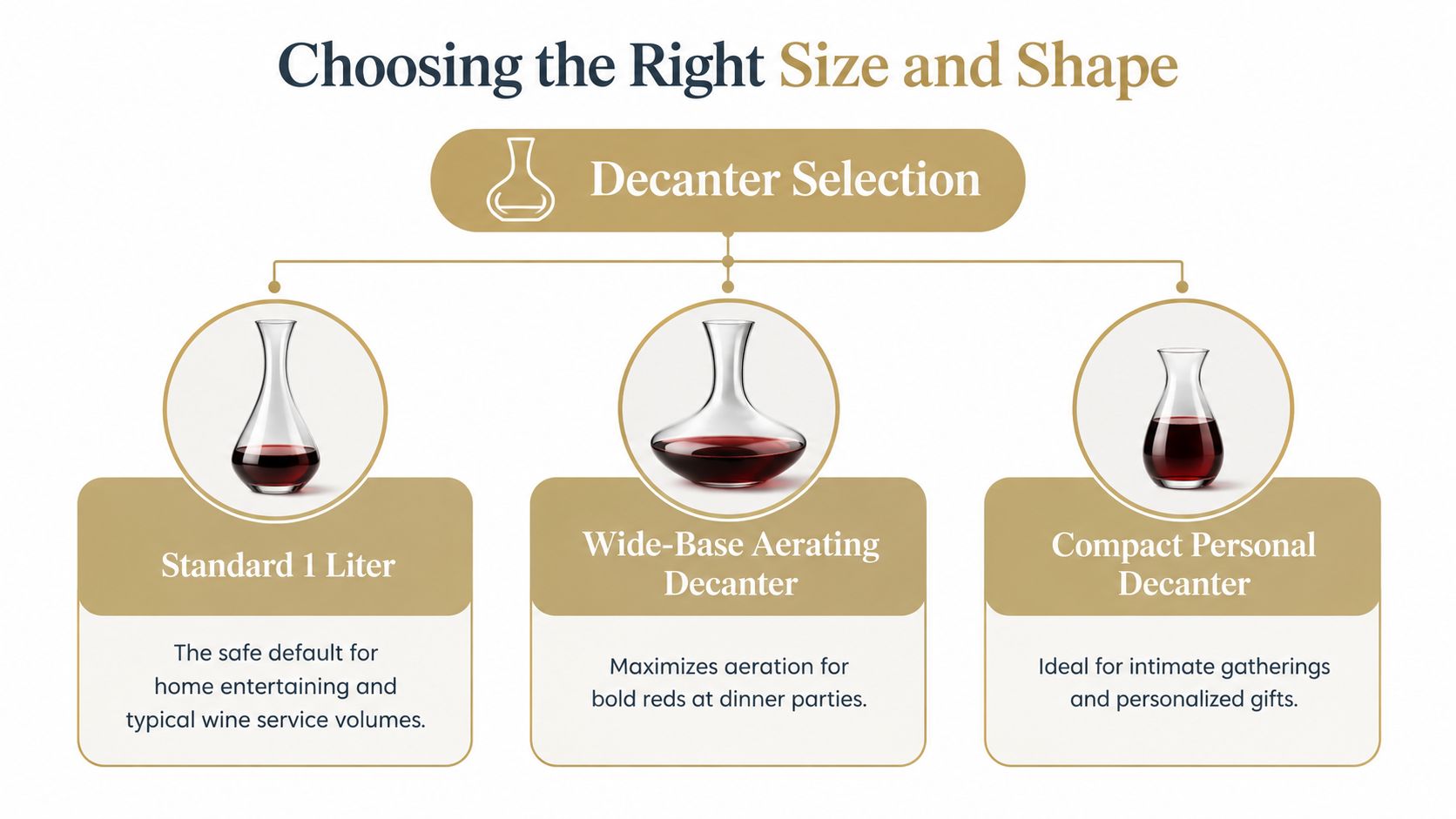
Make 1 liter the default serving choice
One liter is a common personalized decanter capacity, aligning with typical wine service volumes and working well for home entertaining and premium gift sets, according to Brava Marketing's decanter information. It's the safe choice when you don't know the recipient's exact preferences.
A broad-shouldered shape gives red wine more exposed surface area and suits hosts who regularly serve guests. Its generous body creates a functional reason for the gift beyond the engraving. A narrower upright design places more emphasis on display, and its flatter side panel can make names, dates, and logos easier to position cleanly.
Match the form to the event
Choose a wide-base aerating decanter for a confident host, a wine enthusiast, or a dinner-party gift. Select a more upright model for an anniversary, executive recognition, or housewarming where the decanter will spend as much time displayed as it does in use.
Compact formats can work well for intimate gifts and smaller bar carts. One listed model has a 34 oz capacity and laser engraving customization, while another permits up to three characters on the top line and fifteen characters on the lower line, as shown in the Cristoff decanter engraving listing.
That character limit should influence the gift before you place the order. A three-character top line might suit initials, while the lower line can carry a surname or short date treatment. It won't accommodate every message, and forcing extra text onto a curved surface makes the result look cramped.
If the recipient entertains, prioritize capacity and stability. If the gift is primarily commemorative, prioritize the engraving panel and display silhouette.
Why Personalized Wine Decanters Work for Corporate Gifting
A client opens a gift box after closing a major deal and finds a decanter engraved with their name and the deal date. That item is more likely to stay on a shelf where colleagues see it than a logo-only carafe that goes into storage. Corporate buyers should treat a personalized decanter as usable presentationware, not ordinary promotional merchandise.
It suits client appreciation, milestone recognition, holiday gifting, executive onboarding, and event favors. The recipient can use it at home, display it in an office, or keep it with other barware. The right engraving makes the gift feel selected for a person rather than distributed to a list.
Where the gift earns its place
For a client, engrave the recipient's name and keep the company mark restrained. For an employee milestone, use the person's name with the recognition date. At an event, make the logo secondary and let the recipient's identity lead. Executive onboarding gifts work best with a clean monogram or name.
Personalized and engraved decanters can carry a 15-25% price premium over base products, according to Barchart's coverage of corporate alcohol gifting requirements. I support that premium when the decanter, engraving, and presentation match the recipient and occasion. A poorly chosen item still feels like merchandise, regardless of the personalization.
Plan the logistics before approving artwork
Corporate alcohol programs commonly involve:
- Adult-signature delivery: Someone of legal age may need to receive the shipment.
- Address restrictions: PO Boxes and APO addresses may not be accepted.
- State checks: Availability can vary by destination.
- Production time: Personalized or logo-engraved orders commonly need seven to ten business days during peak season, so build that window into the event date.
Confirm the recipient's address, delivery requirements, artwork, character limits, and arrival date before placing a group order. A carefully engraved gift that arrives after the event has missed its purpose. For corporate buyers, personalized barware works when recognition, practical use, and reliable fulfillment are planned together.
Packaging and Presentation That Match the Price
Engraving gets the attention, but packaging determines the opening experience. A decanter should ship in a rigid gift box with nested foam or a molded insert that protects the stopper, neck, and body. Loose wrapping inside a large carton signals poor planning and increases the chance of damage.
The engraving should be visible as soon as the box opens. Use a cutout, a presentation card, or a deliberate orientation that places the name or logo toward the recipient. If the gift includes a note, mention the personalization directly so the recipient knows the design was made for them.
Select the right presentation tier
A single decanter suits a housewarming or personal milestone. A decanter with matching glasses feels more complete for client appreciation and home-bar gifting. A premium crystal bundle belongs in executive recognition or major anniversary programs where presentation carries as much weight as function.
Commercial listings show a customizable wine decanter at $46, while other suppliers offer higher-end engraved crystal bundles, creating a broad range from accessible gifting to premium corporate presentation. Decanter Engraving's personalized housewarming gift examples also show that some suppliers advertise fulfillment as fast as 1–3 business days. Confirm the actual production and transit schedule before relying on that window.
| Tier | Typical Price | Packaging | Best For |
|---|---|---|---|
| Accessible personalized decanter | $46 listing example | Protective gift box | Housewarming and personal gifts |
| Decanter and glass set | Varies by supplier | Rigid box with fitted insert | Client appreciation and celebrations |
| Premium engraved crystal bundle | Higher-end pricing | Presentation box with premium finishing | Executive recognition and corporate milestones |
If you need a separate carrier for a bottle or coordinated shipment, Bottle Bags, Wholesale Bottle Carriers & Wine Bags can help with branded transport and presentation. For glassware packaging ideas, this gift box guide for glassware is also a practical reference.
Engraved items are often non-returnable. That makes proof approval the key quality-control stage. Confirm every name, date, logo, orientation, and line break before production, then match the packaging to the occasion rather than treating it as an afterthought.
Your Ordering Checklist Before You Commit
Use this checklist before you pay for a wine decanter personalized gift:
- Match method to artwork. Choose laser engraving for fine logos and detailed text. Simple monograms can suit laser, deep-carve, or sand-carve.
- Confirm characters and curvature. Check the available panel, including limits such as three characters on one line and fifteen on another where applicable.
- Approve a digital proof. Review spelling, spacing, line thickness, logo simplification, and placement.
- Confirm the delivery date. Include production time, transit, and peak-season capacity.
- Verify the recipient address. Corporate orders may require adult-signature delivery and may exclude PO Boxes or APO addresses.
- Check the material. Lead crystal is generally suitable for short-term serving when washed thoroughly, but the FDA guidance summarized here advises against storing acidic beverages in it for more than a few hours. California Proposition 65 requires warnings on lead crystal products sold there.
Personalization succeeds when these details are confirmed before the order is placed.
ROCKS Whiskey Chilling Stones offers personalized decanter gift sets with engraving for names, initials, dates, and company logos, supported by a digital preview before ordering. Visit ROCKS Whiskey Chilling Stones to choose a coordinated barware gift for a client, employee, celebration, or spirits enthusiast.


