


You're searching for a gift that looks substantial the moment it's unwrapped, but still earns a place on someone's bar cart years later. A tall crystal decanter often makes that first impression. It catches the light, frames a favorite whiskey beautifully, and feels appropriate for a milestone birthday, wedding, housewarming, or important client.
The difficulty starts after the sparkle. What does “crystal” really mean? Is a leaded decanter suitable for storing whiskey? Does the stopper seal tightly enough? Will the tall shape be stable, and can the recipient clean it without damaging the glass?
This guide answers those questions in practical terms. You'll learn what the form was designed to do, how lead crystal differs from lead-free crystal and crystalline glass, which specifications matter most, and how to care for and present a decanter as a thoughtful personal or corporate gift.
Why a Tall Crystal Decanter Makes Such a Memorable Gift
You've found a birthday gift for a whiskey enthusiast, but a bottle alone feels temporary. You've considered glassware, but you want something that looks more distinctive on a shelf. Then you see a tall crystal decanter, often paired with matching glasses, and the choice becomes easier. It has the visual presence of barware, the usefulness of a serving vessel, and the ceremony of a keepsake.
That combination works across occasions. A whiskey-loving husband may use it during weekend tastings. Someone moving into a new home may display it as the centerpiece of a bar cart. A company can give a decanter set to a client, employee, or event guest without making the gift feel disposable.
The object also carries a sense of place and hospitality. Someone planning a wine-country experience might enjoy exploring an art-filled Napa Valley winery alongside the same ideas of craft, presentation, and shared tasting that make a decanter memorable.
Gift buyer's perspective: A decanter feels personal without requiring you to know someone's exact clothing size, home fragrance preference, or taste in gadgets.
For corporate purchasers, the format has another advantage. A decanter can stand alone as a formal gift, or it can become the foundation of a complete set with whiskey glasses, chilling stones, a serving tray, or personalization. That flexibility makes it suitable for client appreciation, employee recognition, holiday gifting, and premium event programs.
The important detail is that appearance shouldn't be your only filter. A beautiful decanter with an unclear material specification or loose stopper may be a weaker choice than a less ornate model with documented glass composition and a dependable closure.
By the end of this guide, you'll know what to look for, what questions to ask a supplier, how to protect the glass in daily use, and how to choose a tall crystal decanter that feels generous without creating avoidable storage or care problems.
What a Tall Crystal Decanter Actually Is
A decanter is to a bottle what a frame is to a painting. The liquid may already be excellent, but the vessel changes how people see, pour, and share it.
The tall crystal decanter uses height and a narrow neck to create controlled pouring. The neck helps direct the flow, while the body gives amber whiskey, brandy, or cognac a visible stage. Facets work a little like a prism. Light enters the glass, bends through the material and cut pattern, and returns as bright flashes across the bar or dining table.
The shape also has a practical history. Although the Romans invented glassblowing during the 1st century AD, the decanter in its recognizable modern form dates back approximately 300 years. English customs records contain early references to decanters around 1700, and Kersey's 1712 dictionary defined a decanter as a clear flint-glass bottle used to hold wine before it was poured into drinking glasses. George Ravenscroft's 1673 patent for crystalline glass resembling rock crystal helped establish Britain as a major center of luxury glassmaking. The history of decanters and their design development provides useful historical context.
From sediment control to refined hospitality
Early decanters weren't created solely to look impressive. Before the 1780s, much wine was shipped unfiltered and contained bitter sediment called lees. Clear glass allowed the person pouring to see that sediment and leave it behind rather than transferring it into drinking glasses.
That function explains several lasting design choices. A transparent body improves visibility, a controlled neck supports careful pouring, and a stable base keeps the vessel upright while the bottle or decanter is handled. As glassmaking improved, the practical object became associated with formal dining, luxury service, and eventually spirits.
The tall profile also helps a host present a drink without hiding it inside an opaque container. That matters at a dinner, tasting, or client event, where the vessel becomes part of the occasion. If you're deciding what belongs inside one, this guide to which liquors work well in a crystal decanter can help you match the format to the drink.
The result is more than decorative glass. It's a serving tool shaped by sediment, pouring, light, and hospitality. That blend of function and ceremony is why a well-made tall decanter continues to read as a substantial gift.
Crystal Materials and Cuts Explained
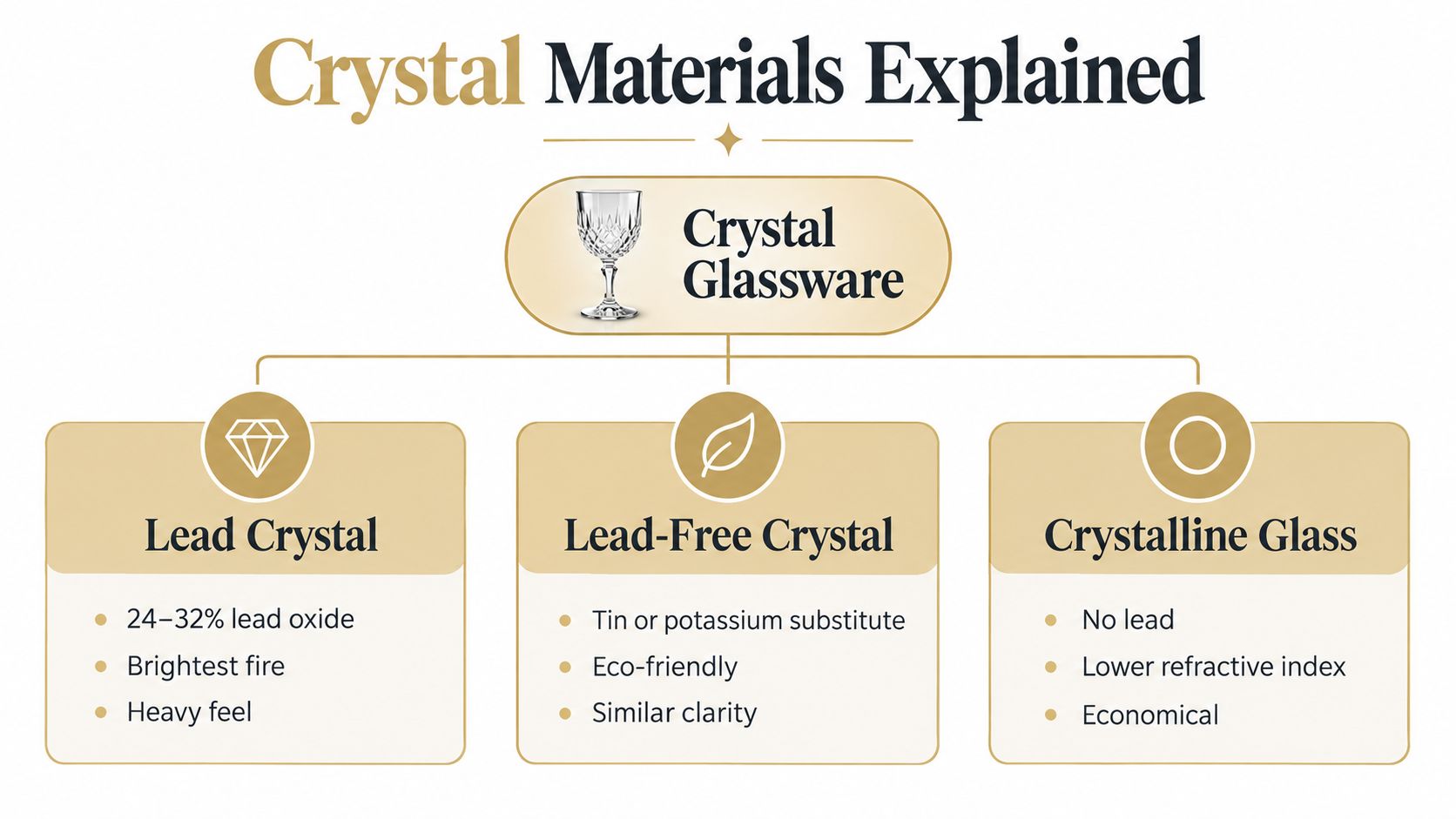
Product listings often use crystal as though it were one uniform material. It isn't. A careful buyer should look for a precise description such as lead crystal, lead-free crystal, or crystalline glass.
Under the IWA 43:2023 classification, lead crystal contains at least 24% lead oxide by mass, has a density of at least 2.90 g/cm³, and has a refractive index of at least 1.545. The IWA 43:2023 crystal classification explains the technical thresholds behind those terms.
The refractive index is the key to the sparkle. Think of sunlight passing through a prism. The light bends as it enters and leaves the material. A cut pattern adds more surfaces for that light to meet, so a star-cut decanter can produce bright points across the body instead of a flat reflection.
Reading the material description
Lead crystal is associated with weight, brilliance, and the traditional luxury-glass experience. Its higher density can make a vessel feel substantial and may help a properly designed decanter resist tipping compared with ordinary soda-lime glass.
Lead-free crystal uses other materials to create clarity and brilliance without intentionally adding lead. The exact formulation varies, so buyers should still request the manufacturer's material and food-contact documentation rather than assuming every lead-free product has identical performance.
Crystalline glass is a broader category. It may offer attractive clarity and a refined finish, but the word alone doesn't establish the composition, refractive index, or suitability for extended spirit storage.
Matching cut, weight, and stability
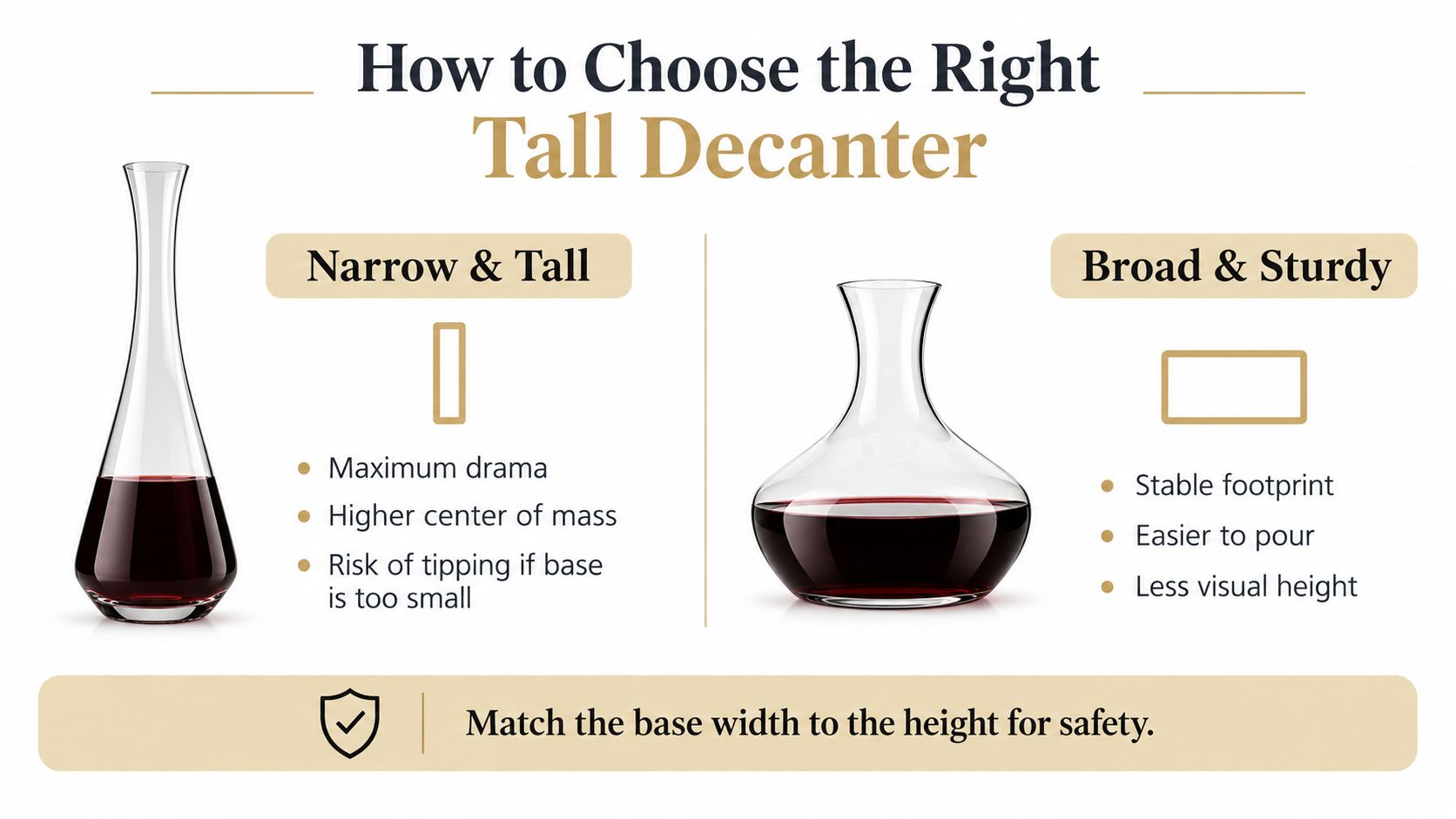
A tall silhouette raises the center of mass. That makes the base specification important. A narrow footprint may look dramatic, but it's more vulnerable to an elbow, a crowded bar cart, or an uneven surface. A broad, stable base provides a better counterweight to the height.
The The Whiskey Decanter Gift Set presents one complete configuration: an elegant star-cut decanter, glasses, and granite whiskey chilling stones, designed to reflect the amber tones of bourbon, brandy, or cognac during serving. The set is described as intended for whiskey lovers and suited for bar-cart presentation, without relying on the decanter alone to create the gift experience.
For a personal purchase, the material label helps you understand what you're buying. For a corporate order, it also supports procurement and recipient communication. Ask for:
- Exact material wording, not just “crystal.”
- Food-contact compliance documentation where relevant.
- Stopper construction details, especially if whiskey will be served from the vessel.
- Base dimensions and packaging protection for a tall, fragile item.
The best listing tells you what the decanter is made from, how it closes, and how it should be used. Sparkle matters, but specification is what lets you buy with confidence.
How to Choose the Right Tall Decanter
Start with the base, not the facets. A tall decanter gains visual drama from its height, but that height also places the center of mass farther from the surface. A broad, stable base is therefore more important than it would be on a short, squat bottle.
Next, consider how the recipient will use it. Someone who pours whiskey during dinner may value a controlled neck and balanced grip. Someone who keeps a bar cart in a busy living room needs a footprint that can tolerate ordinary movement. A corporate buyer should also think about packaging, storage, and whether every recipient will understand the care requirements.
The stopper is a storage specification
A decanter doesn't improve whiskey storage just because it looks elegant. The stopper must create a dependable seal. Whiskey guidance explains that oxidation is driven largely by how well the closure limits air exchange. A tight-fitting, well-machined glass stopper slows that exchange, while a loose stopper with visible gaps exposes the spirit more quickly. This explanation of whiskey storage and decanter stoppers is useful when comparing designs.
Check whether the stopper sits securely without wobbling. Look for a clean fit between stopper and neck, and don't treat a decorative top as evidence of an airtight closure. If the product listing says nothing about the seal, ask before buying, especially for a corporate gift program.
Use the decision guide
| Your priority | What to look for | Why it matters |
|---|---|---|
| Display drama | Tall body, faceted or star-cut finish, clear visibility | Creates a strong centerpiece on a bar cart or dining table |
| Secure seal | Precision-fit glass stopper with no visible gaps | Limits air exchange during serving and short display |
| Everyday stability | Broad base with a low, balanced footprint | Reduces the chance of tipping during normal use |
| Gifting at scale | Documented material, protective packaging, consistent components | Makes procurement and recipient guidance easier |
| Complete whiskey presentation | Matching glasses and non-diluting chilling accessories | Turns a vessel into a ready-to-use gift experience |
The cut is a style decision after those fundamentals are settled. Star-cut glass produces more movement in the light and suits a formal or traditional bar. Smooth glass has a quieter appearance and may suit a minimalist home. Neither finish replaces a secure stopper or stable base.
A complete configuration such as ROCKS' Whiskey Decanter Gift Set pairs a star-cut decanter with glasses and granite chilling stones. That arrangement works well when you want to give a recipient the serving pieces, not just the central vessel.
For an individual, choose the silhouette that suits the recipient's room and drinking habits. For a company, prioritize repeatable specifications, clear materials, and packaging that protects the neck and stopper in transit. A tall crystal decanter becomes a stronger gift when its beauty is supported by these practical details.
Lead Crystal Safety and the Serve-versus-Store Question
The most important distinction is simple: serving is not the same as long-term storage.
Lead-containing crystal should generally be treated as a presentation vessel rather than a permanent container for whiskey or other spirits. In a study of crystalware containing 7–32% lead oxide, lead release followed an approximately square-root relationship with contact time. Sherry stored for two months in a new decanter reached 1,410 micrograms of lead per liter, while decanters already used for 10–20 years measured 50–163 micrograms per liter. The crystalware study on lead release and contact time1099-1522(199803/04)11:2%3C45::AID-PTS417%3E3.0.CO;2-2) provides the underlying findings.
That evidence doesn't mean a leaded decanter has no place at a table. It means the use case should be clear. Fill it for a dinner, tasting, or short display, then empty and rinse it rather than leaving whiskey inside indefinitely.
A practical decision for gift buyers
California health guidance says occasional use of leaded crystal is unlikely to create substantial exposure, while also advising against storing alcohol in leaded-crystal containers because migration increases with contact time. The Center for Environmental Health notes that no current federal standards specifically govern lead leached from crystal glassware and warns against storing food or drink in leaded crystal. California's guidance on lead in tableware gives buyers a clear reason to ask questions before choosing a material.
Use this framework:
- For serving, a leaded decanter can be filled for the occasion and emptied afterward.
- For prolonged storage, choose lead-free crystal or glass with documented food-contact compliance.
- For unknown composition, don't assume that weight or sparkle proves safety. Ask the manufacturer.
- For households with children or broad corporate distribution, lead-free crystal may be the easier recommendation to defend.
A lead-free option can preserve the visual prestige of a premium gift while reducing ambiguity about how the recipient should use it. The lead-free crystal whiskey decanter guide is a useful companion for buyers comparing materials.
For a coordinated tasting gift, The Privilege Collection - Reserve Glass Edition is described as crystal glassware designed to highlight the color, brilliance, and clarity of scotch or bourbon. If you're pairing glassware with a decanter, the same material clarity and care information should be communicated to the recipient.
The principle is calm and practical: choose the material first, then decide whether the decanter is for serving or storage. Buyers who enjoy wine-club experiences can also browse Kunde wine club membership for another example of how tasting occasions center on presentation and shared enjoyment.
Caring for a Tall Crystal Decanter
A tall decanter needs a deliberate cleaning routine because its narrow neck limits hand access and can hide moisture. Treat it as a delicate serving vessel, not as an oversized bottle you can wash casually.
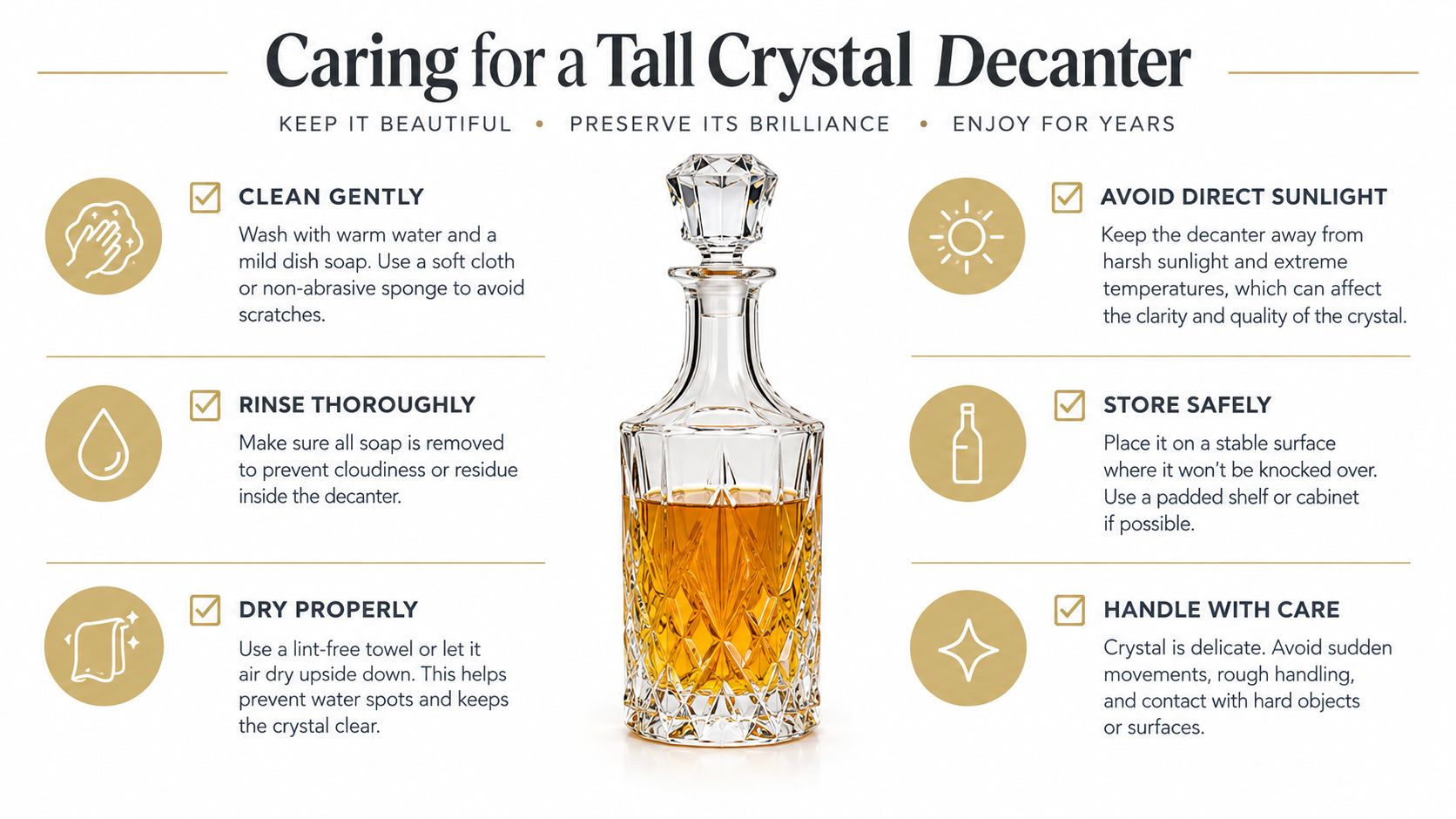
Begin with warm water, mild soap, and a soft sponge or microfiber cloth. Avoid abrasive pads, harsh scrubbing, and the dishwasher. Heat, movement, and contact with other dishes create unnecessary risks for a tall, faceted piece.
A safe cleaning sequence
- Empty it promptly. Don't leave whiskey or another spirit sitting in the vessel after serving, especially when the material is leaded crystal.
- Rinse before washing. Remove remaining spirit so soap can reach the interior without mixing with residue.
- Wash gently. Use a soft bottle brush designed not to scratch, especially around the shoulder and bottom.
- Rinse thoroughly. Detergent left inside can affect the next pour and create a dull film.
- Dry immediately. Use a lint-free cloth wherever you can reach, then allow the interior to air-dry only in a stable position.
- Separate a damp stopper. Let the stopper dry independently before replacing it, so moisture and trapped odors don't remain in the neck.
The crystal decanter cleaning guide offers additional practical care guidance for narrow-necked designs.
Protecting the finish and the gift
Water spots become more visible on faceted glass because each cut catches light. Immediate drying helps prevent that cloudy appearance. A cork or stopper odor can also linger if the closure is stored damp, so give it separate drying time before sealing the decanter.
For display, place the vessel on a weighted tray or a surface with enough depth to support the base. Keep it away from the edge of a crowded bar cart, swinging cabinet doors, and busy serving paths. The taller the shape, the more valuable a low-traffic location becomes.
Shipping deserves the same care. Keep the stopper protected from the decanter body, cushion the neck, and use packaging that prevents the vessel from shifting. For corporate gifting, consistent protective packaging matters because a recipient's first experience begins when the box opens. A beautiful decanter that arrives with a chipped rim has already failed its purpose.
Good care preserves more than shine. It protects the presentation, safety, and emotional value behind a meaningful birthday, wedding, housewarming, or client gift.
Styling, Serving, and Gifting a Tall Crystal Decanter
A tall decanter looks most intentional when the pieces around it support its shape. Center it on a bar cart, place matching glasses nearby, and leave enough space for a hand to grasp the stopper and pour without bumping another object.
Lighting makes a difference. A star-cut pattern catches daylight and warm room light, turning the amber contents into part of the display. Granite chilling stones offer another useful pairing because they cool a pour without adding water, which helps a guest choose between a neat serve and a chilled drink without dilution.
For bar-cart planning, these Woodstock Furniture & Mattress Outlet picks can provide additional ideas for arranging the surrounding essentials. The goal isn't to overcrowd the surface. A tall vessel needs visual space and a stable position.
Match the set to the occasion
A birthday or anniversary gift can focus on the recipient's favorite spirit, with a decanter and glasses presented as a personal tasting ritual.
A housewarming gift works well when the recipient is building a home bar. Add practical serving accessories so the decanter has an immediate role rather than becoming an unused ornament.
A wedding gift can include engraved glassware or a tray, giving the couple an object they can bring out for dinners and celebrations.
For client appreciation, employee rewards, and holiday gifting, consistency matters. Companies can choose a shared-use barware set, add a brand or recipient message through engraving, and package the pieces so they arrive ready to present. ROCKS offers engraving on wood trays and glassware for personalized recognition, which lets a company make a repeatable gift feel more specific to each recipient.
Shared use is especially relevant in corporate programs. One corporate-gifting survey summary reports that 76% of employees prefer gifts they can enjoy with their family or team. The survey summary on shared-use corporate gifts supports the practical appeal of a decanter-and-barware set. A recipient can display it at home, use it during a client dinner, or bring it out for a family or team occasion.
For larger orders, a complete configuration such as The Connoisseur's Set can bundle the decanter experience with coordinated glassware and chilling accessories. The set is positioned for whiskey drinkers who enjoy neat pours, drinks over chilling stones, or old fashioned cocktails, making it suitable for a broad gifting audience.
The strongest gift choice balances three things: material clarity, reliable use, and social value. Choose lead-free crystal or documented glass when long-term storage may be misunderstood, inspect the stopper and base, and complete the presentation with glasses or chilling stones. You'll give the recipient a tall crystal decanter that looks impressive on day one and remains useful for years.
ROCKS Whiskey Chilling Stones offers gift-ready barware for whiskey and spirits lovers, including decanter sets, whiskey glasses, granite chilling stones, and personalized wood-tray or glassware options. Visit ROCKS Whiskey Chilling Stones to choose a coordinated gift for a birthday, wedding, housewarming, client appreciation program, or employee event.


