


You've just opened a new set of stones, guests arrive in an hour, and you're staring at the freezer wondering if tossing them in now is enough. It probably isn't. Whiskey stones in a freezer only work well when the routine matches what you're pouring, whether that's an aromatic neat dram, a high-proof bourbon, or a cocktail-style serve. Freeze them too briefly and they barely cool the whiskey. Chill too aggressively and you can flatten the aroma you wanted to taste. The routine below is direct about those limits, so your first pour behaves the way you expect.
Clean and Dry Stones Before the First Freeze
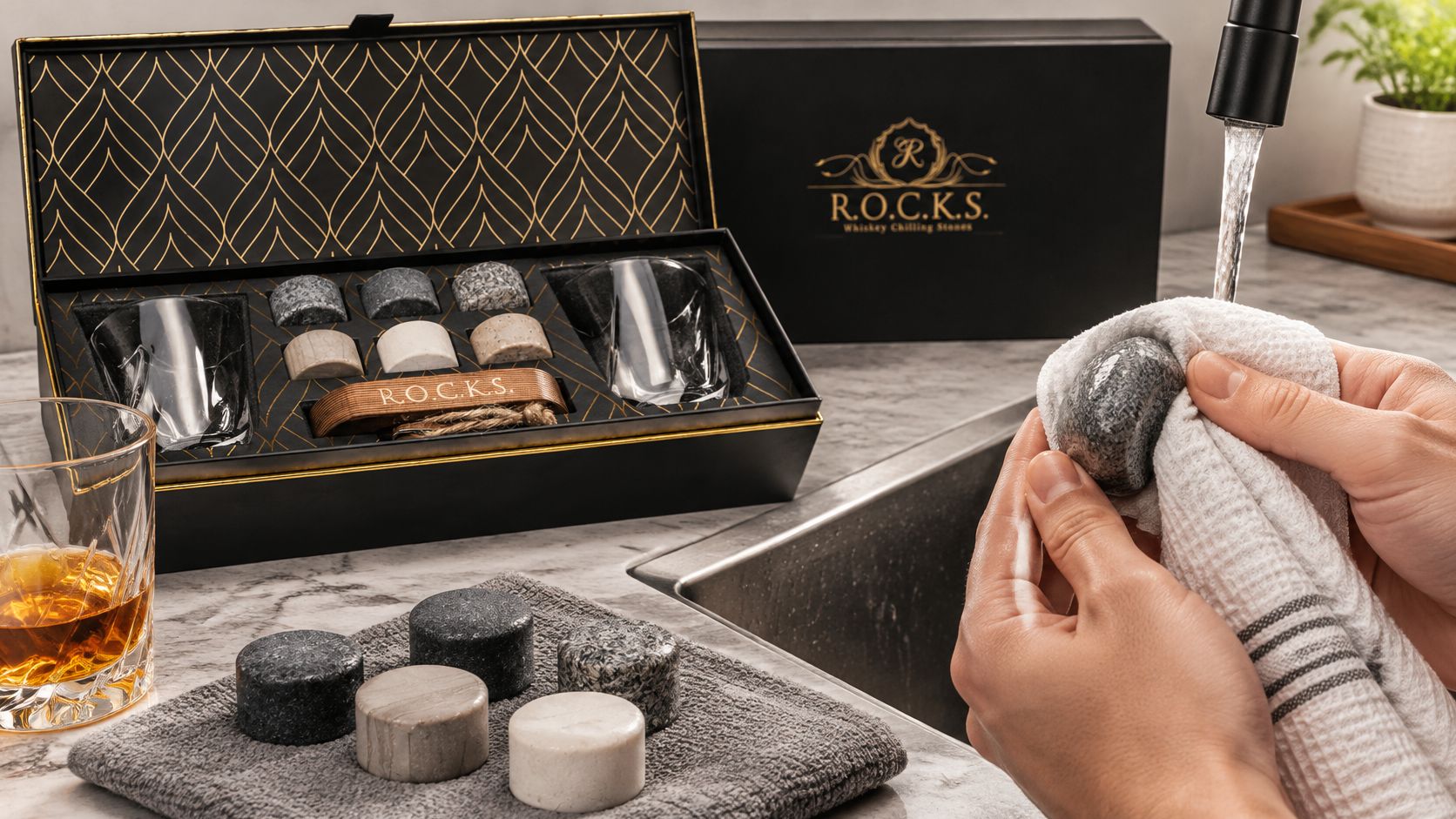
Don't freeze a new set straight from the box. Dust from cutting, polishing, or engraving can sit in tiny surface pores, and that residue ends up in the glass if you skip washing. I'd treat first-use cleaning as part of the Whiskey Stones Freezer routine, not an optional extra.
First Wash in Six Steps
- Remove every stone from its packaging and rinse it under warm running water, because loose dust comes off before scrubbing pushes it around.
- Scrub each stone with a soft brush and a drop of unscented dish soap, because porous stone can hold residue that scents or taints whiskey.
- Rinse each stone twice under clean water, because a thin soap film leaves a flat, chemical note in the first sip.
- Dry each stone with a lint-free towel, then air-dry it until no moisture shows, because trapped water forms frost and can stress the surface in the freezer.
- Inspect every stone under bright light for chips, hairline cracks, and rough edges, because damaged surfaces trap residue and can scratch glass.
- Count the set and match it to the pour you plan to serve, because too little stone mass won't cool a larger pour evenly.
Freezing damp stones is the most common first mistake. They frost over, stick together, and carry freezer odors into a clean glass.
Set aside any stone that fails inspection. Don't try to sand a chip smooth at home, and don't freeze it hoping the damage won't matter.
Finish with a simple cloth test. Rub a dry stone firmly against a clean white cloth, then check both surfaces. The stone should feel smooth, the cloth should show no grit, color, or soapy residue, and your fingers shouldn't feel slick afterward. If the cloth picks up anything, wash, rinse, and dry that stone again.
Freezer Settings and Times for Each Serving Goal
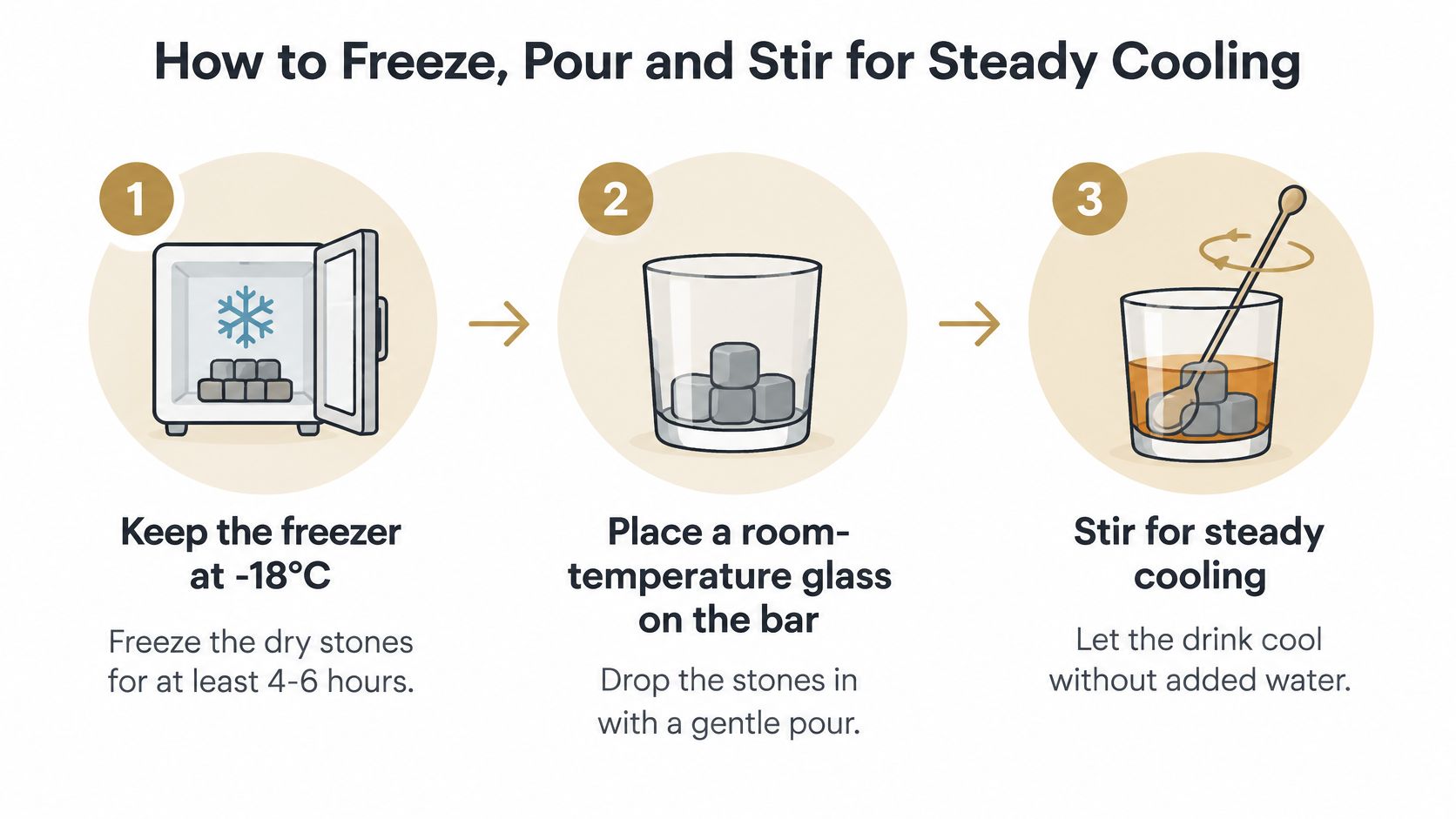
Freeze clean, dry stones at -18°C (0°F) for at least 4 to 6 hours before a single pour. Give a full set overnight if you can. That's the default you can use tonight, and the table below shows when to keep the chill gentle and when to push it firmer.
Soapstone works because it stores cold in solid mass, then absorbs heat as its temperature rises in the glass. The 2023 experimental study on soapstone thermal properties measured its specific heat capacity at 1.074 J/(g·K) at 20°C, meaning each gram absorbs about that much heat for every degree it warms. It doesn't melt, so it releases cold gradually through sensible heat alone. That gradual release preserves proof, but it also caps the total chill you can get.
Match the Routine to the Pour
| Serving goal | Freezer setting | Minimum freeze time | Expected chill |
|---|---|---|---|
| Single 30 mL neat aromatic pour | -18°C (0°F) | 4-6 hours | Gentle cooling that preserves aroma |
| 45 mL bourbon or rye pour | -18°C (0°F) | Overnight for a full set | Moderate drop that holds steadier over minutes |
| High-proof or cocktail-style pour | -18°C (0°F) | Overnight | Firmer chill that softens alcohol burn |
| Batch prepared for a tasting or event | -18°C (0°F) | Overnight, with a spare set frozen | Consistent chill across repeated pours |
Use that split deliberately. For a fragrant Scotch or a delicate bourbon you want to nose slowly, I wouldn't aim for the coldest possible glass, because very cold whiskey can seem muted and flat. The analysis of freezing and whiskey complexity notes that chilling whiskey to around 4°C can reduce perceived floral and fruity aromas even while it reduces alcohol burn. For high-proof whiskey where burn is the problem, that firmer chill is a fair trade.
Warmer freezers need longer. So do heavier sets and stones packed tightly in a bag with no air circulation. Spread them in a single layer for the first freeze if your pouch allows it.
You'll know they're ready when they feel cold and dry with no condensation as you lift them out. Count them against your pour size before you close the freezer, so you're not short one stone after the whiskey is already poured.
How to Freeze, Pour and Stir for Steady Cooling
A repeatable order matters more than chasing one exact temperature. Run the same steps every time and each glass lands where you expect it.
- Keep the freezer at -18°C and freeze dry stones for at least 4 to 6 hours, so the whole stone reaches freezer temperature instead of just the surface.
- Set a room-temperature glass on the bar and lower the stones in with tongs, using the manufacturer's recommended stone-to-spirit ratio, so you don't chip the glass or the stones.
- Pour 30 to 45 mL of whiskey over the stones, covering as much stone surface as the measure allows.
- Rotate the glass or stir gently at 1, 3, 5, and 10 minutes, in short passes, so cooler liquid moves away from the stones and warmer liquid takes its place.
- Sip once the whiskey settles and note how the chill changes, because you learn quickly whether that stone count suits that bottle and glass.
Match the stirring to the serve. For an aromatic neat pour you plan to nose slowly, I'd keep the first two rotations and ease off once the glass feels cool, because pushing the temperature lower flattens the top notes you poured it for. For a high-proof bourbon or a cocktail-style pour where burn is the problem, keep the routine going the full ten minutes and let the stones pull out more heat.
What the Numbers Say You Should Expect
Stones are finite thermal reservoirs that scale with mass. The Alibaba product insights comparison of whiskey stone performance lays out the gap plainly: cooling a 30 mL pour from approximately 22°C to about 8°C requires roughly 1,200 to 1,400 joules of heat removal; a six-piece soapstone set totaling about 14 g and frozen at -18°C holds only approximately 500 to 600 joules of usable cooling capacity before warming toward 0°C; and in its controlled pour test, soapstone brought 45 mL of 46% ABV bourbon to approximately 12.3°C after five minutes, while identical steel cubes reached about 8.7°C in under 90 seconds and rebounded to 14.2°C by minute seven.
Treat those curves as a choice between speed and steadiness. Steel wins the first minutes and gives the cold back within the glass; soapstone moves slower and holds a more even line through the pour.
Practical rule: Size the set to the pour. A small set in a large glass gives you a faint drop no matter how long it stayed in the freezer.
Stone mass, geometry, glass shape, stirring, freezer temperature, and the spirit's starting temperature all move the result, so a universal final temperature is a promise no set can keep. A wide glass warms faster than a narrow one. A whiskey stored in a warm kitchen starts with more heat to remove.
For a tasting, use a fresh frozen set for each glass instead of rinsing and reusing warm stones. A set such as The Connoisseur's Set - Twist Glass Edition pairs granite whiskey stones with twist crystal glasses for a non-diluting tasting format. Whatever set you own, a spare set in the freezer keeps the second pour from disappointing.
Stones Compared With Ice and Chilled Glasses
Ask two questions before you choose. Does this drink need water, and how much cold does it need? Your answers point to the right tool faster than any blanket rule about stones always beating ice.
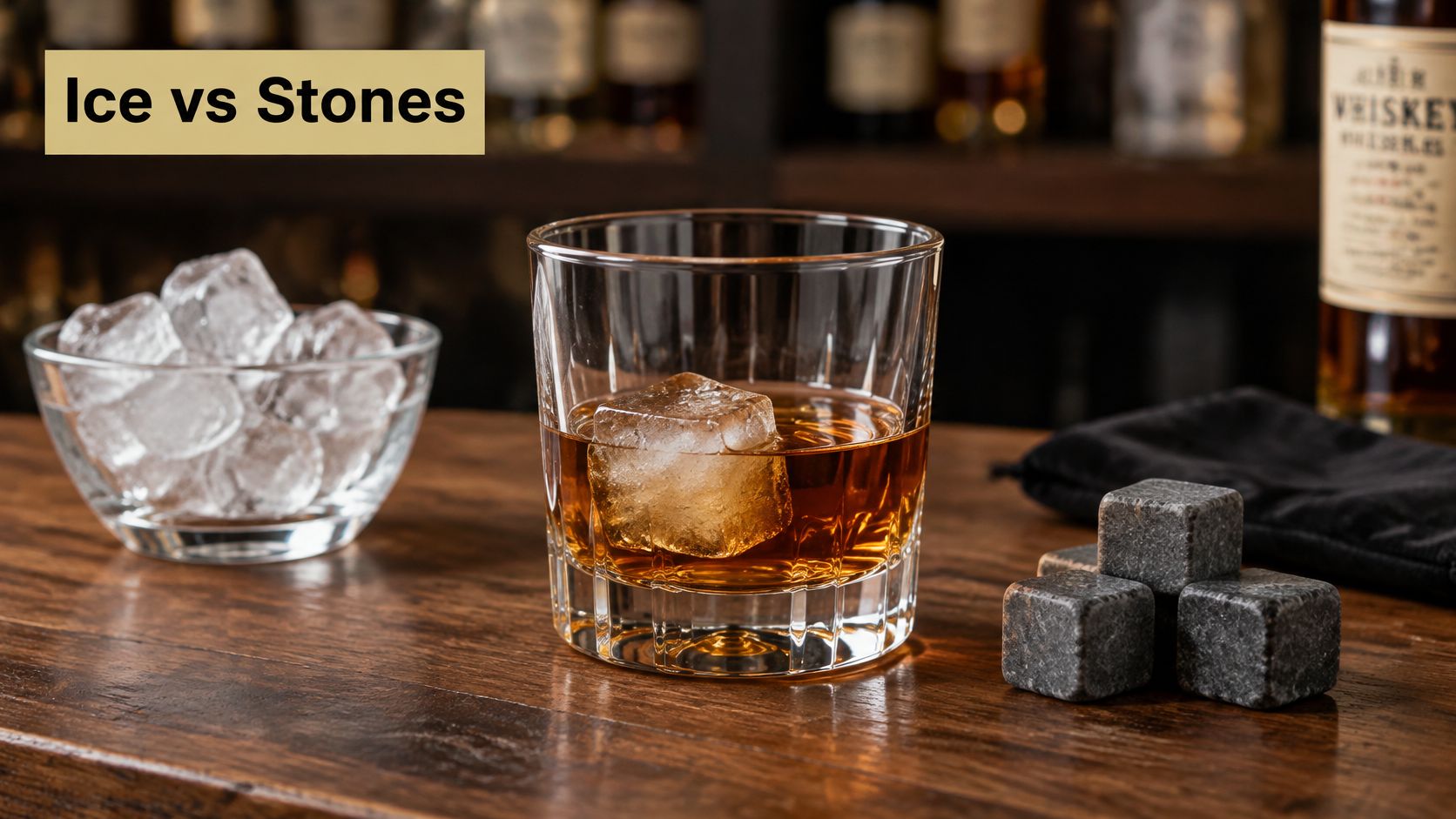
Ice cools partly by melting. That melt adds water, lowers proof, and can open aromas that stay tight at full strength. Stones cool by absorbing heat without melting, so they keep the original proof and add nothing to the glass. A chilled glass sits at the light end, giving you a brief cool edge with no dilution and no object in the drink. Colder is not automatically better either. Push a pour too far down in temperature and you can flatten the aroma you were trying to preserve.
Side by Side
| Factor | Freezer stones | Ice cubes | Chilled glass |
|---|---|---|---|
| Dilution | None; keeps the original proof | Adds water as it melts | None |
| Cooling strength | Moderate and finite | Strong and longer-lasting | Light and brief |
| Reuse | Yes, with care | No, made for each use | Yes |
| Cleanup | Rinse and dry | Discard meltwater | Rinse |
| Best for | Neat sipping and gifting | Highballs and long drinks | Aroma-focused neat pours |
Put that into practice with real serves. For a neat bourbon in a tasting flight, stones keep each sample at the same proof from first sip to last, which makes comparisons cleaner. For a high-proof pour, a short stone chill takes the hot edge off while leaving the strength intact. For a whiskey and soda on a warm evening, ice wins because the drink needs strong, sustained cold and dilution is already built into the serve. For a fragile, aroma-led single malt, I'd start with a chilled glass and no stones at all.
The reuse arithmetic is worth running over a month. Four weekly pours from one set of stones cost you four rinse-and-dry cycles and four stretches of freezer time. The same four pours on ice mean four fresh batches frozen and four servings of meltwater poured away. If you want the fuller head to head, the detailed guide to whiskey stones versus ice walks through dilution and serving cases in more depth.
The split is simple. Choose stones for neat sipping and reusable gifts, choose ice for highballs and long drinks where water belongs, and choose a chilled glass when aroma matters more than cold.
Care, Storage and When to Replace Stones
A damp stone can carry freezer odors or leave residue in a pour. Dry each stone completely before storing it, and keep it sealed away from strongly scented foods such as onions, garlic, and coffee. The Lochs of Whisky guide to stones, ice balls, and spheres recommends drying stones before freezing and using a sealed pouch or container to limit odor transfer. It also notes that porous or unglazed materials can retain flavors or cleaning agents.
Rules by Material
| Material | Storage advice | Odor or residue risk | Replace when |
|---|---|---|---|
| Soapstone | Dry, in a sealed pouch away from strong foods | High if porous and not fully dried | Cracks, chips or odor that stays after washing |
| Granite | Dry, in a pouch or container | Moderate | Chips or hairline cracks |
| Stainless steel | Dry, loose or in a pouch | Low | Deep scratches or rough edges |
| Ceramic | Dry, in a sealed container | Moderate if the glaze is damaged | Chips, crazing or a rough glaze |
After each use, rinse stones in warm water. Use unscented soap only if residue is visible, then dry them fully before returning them to storage. Never seal them while damp. A sealed container in a quiet freezer corner is better than an open tray beside leftovers.
Replace any stone that cracks, chips, develops a rough surface, or keeps an odor after washing. A damaged or scented stone can affect the next pour.
For hospitality and gift sets, include a short care note so recipients know how to clean and store the stones. For material-specific lifespan guidance, see this guide to how long whiskey stones last.
Gift Sets for Clients and Teams
A stones-and-glass set is ready to use without extra purchases. The Connoisseur's Set - Nosing Glass Edition pairs round solid granite stones with a crystal nosing glass for a neat pour and focused tasting. For a more social setting, choose a twist crystal glass format, such as a host gift for dinner or a client thank-you after a project closes.

Why Buyers Keep Choosing Personalized Barware
The 2025 corporate gifting trend report from Sales and Marketing found that 62% of companies prioritize personalized gifts featuring employee or client names, logos, or custom messages. Engraving on glassware and wood trays can turn a reusable barware set into a client gift, employee reward, or event item.
Personalized gifts also appeal to individual buyers. The U.S. personalized gifting market report on Business Wire valued the category at $9.69 billion in 2024 and projects it to reach $14.56 billion by 2030. A named glass gives the recipient a practical keepsake for their bar cart.
For a corporate hospitality hamper, compare barware with regional food gifts such as Italian gourmet gifts for UAE clients. The guide to whiskey stone gifts for clients outlines formats for different recipients and occasions.
Choose the glass format to suit the recipient: a nosing glass for someone who drinks whiskey neat, or a twist crystal glass for a more social setting. ROCKS Whiskey Chilling Stones offers whiskey stones, glassware, gift sets, and engraving on wood trays and glassware for personalized client gifts, employee rewards, birthdays, and other occasions.


