


The most popular advice in the Whiskey Stones vs Stainless Steel Cubes debate is also the least useful: buy whichever gets colder. That rule fails as soon as you put a cube in a real glass. A very cold sip can mute aroma, a heavy frozen cube can threaten thin glass, and a slow drinker doesn't need the same chilling profile as someone who wants a crisp first sip and moves on.
I would start with the drinker, not the temperature. Ask how long the pour lasts, whether dilution would help or hurt that bottle, what glass it'll sit in, and whether you're buying for your own bar cart or for a gift recipient who'll judge the set the moment the box opens. Those answers point clearly to stone or steel. The numbers below explain why, and they also show why test conditions can make either format look better than it'll feel in your hand.
Whiskey Stones and Stainless Steel Cubes at a Glance
The right choice depends on the pour and the ritual. Whiskey stones suit a measured sip that benefits from modest cooling; stainless steel cubes suit drinkers who want a stronger chill. Both chill without melting, so they add no water and cannot replicate ice.
| Factor | Whiskey stones | Stainless steel cubes |
|---|---|---|
| Weight and feel | Lighter, with a natural stone finish | Heavier, with a metal finish |
| Glass consideration | Round edges help avoid scratching glasses | Handle carefully with thin glass |
| Best fit | A slow, ritual sip | A drinker who prefers a colder pour |
How to Read This Table Fairly
A comparison depends on the test conditions. Cube size, freezer temperature, glass shape and pour volume all affect the result. A large stone in a small pour may cool it more noticeably than a smaller cube in a larger glass.
For a useful comparison, give both formats the same freezer time and use the same pour volume and glass. Without those controls, a claim about which cools better may say more about the setup than the material.
For a gift, match the format to the recipient's drinking ritual. A person who nurses a neat bourbon may appreciate handcrafted granite stones, while someone who wants a colder pour may prefer steel cubes. The glass and presentation matter too: ROCKS offers a Whiskey Decanter Gift Set pairing granite whiskey chilling stones with a decanter and glasses.
Why Steel and Stone Chill Differently
The heft of a cube can mislead: a heavier cube is not automatically a better fit for every pour. Density determines how much material fits into a given volume; specific heat describes how much thermal energy each kilogram can absorb; thermal conductivity affects how quickly heat moves through the material. Together, these properties help explain why steel and stone behave differently in a glass.
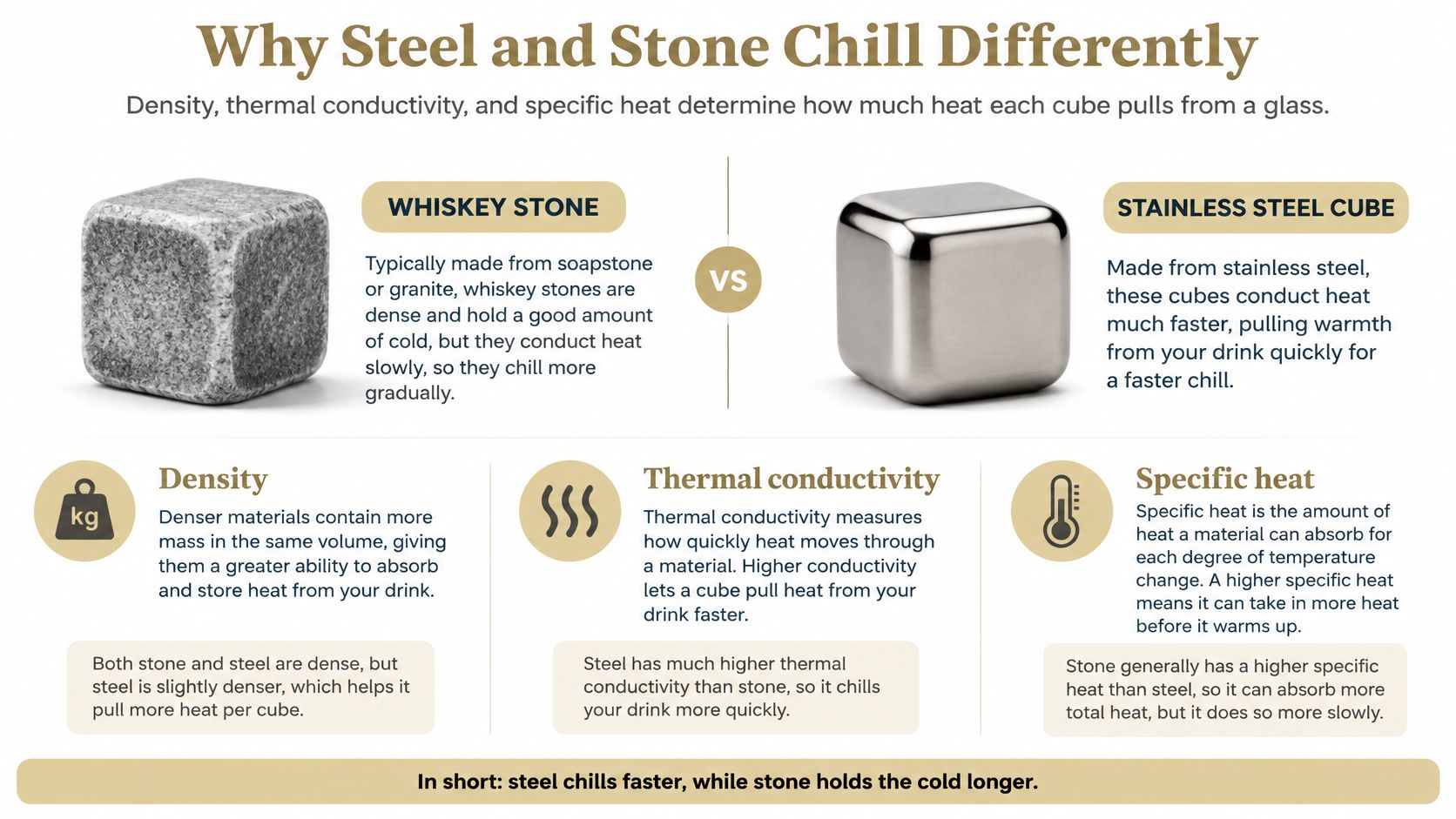
The Traditional Oven soapstone data sheet lists soapstone at approximately 2.96 g/cm³ density, 12.5 W/m·K thermal conductivity, and 785 J/kg·K specific heat. These are reference values for soapstone, not granite or stainless steel. They show why density alone cannot settle the comparison: a cube's size, mass, and heat capacity all affect how much cooling it can provide.
| Property | Soapstone reference | Stainless steel |
|---|---|---|
| Density | About 2.96 g/cm³ | Varies by grade |
| Thermal conductivity | About 12.5 W/m·K; other reported values range from 2.5 to 3.18 W/m·K | Varies by grade |
| Specific heat | About 785 J/kg·K; another reported value is about 1,074 J/kg·K | Varies by grade |
| Volumetric heat capacity | About 2.3 MJ/m³·K, calculated from the listed density and specific heat | Not calculated here |
The Equal Volume Test That Matters
Volumetric heat capacity is calculated by multiplying density by specific heat. Using the listed soapstone figures gives about 2.3 MJ/m³·K. The earlier steel comparison cannot be supported by the cited soapstone data, so a precise percentage difference would give a false sense of certainty.
The practical lesson is that material properties are only part of the result. A stone cube and a steel cube of equal size can differ in mass and heat capacity, while freezer temperature, contact area, and pour size also affect the drink. ROCKS Whiskey Chilling Stones are handcrafted granite stones, so soapstone reference figures should not be treated as exact granite specifications.
How Fast Each Format Cools a Pour
Cooling speed depends on the cube, the pour and the time you allow it to work. In a home comparison, Tasting Table's stone-versus-steel experiment measured a larger temperature drop from the steel cube than from the stone. The result helps explain why steel can suit a short wait before the first sip, while granite stones are intended to bring a drink to a few degrees below room temperature.
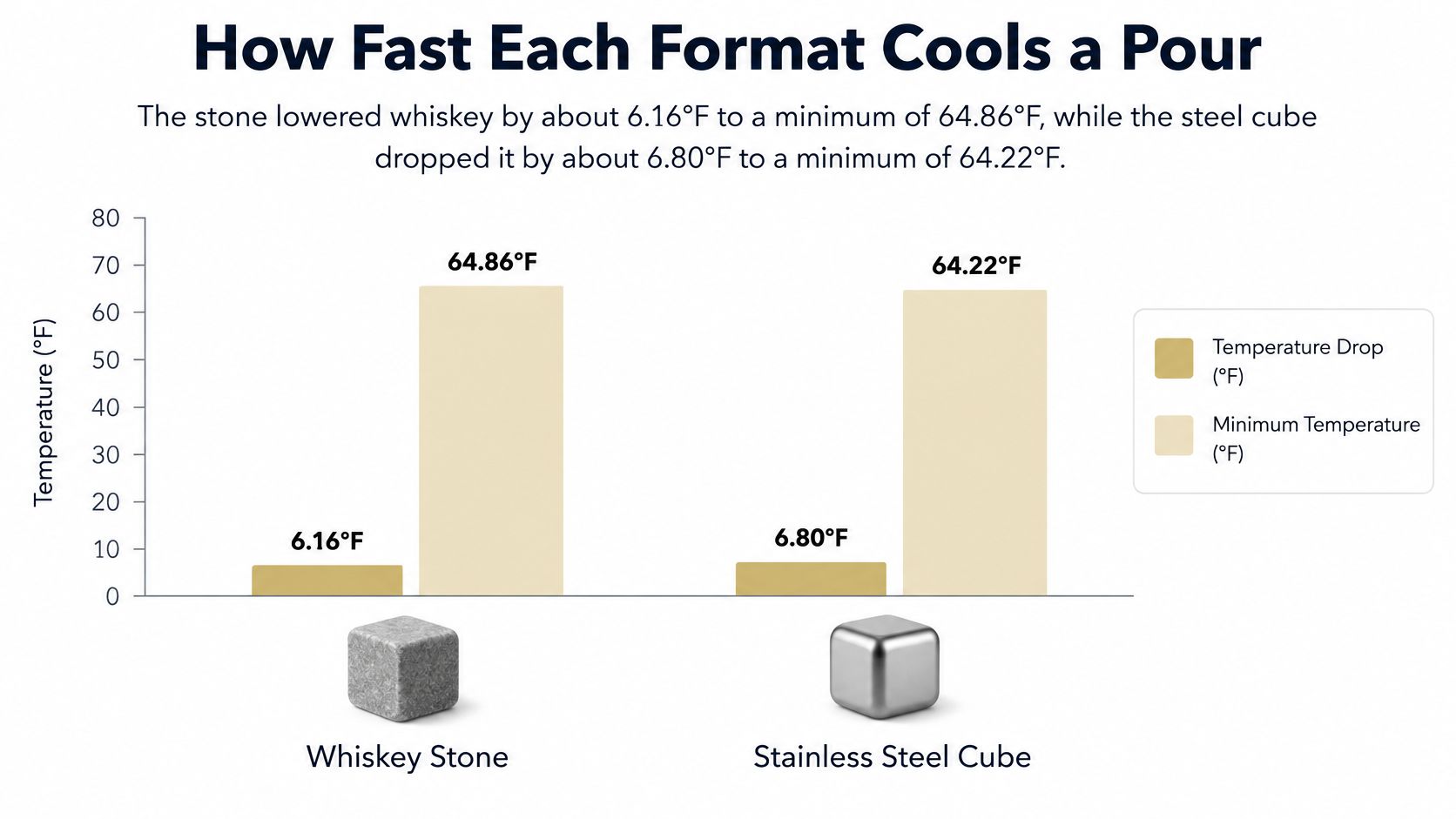
| Measure | Whiskey stone | Stainless steel cube |
|---|---|---|
| Home test: temperature drop | 6.16°F | 14.31°F |
| Home test: minimum reached | 64.86°F | 52.74°F |
| Home test: cooling efficiency | 0.08°F per gram | 0.18°F per gram |
What the Timeline Feels Like
Steel can cool a pour quickly, which suits someone who pours, waits briefly and prefers a colder first sip. Granite stones offer a milder chill for a longer tasting session. The right choice depends on the ritual: a quick, cold drink or a neat pour kept near room temperature.
For a home comparison, keep the pour volume, starting temperature, glass, freezer time and timing interval consistent. Record both the starting and final temperatures; a temperature drop alone does not show how cold the drink became. Cube size and weight also affect the result, so compare similar formats where possible.
Our stones are not meant to be as cold as ice cubes. ROCKS whiskey chilling stones chill a drink to a few degrees below room temperature, and the business recommends 2 stones per glass. The Connoisseur's Set with Nosing Glass pairs granite stones with a crystal whiskey nosing glass.
Check Any Cools Faster Claim
- Cube mass and geometry: A larger or heavier cube can change the cooling result.
- Starting and final temperature: Record both, along with the pour volume.
- Time interval: Compare at the same elapsed time.
- Freezer conditions: Use the same freezer and chilling duration for each format.
Use the same controls when comparing options in this guide to the best reusable ice cubes. A speed claim is useful only when the test setup matches the way you plan to serve the drink.
Taste, Dilution and Glass Safety
No dilution keeps alcohol strength intact. It doesn't guarantee better flavor, and treating it as an automatic win is the second piece of popular advice worth challenging. Very cold spirit can suppress aroma perception, and an undiluted pour can taste sharper than one softened by a little water. Some bottles, particularly high strength bourbon, open up with controlled dilution rather than despite it.
That's why a few degrees below room temperature suits so many neat pours. You're taking the warm edge off the alcohol without locking down the nose. If a whiskey tastes tight and hot, a small measured addition of water or a single ice cube may serve it better than any reusable cube. Our explainer on whether whiskey stones work walks through that expectation in practical terms.
Protect the Glass First
Frozen metal and thin glass are a poor pairing. A Taobao shopping guide on material verification and glass safety recommends verifying food-grade 304 or 316 stainless steel, notes lower-quality alloys may create corrosion or metallic-flavor concerns in acidic beverages, and identifies thermal shock to thin glass as a potential risk with metal chillers. Citrus-based cocktails are where a poor alloy shows itself first, so a cube that tastes neutral in whiskey still needs its grade stated clearly.
Handle both formats the same careful way:
- Choose sturdy glassware: Thick-walled tumblers tolerate frozen cubes far better than delicate crystal.
- Lower, never drop: Slide a frozen cube in gently instead of dropping it from height onto glass.
- Rest stones flat: Our stones have round edges that avoid scratching glasses, and a stone placed flat shouldn't roll around the base.
If a seller can't name the steel grade, describe the sealed construction, or provide cleaning instructions, you're buying an appearance, not a specification.
Flavor and glassware come before the cube. Decide whether the drink wants chill, water, or both, confirm the glass can handle a frozen object, and the material choice usually makes itself. Gift buyers should put those two facts on the card or in the product copy, because a recipient who cracks a favorite glass won't remember how cold the first sip was.
Durability, Cleaning and Care Compared
A hairline crack in a stone is easy to miss before freezing, but it can trap residue and makes the stone unsuitable for further use. Steel tends to show wear as dents or scratches instead. That difference matters for care: inspect stone for damage, while keeping steel surfaces clean and smooth.
The Food Protection Trends guidance on stainless steel food-contact surfaces describes suitable surfaces as smooth, non-porous, non-absorbent, corrosion-resistant, non-contaminating, durable and cleanable. Stone care depends on its finish. A sealed, smooth surface is easier to clean than porous or damaged stone.
| Care task | Stainless steel cubes | Stone cubes |
|---|---|---|
| Dishwasher use | Follow the maker's instructions for the grade and finish | Check the maker's care instructions first |
| Hand washing | Smooth surfaces are straightforward to clean | Follow the care instructions; a smooth, sealed surface is easier to clean |
| Freeze and room-temperature cycles | Inspect for wear after use | Use only crack-free stones |
| Chips and cracks | Look for dents or scratches | Retire chipped or cracked stones |
| Porosity and staining | Non-porous surfaces are easier to clean | Porous stone can absorb residue |
| Failure mode | Surface wear, dents or scratches | Chips, cracks or trapped residue |
The Checks to Run at Home
For steel, clean the cubes according to the maker's instructions and store them so they do not knock against glassware. For stone, inspect each piece before freezing. A damaged stone should be retired, not scrubbed harder: residue can remain inside a crack.
The guide to how long whiskey stones last explains what to watch for during inspection. For gift orders, include clear care instructions so recipients know how to clean and check the cubes before use.
Pick the Cube for the Drinker, the Glass and the Gift
Choose by the drinking ritual, not by a temperature contest. A slow sipper, a drinker who prefers a colder first taste, and a gift recipient who values presentation may each suit a different format.
For the slow sipper nursing a neat pour, granite stones offer gradual, gentle chilling without dilution. They suit a long conversation and a glass chosen for nosing. The Original ROCKS set includes six handcrafted, hand-polished granite stones, each with a different color and granite style.
When Steel Is the Right Answer
For the bourbon drinker who wants a colder first sip, stainless steel is the better fit. Its faster initial cooling suits someone who pours, lets the glass rest briefly, and prefers a colder taste. Pair it with a sturdy tumbler, and check that the cubes have a smooth finish and rounded edges.
For someone who wants a non-diluting alternative to ice, either format can work. Match the choice to the pour and the preferred degree of chill: steel for a stronger initial cooling effect, granite for a gentler one. Neither format reproduces an ice-cold pour that gradually dilutes as the ice melts, so set that expectation when choosing the gift.
The Gift Buyer and the Corporate Order
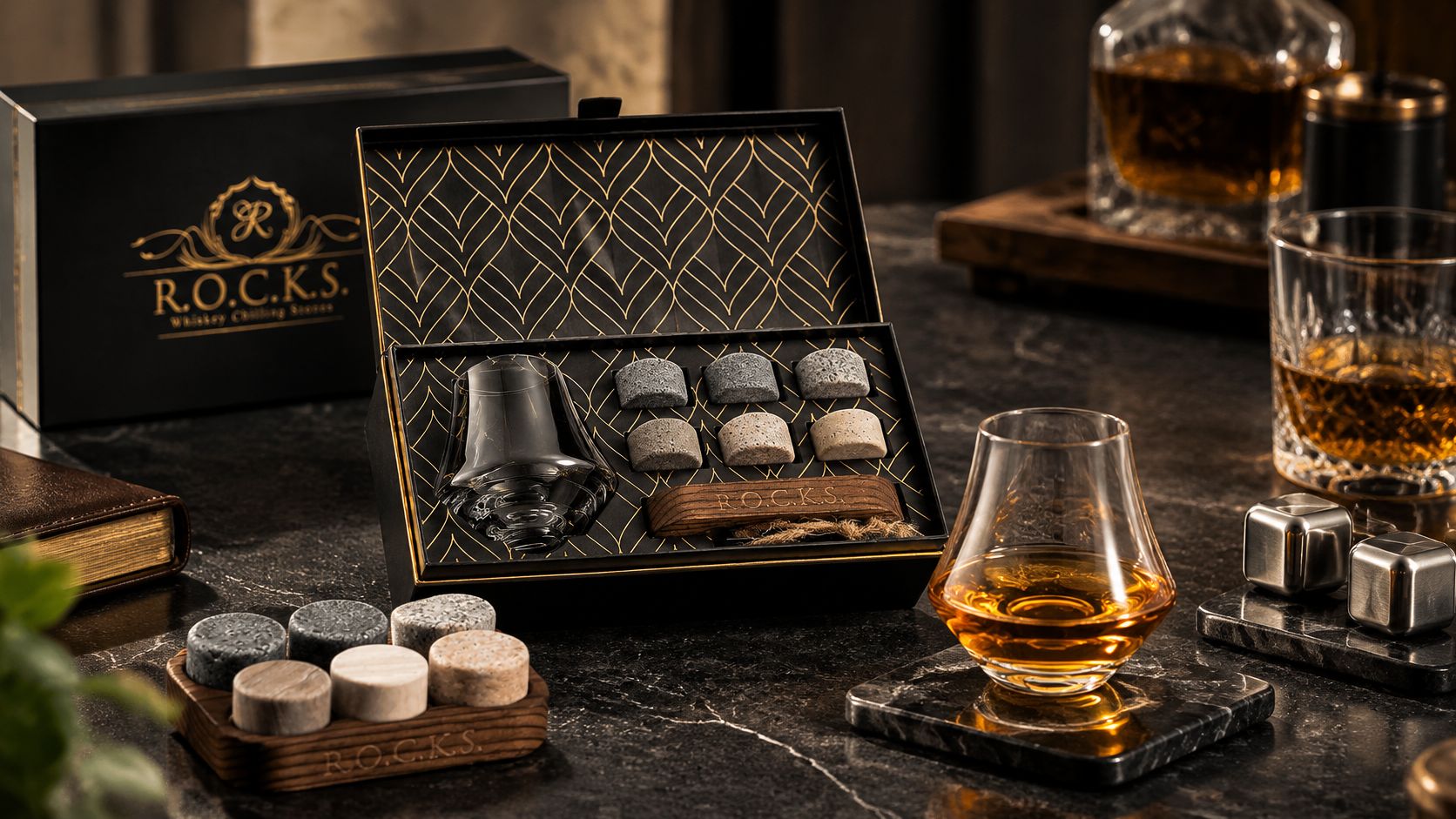
For someone who already has a well-stocked bar, presentation can matter as much as the chilling method. A stone-and-glassware set or wood tray suits a traditional whiskey ritual; steel suits a drinker interested in a more immediate chill. ROCKS gift options include whiskey sets with crystal glasses and decanters, the Gentleman's Set, the Cocktail Kit, and the Privilege Collection crystal glassware. The Connoisseur's Set - Twist Glass Edition pairs granite whiskey stones with twist crystal glasses.
Corporate buyers can choose personalised whiskey gifts, with engraving available on wood trays and glassware. These options suit client and prospect gifts, premium events, and employee rewards. ROCKS offers a lifetime warranty on its whiskey chilling stones and will buy them back at any time, for any reason, if the customer does not love them.
Run These Checks Before You Order
- Pair the glass: Match the format to a sturdy tumbler or a nosing glass suited to the drinker's ritual.
- Confirm the material: Check steel grade and finish, or make sure stone is crack-free.
- Choose the presentation: Consider engraving, a decanter set, or a Connoisseur's Set.
- Match the occasion: Select a personal gift for a whiskey fan, or a personalised option for a corporate order.
Choose the cube that fits the drinker, the glass and the occasion. ROCKS Whiskey Chilling Stones are handcrafted granite stones for chilling whiskey without dilution, alongside crystal glassware and gift sets. Browse the ROCKS Whiskey Chilling Stones collection to find a set that suits the recipient and the occasion.


